
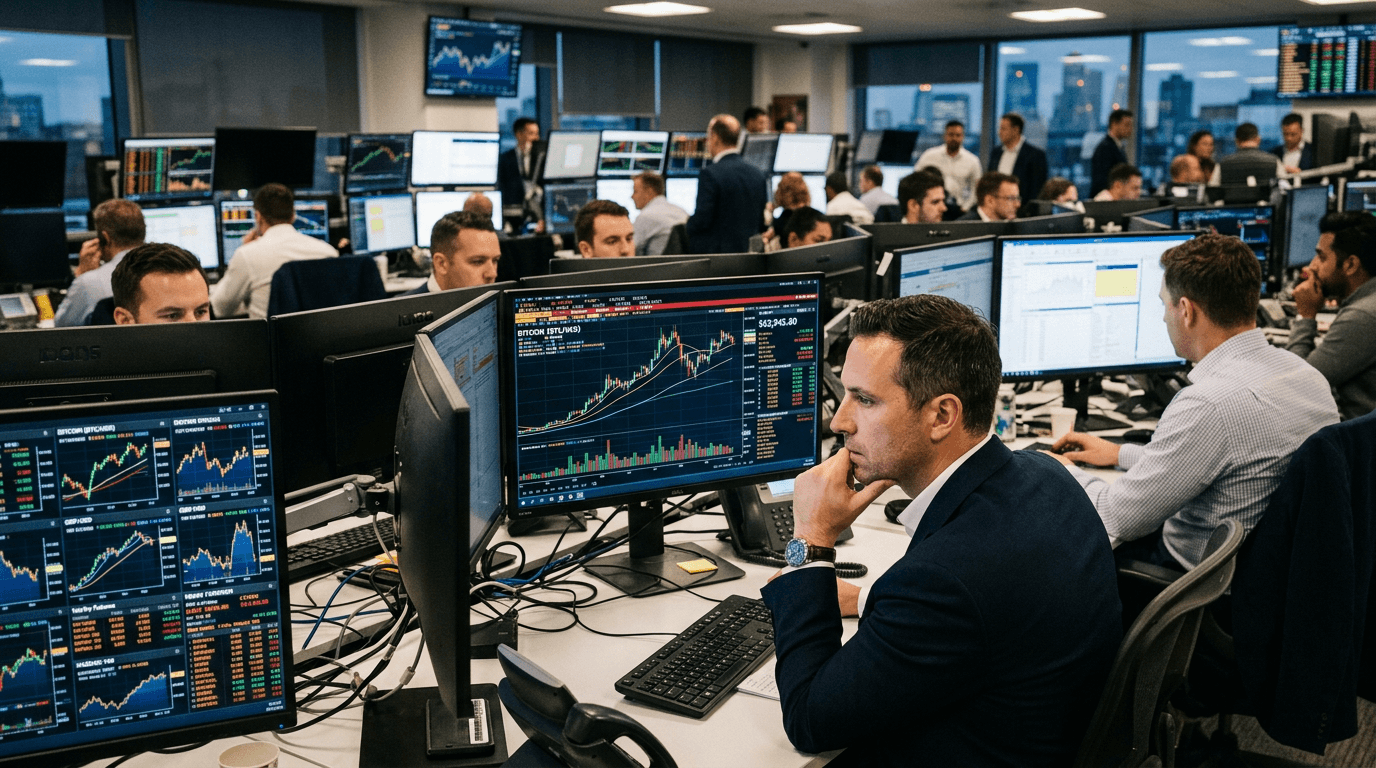
Cautious sentiment continues to hang over crypto markets, even as prices hold relatively firm and leveraged positioning remains in play. Bitcoin trading around the $63,000–64,000 area, combined with a Crypto Fear & Greed Index reading near 37, paints a picture of a market that is uneasy rather than euphoric, and far from outright panic.[2][8][10][15] For active traders and SimFi participants, this backdrop favors disciplined risk management over aggressive trend-chasing.
Current Sentiment: Fear, Not Panic
The Crypto Fear & Greed Index sits at roughly 37, squarely within the “Fear” band defined by common sentiment frameworks that classify 25–46 as fear.[2][9][12] This level signals that investors remain risk‑averse, but it also suggests that the worst phase of anxiety has eased compared with extreme fear readings closer to 0–24.[6][12] Recent data shows the index has been hovering around this zone for several sessions, indicating persistent caution rather than a sharp, one‑off shock.[4][8][9]
At the same time, Bitcoin has held in a relatively tight range around $63,000–64,000, rather than collapsing to new lows, implying that sellers are not capitulating en masse.[2][10][15] Funding rates in perpetual futures remain modestly positive, confirming that leveraged longs are still present, even if they are more measured than in periods of outright greed. This combination—fearful sentiment, range‑bound prices, and residual leverage—creates fertile ground for choppy, mean‑reverting price action rather than clean, trending moves.
What A Fear Reading Means For Price Action
A fear reading below the neutral threshold of 50 typically aligns with markets where participants demand a higher risk premium and prefer to reduce exposure into strength.[7][9][12] Buyers exist, but they tend to be selective, focusing on higher‑quality assets or short‑term tactical trades rather than long‑duration bets. In crypto, that often translates into dominance by large caps such as Bitcoin and stablecoins, while smaller altcoins struggle to attract sustained inflows.[8][9]
This sentiment regime also affects volatility patterns. Under fear, rallies are often sold more quickly, as traders use strength to cut risk rather than to build positions.[4][9] Pullbacks can be sharp but not necessarily catastrophic, because there is still a base of investors willing to buy dips—just at lower sizes and with tighter risk controls. Practically, this means intraday swings can be significant, but directional conviction remains low, favoring strategies like range trading, volatility selling (for advanced participants), and relative value plays over simple trend‑following.
Impact On Correlated Assets
Crypto’s cautious tone does not exist in isolation. A sustained fear reading and range‑bound Bitcoin price can spill over into correlated high‑beta assets, including certain FX crosses and equity index futures.[7] When crypto sentiment is risk‑off, traders often interpret it as a broader signal about appetite for speculative exposure. High‑beta currencies, such as pro‑growth or commodity‑linked FX pairs, may see reduced carry trades and faster position unwinds when risk sentiment deteriorates. Equity indices with heavy exposure to technology and speculative growth can also feel the impact through dampened momentum and lower participation from short‑term traders.
However, the relationship is not perfectly linear. A moderate fear reading like 37 with stable prices can coincide with a “wait‑and‑see” environment in traditional markets, where major indices grind sideways while pockets of volatility appear in more leveraged or speculative segments.[4][8] For multi‑asset traders, this backdrop reinforces the importance of monitoring sentiment gauges beyond price alone—crypto indices, equity volatility measures, credit spreads, and FX risk indicators can all help to confirm whether risk aversion is broad‑based or confined mainly to the digital asset space.
How Traders Can Respond In A Simulated Environment
For traders using a SimFi platform such as E8 Markets, a fear‑dominated environment offers a valuable laboratory to test how strategies behave under cautious sentiment without risking real capital. Simulated trading allows participants to experiment with adjustments that are especially relevant in the current regime:
1) Position sizing and leverage Running scenarios with different leverage levels shows how quickly drawdowns can escalate when sentiment is fragile and volatility is episodic. Reducing leverage and tightening maximum loss limits are common real‑world responses to a fear reading, and they can be stress‑tested in simulation before being applied to live trading.
2) Switching from trend to range strategies With Bitcoin stuck near $63,000–64,000 and sentiment hesitant, range‑based approaches—such as fading moves back toward the middle of the range—often outperform pure breakout systems.[2][8][10] In a SimFi environment, traders can back‑test and forward‑test rules for defining ranges, entry criteria, and stop placement, comparing performance against trend‑following models.
3) Cross‑asset risk mapping Because crypto fear can influence high‑beta FX and equity index futures, simulated portfolios that include multiple asset classes help traders understand correlation risk.[7] For example, a strategy that is simultaneously long Bitcoin, a pro‑growth currency pair, and a tech‑heavy equity index may behave like a concentrated risk‑on bet, even if each position appears modest in isolation. SimFi tools can reveal how combined exposures respond when sentiment stays in fear territory longer than expected.
4) Sentiment‑aware trade filters Integrating the Fear & Greed Index into a rules‑based framework is another practical exercise. Traders can design filters that throttle position sizes, delay new entries, or require stronger confirmation signals whenever the index sits below 50 or within the 25–46 fear band.[9][12][14] Testing such filters in simulation helps determine whether sentiment‑aware rules enhance risk‑adjusted returns or simply reduce opportunity.
Key Takeaways For Active Traders
Several practical lessons emerge from the current setup of a fear‑zone sentiment reading, positive but modest funding, and range‑bound price action:
- Fear does not mean collapse A reading around 37 indicates caution, not catastrophe. Markets can grind higher or sideways even when sentiment is subdued, as seen with Bitcoin holding the $63,000–64,000 area.[2][8][10][15]
- Leverage requires extra discipline Modestly positive funding shows that longs remain in the system, but in fear regimes, forced liquidations and sharp squeezes can occur if sentiment deteriorates.[7][9] Keeping leverage conservative and stops well‑defined is essential.
- Sentiment is a risk filter, not a crystal ball The Fear & Greed Index is a useful gauge, yet it should complement—not replace—price action, macro data, and cross‑asset signals.[8][12][14] Traders benefit from using it to shape how they take risk, rather than to predict exact price levels.
- Simulation is the ideal testing ground In a cautious market, learning how strategies behave under stress is at least as important as chasing near‑term returns. A SimFi environment enables traders to refine position sizing, correlations, and sentiment filters before deploying capital.
Conclusion
With the Crypto Fear & Greed Index anchored in the fear zone around 37 and Bitcoin holding near $63,000–64,000, crypto markets are signaling unease rather than exuberance.[2][8][9][10][15] This climate tends to reward patience, disciplined risk control, and nuanced cross‑asset thinking. For traders—especially those honing their skills on simulated platforms—the current environment is less about predicting the next big breakout and more about building robust frameworks that can endure shifting sentiment. Navigating fear successfully today offers a crucial edge when the cycle eventually turns back toward greed.