
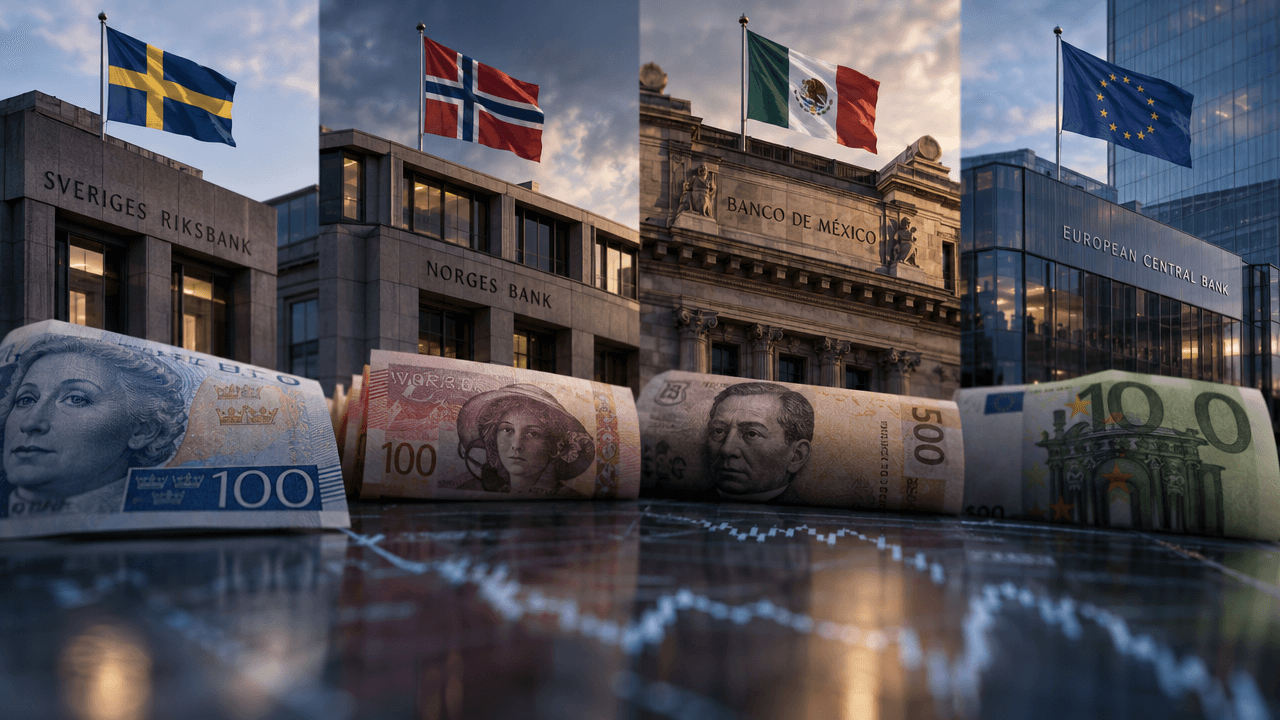
A dense cluster of central-bank events across Europe and Latin America is pushing foreign-exchange markets into a higher-risk regime for volatility, particularly in SEK, NOK, MXN and EUR pairs.[5] When several policymakers deliver decisions and speeches in the same trading session, liquidity often fragments and currencies start trading on their own meeting-by-meeting narratives rather than global macro themes.[5] For traders, this environment can be rewarding but unforgiving, making preparation and risk control more important than direction calls.
The New Wave Of Central-bank Risk
In the current calendar, Riksbank, Norges Bank and Banxico are lined up alongside other European policymakers, concentrating multiple rate decisions and guidance into a single window.[5] Historical patterns show that when Riksbank, SNB, Norges Bank and Banxico all announce policy on the same day, smaller G10 and EM rates markets tend to see thinner liquidity and more idiosyncratic price action.[5] This means that SEK, NOK and MXN can diverge sharply from broader dollar or euro trends, reacting primarily to local policy surprises.
From a volatility perspective, clusters matter because they amplify uncertainty about relative rate paths and capital flows. Traders are not just pricing one decision; they are constantly updating expectations as each central bank speaks, and the interaction of those narratives can produce overshooting in the short term. In practice, that can translate into wider intraday ranges, faster breakouts through technical levels, and more frequent “whipsaw” reversals when guidance contradicts market consensus.
Europe: Ecb Guidance And Nordic Rate Sensitivity
On the European side, ECB Executive Board member Isabel Schnabel has become a key voice shaping expectations for the euro’s rate trajectory.[1][8] She has repeatedly argued that euro-area inflation is unlikely to return to the 2% target over the medium term at current policy settings, implying that further tightening is still necessary.[8][10][15] This emphasis on persistent price pressures and second-round effects in wages reinforces the market’s focus on the ECB’s reaction function and raises the sensitivity of EUR pairs to even subtle changes in her tone.[10][13]
Interestingly, recent remarks from Schnabel have not always triggered immediate, large moves in EUR/USD, even when they were interpreted as hawkish.[6][12][15] In several instances, the euro remained under pressure against the US dollar despite concerns she expressed about energy prices and upside inflation risks.[6][12] That pattern illustrates a key lesson for traders: speeches can be more important for shaping medium-term expectations than for producing instant volatility, but they still increase event risk because positioning may adjust gradually over subsequent sessions.
In Scandinavia, research from Norges Bank shows just how sensitive exchange rates can be to surprise changes in policy rates.[3] A 1 percentage point unexpected increase in the Norwegian policy rate tends to produce an immediate appreciation of around 2% in key NOK crosses, with the effect largely fading within about three months.[3] Similar dynamics appear in the response of EUR/NOK to surprises from both Norges Bank and the ECB, highlighting how relative rate expectations drive short-run FX moves.[3] For SEK and NOK traders, this means that even modest deviations from guidance can trigger sharp, but often short-lived, currency reactions.
Latin America: Banxico, Mxn And Fx Intervention
In Latin America, Banxico’s decisions carry outsized weight because the Mexican peso is widely used as a proxy for broader EM risk and carry trades. When Banxico moves rates or signals a change in stance on inflation and growth, MXN pairs can reprice quickly as global investors reassess both local yields and risk appetite toward emerging markets. On days when Banxico shares the stage with multiple G10 central banks, the result can be particularly volatile price action as traders juggle domestic and external narratives.[5]
Emerging-market central banks also have another tool: foreign-exchange intervention. Guidance from international institutions suggests that in turbulent external environments, FX intervention can help address disorderly market conditions without forcing very sharp rate hikes that might damage domestic activity.[7] By selling foreign currency during episodes of capital flight, central banks can provide liquidity when markets are shallow and spreads are wide.[7] However, using FX intervention to smooth volatility mechanically or to target a specific exchange-rate level is discouraged, because it risks undermining confidence in the central bank’s primary task of stabilizing inflation and is constrained by finite reserves.[7] For MXN traders, this means intervention is possible but usually reserved for genuinely stressed conditions.
What Heightened Fx Volatility Means For Traders
When several central banks act in close succession, FX markets often move from trend-following to event-driven regimes. Liquidity can fragment, bid-ask spreads widen, and order-book depth thins around key announcement times.[5] Under these conditions, even well-placed stop orders can be vulnerable to slippage, and short-term technical signals may fail as policy headlines override price patterns.
For directional traders in SEK, NOK, MXN and EUR pairs, the main impact is a higher probability of large, sudden moves around the decision window, followed by more muted trends once the dust settles. For relative-value and cross-currency traders, the opportunity lies in mispricings between currencies whose central-bank narratives are diverging—for example, a hawkish ECB tone against a more cautious Nordic stance, or Banxico signaling a pause while developed-market central banks continue tightening.[3][8][10]
How To Navigate Event-driven Fx With Simulated Finance
A simulated finance (SimFi) environment offers a practical way to turn this volatility risk into a learning opportunity without capital at stake. Traders can build and test playbooks around clustered central-bank days, mapping out scenarios such as “hawkish surprise,” “dovish surprise,” and “no change but hawkish guidance” for each institution. In a simulation, it is possible to study how SEK, NOK, MXN and EUR pairs behave across these scenarios and refine entry, exit and sizing rules before applying them to live markets.
Useful exercises include planning trades for each bank’s announcement with strict pre-defined risk limits, then reviewing how those plans would have performed once the actual decisions and speeches are known. Because the research shows that some policy surprises produce sharp but short-lived moves—such as the roughly 2% impact appreciation in NOK after a sizable rate surprise—traders can experiment with strategies that fade or follow the initial move and compare outcomes over a three-month horizon.[3] SimFi platforms are well suited to this kind of event-study approach, helping traders learn how quickly to adjust positions after guidance changes and when to stand aside.
Another valuable practice is stress-testing portfolios against liquidity shocks on busy policy days. By simulating wider spreads, faster gaps through levels and more aggressive intraday swings, traders can see whether their usual leverage and stop placement remain robust. The goal is to develop a disciplined framework—focused on position sizing, diversification across pairs, and realistic profit targets—that can be applied consistently when central-bank calendars become crowded.
Conclusion
Central-bank decisions and speeches across Europe and Latin America are raising FX volatility risk by concentrating policy uncertainty into narrow time windows and fragmenting liquidity across key currency pairs.[5] Hawkish guidance from ECB officials like Isabel Schnabel, rate-path adjustments from Riksbank and Norges Bank, and Banxico’s stance toward inflation and financial stability all feed into a more event-driven FX landscape for SEK, NOK, MXN and EUR.[3][5][8][10] For traders, the challenge is less about predicting each outcome perfectly and more about building robust processes for managing risk around them. Using simulated environments to rehearse scenarios, test playbooks and refine execution can turn a potentially destabilizing cluster of decisions into a structured opportunity to improve FX trading skills—before volatility hits real capital.