
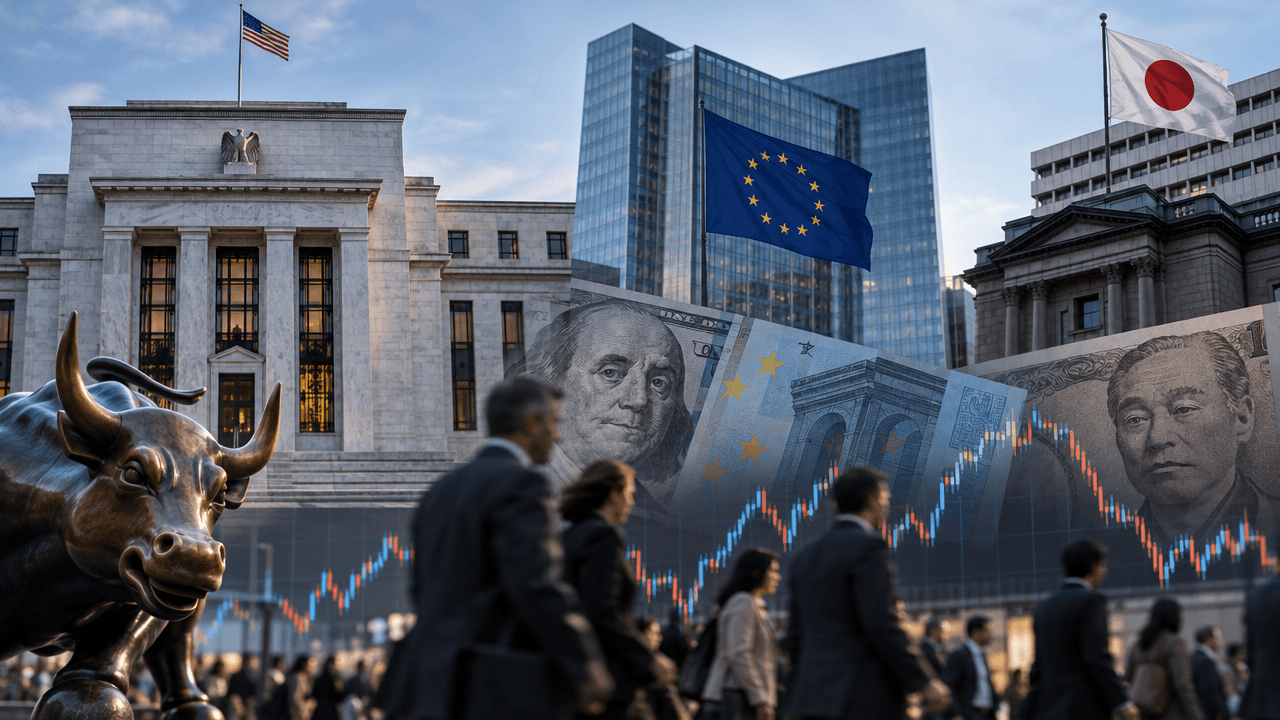
A stronger-than-expected U.S. employment report has forced investors to reconsider how quickly major central banks may ease—or tighten—monetary policy. The Federal Reserve’s decision to leave rates unchanged provided one signal, but October’s jobs data delivered another: the U.S. economy may still be resilient enough to tolerate higher borrowing costs. At the same time, traders are assessing the next moves from the European Central Bank and Bank of Japan, creating a widening gap between policy expectations that is driving currencies and government-bond futures.
THE FED’S PAUSE DOES NOT CLOSE THE DOOR
The Federal Reserve held interest rates steady at its latest meeting, encouraging some investors to believe that the tightening cycle was nearing its end. However, the decision was better understood as a pause than a definitive pivot. Policymakers still have to balance persistent inflation against signs that parts of the economy are losing momentum.
The employment report complicated that calculation. U.S. employers added 165,000 jobs in October, more than twice the roughly 70,000 economists had expected, while the unemployment rate declined to 4.1%. [1][5] Those figures suggest that demand for workers remains firm and reduce the immediate pressure on the Fed to support growth through lower rates.
Markets responded quickly. The probability of a quarter-point Fed rate increase at the December 8–9 meeting rose to approximately 78% after the report, compared with about 67% the previous day. [1] Expectations for another increase also moved forward, with some traders looking toward April rather than June for the next potential step. [2]
For traders, the lesson is straightforward: a central-bank pause is not necessarily the same as a completed policy cycle. Future inflation readings, wage data, financial conditions and the next employment report could all change the path again.
Bond Markets Reprice The Longer-term Outlook
Interest-rate expectations are reflected most directly in government-bond futures and yields. When traders anticipate higher policy rates, short-term futures generally decline and yields rise. Longer-maturity bonds can also weaken because investors demand greater compensation for inflation and the possibility that rates remain elevated for longer.
That dynamic was visible after the U.S. jobs release. Treasury markets had been benefiting from expectations of slower growth and eventual policy relief, but the employment data challenged the idea that the economy was rapidly weakening. The Treasury market subsequently pared part of its weekly gains as investors revived bets on a December Fed hike. [15]
The reaction does not mean every bond maturity will move in the same way. Short-dated securities are especially sensitive to the next central-bank meeting, while longer-term bonds respond to expectations for inflation, productivity and economic growth over several years. A strong jobs report may lift short-term yields, but concerns about future growth can limit increases at the long end.
SimFi traders can use this distinction when testing strategies. Rather than treating “rates up” as a single market view, separate the expected policy move from the broader economic outlook. A steepening yield curve, a flattening curve or a parallel shift can each produce different outcomes for bond futures, currencies and equities.
Europe And Japan Add To The Policy Divergence
The Federal Reserve is not the only central bank influencing markets. The ECB and BOJ are also being closely watched because their economic conditions and policy challenges differ from those in the United States.
The ECB has kept its deposit rate at 2.5%, while inflation risks linked to energy prices and wage pressures remain part of the policy debate. Some analysts expect another quarter-point increase in December, potentially followed by an extended pause. [8][10] If European rates rise while U.S. policy expectations also become more hawkish, the euro’s direction will depend on which central bank delivers the larger surprise relative to market pricing.
Japan presents a different challenge. The BOJ continues to balance inflation, wage growth and a weak yen against the risk of weakening household demand. Higher energy costs and currency-driven import inflation can increase pressure for tighter policy, while fragile growth argues for caution. This tension makes every BOJ communication important for the yen and Japanese government bonds.
Policy divergence is therefore not simply a comparison of interest-rate levels. Traders must examine the direction of travel, the pace of expected changes and the credibility of each central bank’s guidance.
What Traders Should Watch Next
The most important upcoming indicators are those that can validate or challenge the current rate narrative. U.S. inflation data will help determine whether the strong labor market is translating into renewed price pressure. Additional employment figures will show whether October represented a durable improvement or a temporary rebound.
In Europe, investors should focus on the ECB’s assessment of energy prices, wages and underlying inflation. In Japan, wage negotiations, inflation expectations, currency movements and official comments will be central to interpreting the BOJ’s next decision.
Traders should also monitor volatility around event risk. Markets can move sharply when positioning becomes crowded, particularly if futures prices imply a high probability of a specific rate decision. A disciplined approach includes defining the expected scenario, identifying the alternative outcome and setting risk limits before the announcement.
For SimFi participants, this is an opportunity to practice scenario analysis without confusing a market forecast with a certainty. Build separate plans for a hawkish surprise, a dovish surprise and an outcome that matches expectations. Then examine how each scenario could affect the dollar, euro, yen, Treasury futures and equity indices.
Conclusion
Markets are repricing central-bank paths because the latest information is sending mixed signals. The Fed’s hold suggests caution, but strong U.S. employment data keeps additional tightening in play. Meanwhile, the ECB and BOJ face their own inflation, growth and currency pressures, creating a complex global policy landscape.
The key takeaway is that traders should follow changes in expectations rather than headline decisions alone. A central bank can hold rates today while still influencing markets through its outlook for tomorrow. In an environment where policy paths are diverging, preparation, scenario planning and careful risk management are more valuable than relying on a single directional prediction.