
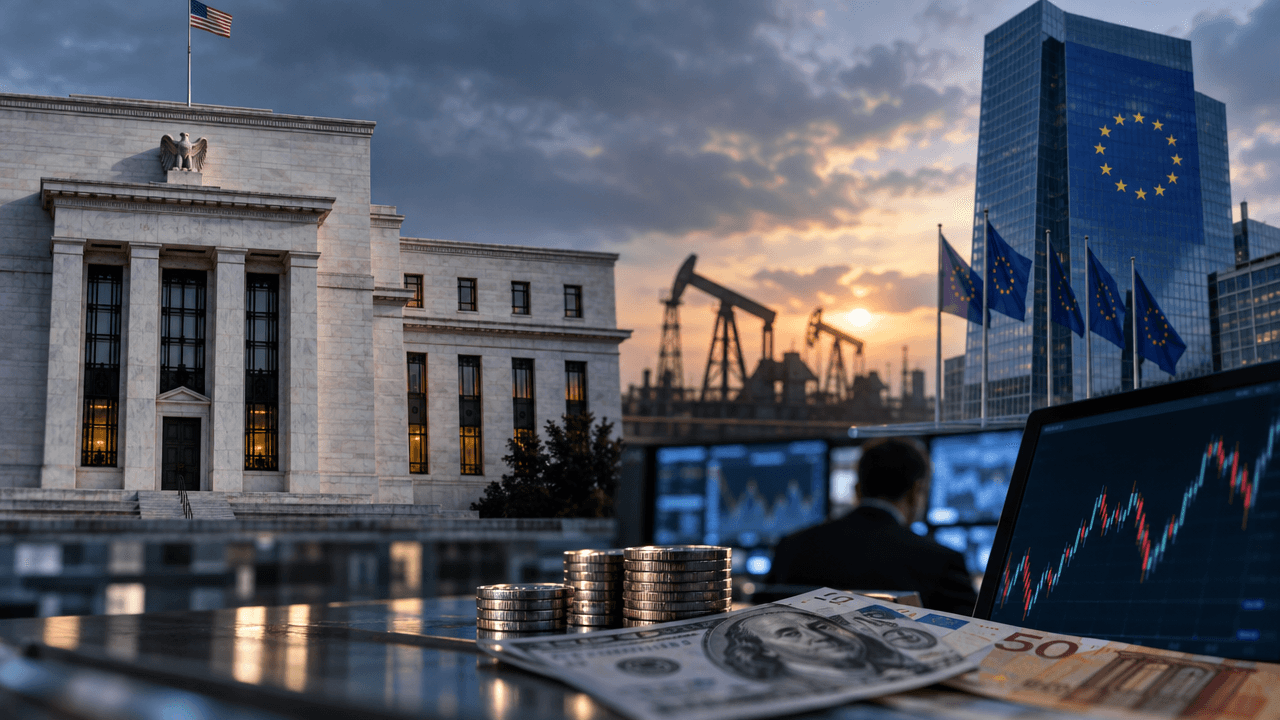
A pause in interest-rate decisions has not removed the possibility of tighter monetary policy. The Federal Reserve and European Central Bank both left borrowing costs unchanged this week, but neither central bank closed the door on a December increase. Instead, policymakers highlighted a difficult combination: energy prices are pushing inflation higher while tighter financial conditions threaten economic growth. That tension is keeping traders focused on every inflation report, energy-market move, and central-bank comment.
For financial markets, the message is clear. “Unchanged” does not necessarily mean “dovish.” The decisions represent a temporary pause while policymakers assess whether the latest energy shock will fade or spread into wages, services, and broader consumer prices.
What The Central Banks Signalled
The Federal Reserve maintained its target range at 3.75% to 4.00% after raising rates in September. The decision was not unanimous: two Federal Open Market Committee members preferred a 25-basis-point increase, showing that concern about inflation remains meaningful within the committee. The Fed also acknowledged that inflation remains elevated and left future decisions dependent on incoming data. [10][15]
The European Central Bank kept its deposit rate at 2.50%, following two increases earlier in the year. ECB President Christine Lagarde said policymakers had discussed whether an immediate hike was appropriate, but ultimately chose to wait because uncertainty had increased. The ECB specifically warned that rising energy prices pose upside risks to inflation and downside risks to growth. [1][2]
That combination has created what traders often call a hawkish pause. Rates are stable today, but the policy outlook is still restrictive. Markets are being told that a December increase is possible if inflation pressures intensify or become more persistent.
Why Energy Prices Matter
Energy is an important inflation variable because it affects households and businesses directly. Higher fuel and electricity costs reduce consumers’ disposable income, increase transportation expenses, and raise production costs across many industries. If companies pass those costs on to customers, an initial energy shock can become more deeply embedded in the economy.
Central banks must also distinguish between a temporary price jump and a broader inflation problem. A short-lived increase in oil or gas prices may lift headline inflation without changing underlying trends. However, persistent energy costs can influence wage negotiations, service prices, inflation expectations, and corporate pricing decisions.
The ECB has indicated that underlying inflation has remained broadly stable and that wages have not yet shown a material response to the energy shock. That provides some justification for waiting. At the same time, policymakers cannot assume that stability will continue if energy prices remain elevated for several months. [9]
The Fed faces a similar challenge. Strong economic activity and resilient investment can support demand, while higher gasoline and other goods prices complicate the inflation outlook. If incoming data show that price pressures are broadening, officials may decide that another increase is necessary even if growth begins to slow.
Market Impact For Currencies And Futures
The prospect of two major central banks raising rates in December is likely to keep currency markets volatile. Interest-rate expectations are a major driver of exchange rates because they influence the relative return available from holding one currency rather than another.
For the euro, the ECB’s willingness to consider another hike can provide support against the dollar, particularly if European inflation data remain firm. However, a weaker growth outlook or concerns about the region’s energy exposure could limit that support. The euro may therefore respond sharply to changes in both rate expectations and energy prices.
The dollar faces a similarly mixed outlook. Expectations for a December Fed hike can strengthen the currency by lifting Treasury yields and attracting demand for dollar assets. Yet if traders interpret the Fed’s pause as evidence that officials are worried about economic risks, the dollar could weaken instead. The result is a market driven less by the rate decision itself and more by changing expectations about the next meeting.
Interest-rate futures are also likely to remain sensitive. Market pricing has already reflected substantial odds of December increases for both institutions, but those probabilities can move quickly after inflation, employment, or energy-market data. A single report that shows cooling price pressures could reduce hike expectations, while an upside surprise could produce a rapid repricing of bonds and currencies. [2][6]
A Practical Framework For Traders
Traders should avoid treating a rate hold as an automatic signal to buy risk assets or sell the relevant currency. The more useful question is whether the decision was more hawkish or dovish than the market expected.
First, monitor inflation data, especially measures that exclude volatile energy components. These figures can reveal whether higher input costs are spreading into services and other categories.
Second, follow energy prices and supply developments. A sustained move higher is more important than a brief spike because central banks are primarily concerned with persistence.
Third, compare central-bank expectations across economies. Currency pairs respond to relative policy outlooks. If the Fed is expected to hike while the ECB is expected to wait, the dollar may gain against the euro. If both are expected to tighten, the reaction may depend on which central bank is perceived as more aggressive.
Finally, manage event risk. Major policy meetings can produce sharp movements, wider spreads, and false breakouts. Traders using a SimFi platform can practice reducing position size, setting predefined invalidation levels, and testing scenarios without exposing real capital.
The Bigger Picture
The current environment is defined by uncertainty rather than a clear shift toward either easing or aggressive tightening. Both the Fed and ECB are balancing inflation risks against the damage that higher borrowing costs can cause to growth. Their decisions suggest that December remains an active policy meeting, not a formality.
For traders, the key lesson is to focus on the path of policy rather than a single headline. Rate decisions, inflation data, energy prices, bond yields, and central-bank communication must be assessed together. A pause can still be hawkish, and the risk of a future hike can matter almost as much as an actual increase.
Until policymakers gain greater confidence that inflation is returning to target, major currency pairs and interest-rate futures may continue to experience sudden, data-driven swings. Preparation, disciplined risk management, and a clear understanding of market expectations will be more valuable than attempting to predict every short-term move.