
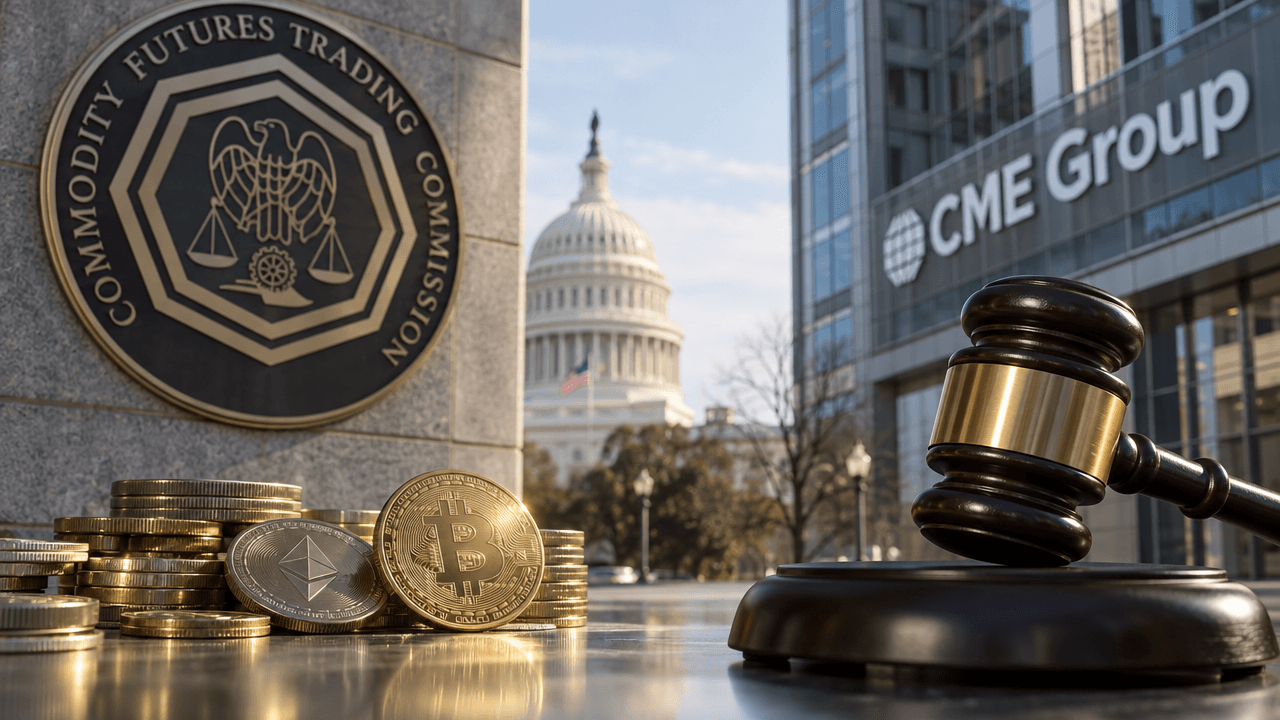
The U.S. Commodity Futures Trading Commission’s challenge to CME Group’s lawsuit over cryptocurrency perpetual futures places a fundamental question before the courts: what exactly is a perpetual contract, and who should decide how it is regulated?
The dispute could influence how crypto derivatives develop in the United States. It affects not only CME and the CFTC, but also exchanges, market makers, trading firms, and retail investors seeking access to products that have become central to global cryptocurrency markets.
The Core Dispute
Perpetual futures, commonly called “perps,” are leveraged derivatives that track the price of an underlying asset without a fixed expiration date. Unlike traditional futures, which settle or roll over on a specified schedule, perpetual contracts are designed to remain open indefinitely.
Traders generally remain aligned with the spot market through periodic funding payments. When the perpetual contract trades above the underlying asset, for example, traders holding long positions may pay those holding short positions. This mechanism helps keep the contract’s price near the spot price while allowing continuous trading.
The CFTC opened the door to U.S. crypto perpetual futures in May 2026 by approving Kalshi’s bitcoin perpetual contract. The agency also issued a policy statement indicating that registered futures exchanges could list similar products, subject to case-by-case review. That decision marked a significant step toward bringing a product widely traded overseas into the domestic derivatives framework. [1]
CME challenged the approval and the broader policy in federal court. Its central argument is that perpetual contracts do not qualify as futures because they lack an expiration or delivery date. CME maintains that they should instead be classified as swaps, which would place them under a different regulatory structure. [1]
THE CFTC’S DISMISSAL ARGUMENT
The CFTC is asking the court to dismiss CME’s case, arguing that the exchange has not demonstrated the type of concrete harm required to bring the lawsuit.
In its latest filing, the agency said that allegations of increased competition are not enough. CME must plausibly show actual or imminent financial injury, or an identifiable competitive threat connected to the CFTC’s policy. According to the regulator, CME has not met that standard. [1]
The CFTC also points to CME’s own public statements. During earnings discussions, CME reportedly indicated that it had not seen meaningful demand for perpetual futures and that the products were not substitutes for the futures contracts it already offers.
That creates a strategic problem for CME. In court, the exchange argues that the policy threatens its business by enabling competing venues to list similar products. In communications with investors, however, it has reportedly characterized perps as distinct from its existing offerings. The CFTC argues that CME should not be able to present one position to the court and another to the investing public. [1]
The regulator further noted that CME’s cryptocurrency futures trading volume has increased since the policy shift. While higher volume does not settle the legal issue, it weakens the argument that the CFTC’s decision has already caused measurable commercial damage.
Why The Classification Matters
The futures-versus-swaps question is more than a technical label. Classification determines which rules apply, how products may be listed, and what compliance obligations exchanges must meet.
If perpetuals are treated as futures, registered derivatives exchanges could potentially offer them through the established futures framework, provided their products satisfy CFTC requirements. This approach could encourage competition among regulated venues and give U.S. traders access to contracts that are already important in international crypto markets.
If the court agrees with CME that perpetuals are swaps, the products could face a different approval pathway and potentially more restrictive requirements. That outcome could slow the expansion of U.S. crypto derivatives or force exchanges to redesign how these contracts operate.
The case also tests the limits of agency discretion. The CFTC’s policy allows it to assess perpetual products individually rather than apply a single automatic rule to every contract. Supporters may view that flexibility as practical, while critics could argue that the agency is stretching existing law to accommodate a new product category.
Market Structure And Trader Implications
For traders, the immediate issue is product availability. A dismissal would strengthen the CFTC’s policy and make it easier for additional U.S.-registered exchanges to explore crypto perpetual futures. Greater competition could improve liquidity, narrow spreads, and expand the range of bitcoin and other digital-asset contracts available to market participants.
It could also introduce additional risks. Perpetuals typically involve leverage, which can magnify both gains and losses. Continuous funding payments may become expensive when positions are held for extended periods, and sharp price movements can trigger liquidations. Access through a regulated venue does not eliminate those risks.
For exchanges, the case is about more than one bitcoin contract. A clear ruling could determine whether the U.S. market develops around a broad futures model or a more limited swaps framework. That decision may influence product design, clearing arrangements, margin requirements, and the competitive balance between incumbent exchanges and newer platforms.
The timing is important. Perpetual trading has already become a major part of global crypto derivatives activity, while the U.S. legal challenge remains unresolved. Analysts have warned that continued market growth could make any eventual reversal more difficult. If CME ultimately prevails, unwinding or restructuring products that have already attracted traders could create operational and regulatory complications. [1]
What Traders Should Watch Next
The next major development is the court’s decision on the CFTC’s request for dismissal. A dismissal would not necessarily resolve every question about the legal status of perpetuals, but it would allow the regulator’s framework to remain in place and could accelerate new listings.
If the court allows CME’s lawsuit to proceed, the case could produce a more detailed ruling on standing, agency authority, and the legal definition of a futures contract. The court may also examine whether the CFTC properly considered the consequences of its policy before approving Kalshi’s product.
Traders should monitor exchange announcements, margin policies, funding mechanics, contract specifications, and regulatory disclosures rather than assuming every perpetual product works the same way. They should also treat leverage conservatively and understand how funding payments and liquidation rules affect a position over time.
The CFTC’s challenge to CME is therefore a pivotal development, but not an immediate verdict on the future of crypto markets. At stake is the regulatory architecture for a rapidly growing product class. Whether the court sides with the regulator’s flexible futures approach or CME’s swaps-based interpretation, the decision will help define how innovation, competition, and investor protection coexist in the next phase of U.S. crypto derivatives.