
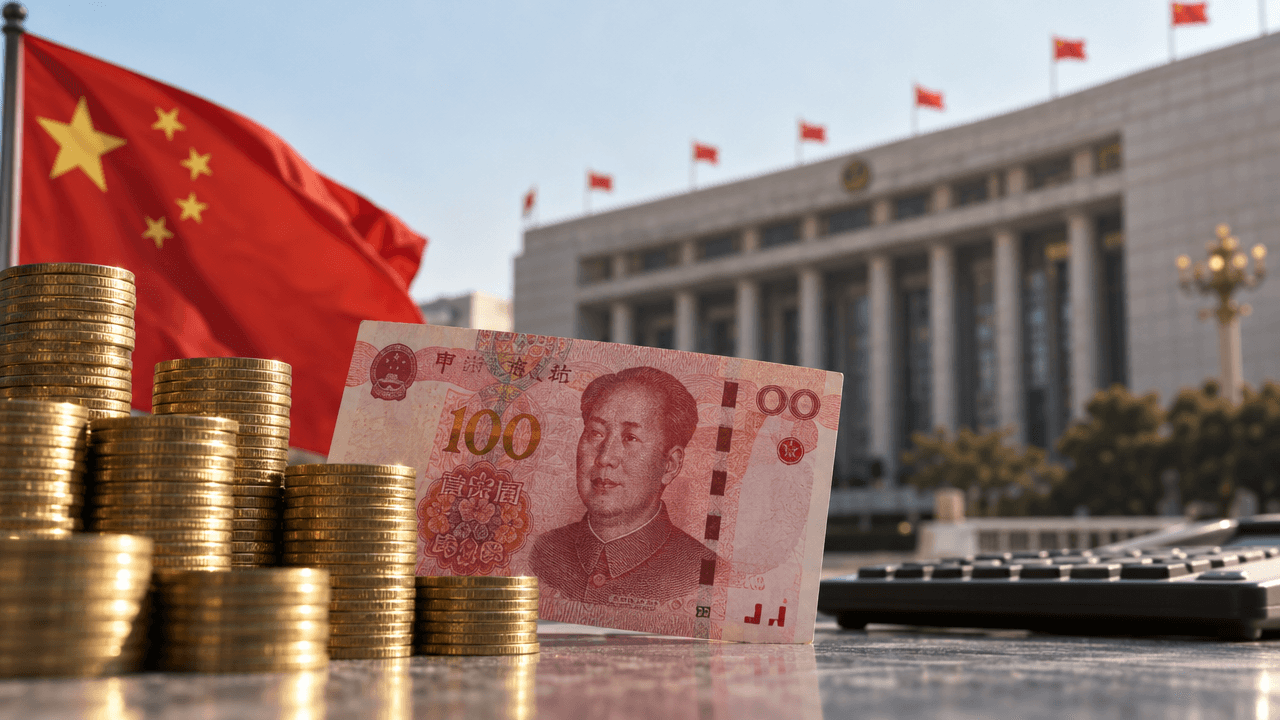
China has kept its key lending rates unchanged while guiding the yuan toward its strongest official level in more than three years. The combination sends a nuanced message: policymakers are not adding broad-based interest-rate stimulus, but they appear increasingly comfortable supporting a firmer currency as economic conditions stabilize.
The People’s Bank of China left the one-year loan prime rate at 3.00% and the five-year rate at 3.50% in October. This extended the unchanged streak to 17 consecutive months, matching market expectations. [1] At the same time, the central bank set the yuan’s daily reference rate at its strongest level since February 2023, reinforcing the currency’s recent appreciation. [5]
For traders, the decision is less about a surprise rate move and more about what the policy mix reveals about Beijing’s priorities.
What The Rate Decision Means
The one-year LPR is a key reference for many corporate and household loans, while the five-year LPR is closely associated with longer-term borrowing, including mortgages. Keeping both rates unchanged means borrowers will not receive an immediate reduction in benchmark financing costs.
The decision also confirms that the LPR has temporarily taken a back seat as China’s main tool for adjusting monetary conditions. Market attention has increasingly shifted toward shorter-term instruments, including the seven-day reverse repo rate, which has become a more important signal of the central bank’s day-to-day policy stance. [5]
A prolonged hold does not necessarily indicate that policymakers are abandoning economic support. Instead, it suggests that officials may prefer targeted measures, liquidity operations, or fiscal support rather than another broad reduction in lending benchmarks.
The timing is important. Expectations for immediate easing have weakened after stronger-than-expected third-quarter economic data reduced pressure for an urgent policy response. [6] A rate cut could still become more likely if domestic demand, property activity, or credit growth deteriorates, but the latest decision indicates that policymakers are willing to wait for additional evidence.
Why The Yuan Fix Matters
The yuan’s daily reference rate is set by the PBOC before onshore trading begins. The currency is then allowed to move within a specified band around that midpoint. The PBOC currently permits the onshore yuan to fluctuate within 2% of the daily reference rate. [7]
A stronger fixing does not guarantee that the yuan will rise throughout the trading session. However, it provides an important policy signal. By guiding the midpoint higher, the central bank can communicate greater tolerance for yuan strength and discourage excessive expectations of depreciation.
The latest fixing stood near 6.72 yuan per U.S. dollar, the strongest reference point since February 2, 2023. [7] The onshore yuan also traded around 6.6789 per dollar, supported in part by exporters converting foreign-currency receipts into yuan. [10]
Several forces may be contributing to the currency’s improvement. Strong trade flows can generate foreign-exchange inflows, while a softer dollar or changing expectations for global interest rates can reduce pressure on Asian currencies. A more stable domestic outlook can also encourage businesses and investors to hold yuan-denominated assets.
Market Impact Across Asia
The stronger fixing arrived as Asian equities weakened, highlighting the difference between currency policy and broader risk sentiment. Asian stocks can decline even when the yuan strengthens if investors remain concerned about global growth, technology valuations, geopolitical risks, or uncertainty surrounding China’s property sector.
For equity traders, unchanged lending rates offer limited fresh support to rate-sensitive areas such as developers, banks, and consumer companies. Mortgage-linked sectors may welcome the absence of further tightening, but they do not receive the immediate boost that a lower five-year LPR could provide.
A firmer yuan can help companies that rely heavily on imported commodities, equipment, or foreign-currency inputs because those purchases become cheaper in yuan terms. It can also reduce the local-currency burden of foreign debt. However, exporters may face a less favorable translation effect if their overseas revenues are converted back into a stronger yuan.
The impact is therefore uneven. Importers and businesses with foreign-currency liabilities may benefit, while exporters need stronger overseas demand or improved pricing power to offset currency headwinds.
Practical Takeaways For Traders
First, treat the unchanged LPR decision as confirmation of policy stability rather than a new stimulus announcement. The absence of a cut can limit short-term upside in rate-sensitive Chinese assets.
Second, monitor the PBOC’s daily yuan fix alongside spot trading. A sequence of stronger fixings can be more meaningful than a single adjustment, especially if market prices remain close to the guided level.
Third, watch the seven-day reverse repo rate and liquidity operations for clues about near-term monetary policy. The LPR may remain unchanged even while the central bank adjusts liquidity conditions through other channels.
Fourth, separate currency exposure from equity exposure. A stronger yuan does not automatically imply stronger Chinese stocks, particularly when regional risk appetite is deteriorating.
Finally, consider the role of trade flows. If exporters continue converting dollars into yuan, the currency may receive support even without a major shift in interest-rate policy. That support could weaken if external demand slows or companies choose to retain foreign-currency balances.
The Bigger Picture
China’s latest policy combination reflects a measured approach. The PBOC is preserving low benchmark borrowing costs while using the exchange-rate fixing to signal confidence in the yuan. Policymakers appear willing to support currency stability without committing to another economy-wide rate cut.
For markets, the message is one of gradual recalibration rather than dramatic policy change. The yuan’s strength may improve confidence and reduce imported inflation risks, but unchanged lending rates leave the burden of supporting growth to targeted measures and fiscal policy.
The most important question is whether stronger currency guidance becomes a sustained trend or simply reflects temporary trade-related inflows. Traders should focus on the consistency of future fixings, domestic credit demand, property indicators, and signs of consumer recovery. Together, those factors will determine whether China’s current policy stance represents a durable stabilization phase or only a pause before further support becomes necessary.