
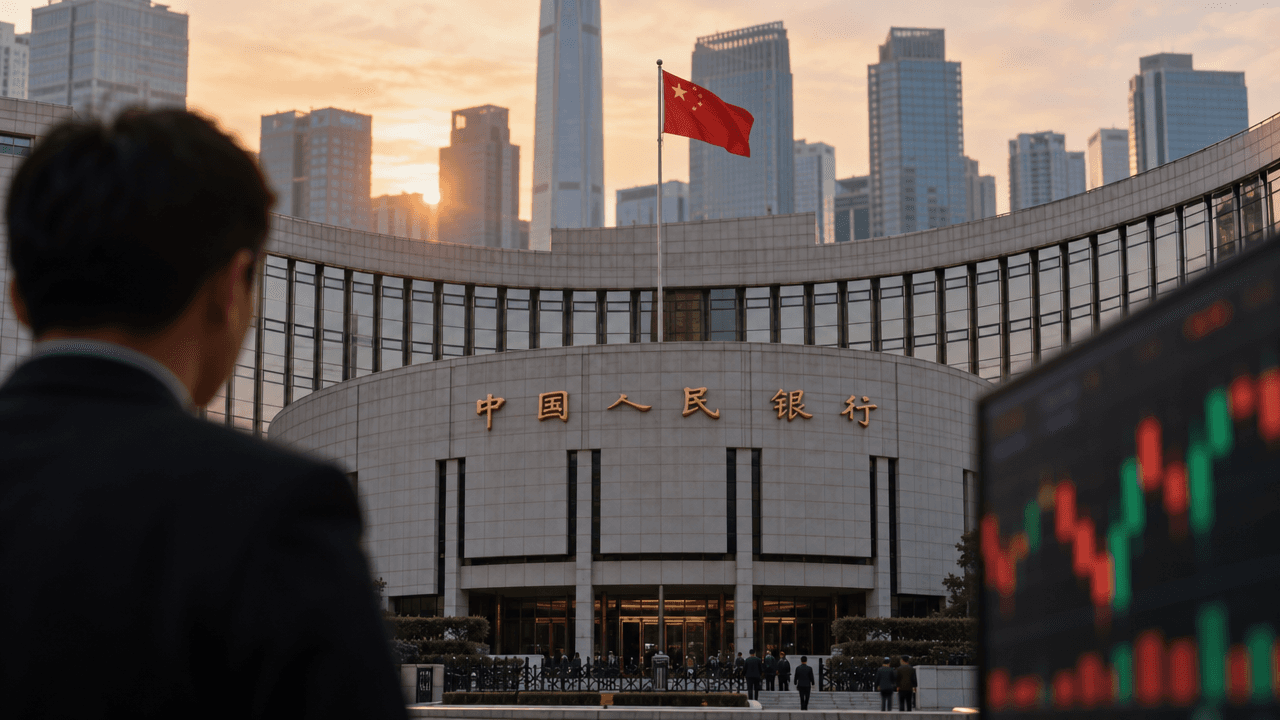
China’s central bank has chosen stability over fresh stimulus, keeping its benchmark lending rates unchanged in October. The People’s Bank of China (PBOC) held the one-year loan prime rate (LPR) at 3.00% and the five-year LPR at 3.50%, extending the pause to 17 consecutive months. The decision was widely expected, but it highlights the difficult balance facing policymakers as they try to support growth without creating new financial risks. [1]
What The Decision Means
The LPR is China’s key reference point for many bank loans. The one-year rate is commonly associated with corporate and working-capital lending, while the five-year rate is particularly important for mortgages and longer-term financing. By leaving both rates unchanged, the PBOC signaled that it does not currently view a broad reduction in lending rates as the most urgent policy tool.
The announcement was not a surprise. Market participants had broadly anticipated that both rates would remain unchanged, especially after stronger-than-expected third-quarter economic growth reduced expectations for an immediate rate cut. A Reuters survey found that all 22 respondents expected the one-year and five-year LPRs to remain at 3.00% and 3.50%, respectively. [4]
For financial markets, an expected decision generally creates less volatility than an unexpected move. Investors may therefore focus less on the headline rates and more on future signals from the PBOC, including liquidity operations, reserve-requirement policy, targeted lending programs and guidance for banks.
Why Property Remains The Central Concern
The five-year LPR matters because it influences the pricing of many household mortgages. Holding it steady means borrowers should not expect a new, broad-based reduction in mortgage-linked borrowing costs from this decision alone. That leaves China’s property sector facing the same fundamental challenge: lower interest rates can reduce financing costs, but they cannot by themselves restore confidence among homebuyers, developers and lenders.
The property market has been affected by weak demand, unfinished housing projects, developer debt problems and falling expectations about future home values. These pressures can reinforce one another. When households delay purchases, developers receive less cash flow. When developers remain financially stressed, buyers become more cautious about new projects. Banks then face greater uncertainty when extending credit.
A lower five-year LPR could have provided an immediate signal of stronger support for housing demand. Its absence suggests policymakers may prefer targeted measures rather than another broad reduction. Possible tools include support for first-time buyers, adjustments to mortgage requirements, financing for project completion and measures aimed at restructuring distressed developers.
The unchanged rate does not mean property support has ended. It means that the latest policy decision did not add a new economy-wide interest-rate incentive.
The Credit And Growth Trade-off
China’s policymakers are attempting to support domestic demand while protecting bank profitability and financial stability. Lower rates can encourage borrowing, investment and consumption, but they also reduce banks’ net interest margins. If credit demand is weak, rate cuts may have only a limited effect: businesses and households may choose to repay debt or hold cash instead of taking out new loans.
This is an important distinction for traders. A lower policy rate is not automatically equivalent to stronger economic activity. The quality of new credit, loan demand and the willingness of private companies to invest may matter more than the headline rate itself.
The decision also reflects the possibility that authorities want to preserve room for future action. Keeping rates unchanged allows the PBOC to respond later if growth weakens, property stress intensifies or external conditions deteriorate. At the same time, avoiding an aggressive easing cycle may reduce pressure on the yuan and limit concerns about excessive leverage.
The PBOC’s broader policy framework is also evolving. Market attention has increasingly shifted toward short-term liquidity tools, including the seven-day reverse repo rate, rather than relying solely on changes to the LPR. Recent market commentary has identified the seven-day reverse repo rate, currently reported at 1.40%, as an important operating signal for monetary policy. [5]
What Markets May Watch Next
The immediate reaction to the LPR decision may be relatively restrained because the outcome matched expectations. Currency traders will watch whether the yuan gains support from the absence of additional easing or instead weakens if investors interpret the decision as insufficient assistance for growth.
Chinese government bonds, bank shares, property developers and equity indices could respond differently. Bond markets may focus on the prospect of future easing, while bank stocks may welcome protection for lending margins. Property shares could remain under pressure if investors conclude that mortgage support will not expand quickly enough.
Commodity markets will also be sensitive to the growth implications. A credible improvement in Chinese construction, manufacturing and household demand would support industrial metals, energy and bulk commodities. Continued weakness in property investment, however, could limit expectations for a strong recovery in raw-material demand.
For SimFi traders, the practical lesson is to avoid treating the LPR announcement as an isolated buy-or-sell signal. Instead, monitor the interaction between rates, credit growth, property data, industrial production, retail sales and the yuan. A confirmed improvement across several indicators is generally more meaningful than a single policy headline.
Practical Takeaways For Traders
First, distinguish between an expected policy decision and a genuine policy surprise. Since the October hold was widely forecast, its market impact is likely smaller than an unexpected cut or change in forward guidance.
Second, track the one-year and five-year LPRs separately. The one-year rate offers clues about business and short-term credit conditions, while the five-year rate provides a clearer signal about mortgage and property-sector support.
Third, watch implementation rather than announcements alone. Targeted property financing, local-government debt measures and liquidity operations may have a greater real-world effect than an unchanged benchmark rate.
Finally, manage exposure around related data releases. China’s property sales, credit growth, industrial output and consumer spending figures can quickly alter the market’s interpretation of a rate decision.
Conclusion
China’s decision to keep the one-year LPR at 3.00% and the five-year LPR at 3.50% is best understood as a continuation of cautious, targeted policymaking. It provides stability, but it does not resolve weak property demand or uncertainty surrounding credit growth.
For investors and traders, the key question is no longer simply whether China will cut rates. It is whether policymakers can make existing credit more effective, restore confidence in housing and encourage households and businesses to spend and invest. Until those signals improve, the unchanged LPRs are likely to be viewed as a pause in policy support rather than evidence that China’s economic challenges have disappeared.