
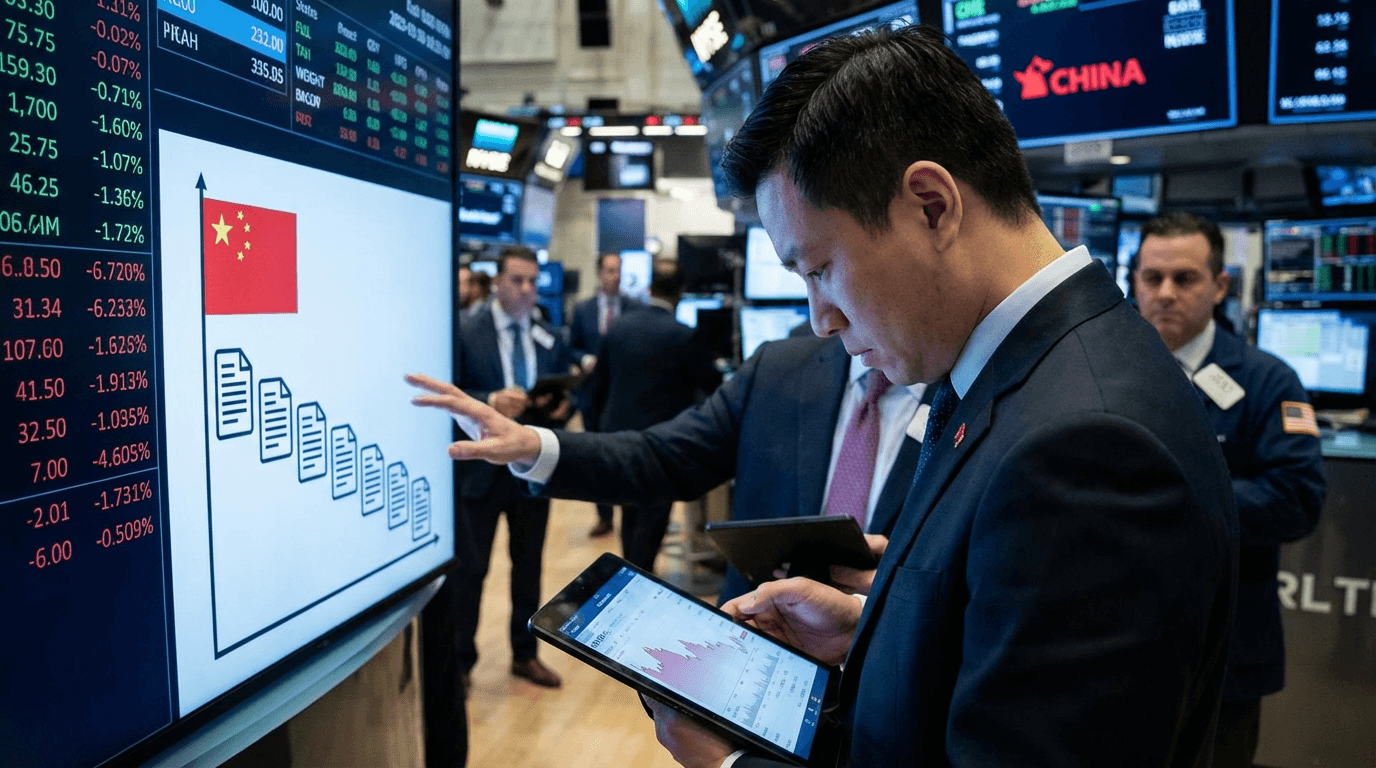
China's Strategic Shift: A Closer Look at Its Reduced US Treasury Holdings
China's recent decision to slash its US Treasury holdings to $683 billion as of November 2025, marking the lowest level since 2008, signals more than a mere portfolio adjustment. This move, spurred by Chinese regulators instructing banks to scale back US Treasury investments, is increasingly viewed through a geopolitical lens. For traders and investors, comprehending the implications of China's Treasury pullback is crucial as it may herald shifts in global financial markets and impact the stability of the world's most significant bond market.
The Scope of China’s Treasury Pullback
China's gradual yet accelerating retreat from US Treasuries reveals a strategic shift. Since reaching peak holdings in 2013, China has nearly halved its US Treasury portfolio. The decline from holding 28.8% of all foreign US Treasury holdings in June 2011 to just 7.3% today—a level not seen since 2001—translates to a $627 billion drop. The recent directive for Chinese banks to reduce holdings suggests an intentional policy shift rather than passive market forces.
In tandem with reducing US assets, China has pivoted towards gold, buying it for 15 consecutive months through January, amassing total reserves to a record 2,308 tonnes. This dual strategy of selling US assets while accumulating precious metals highlights Beijing's deliberate effort to diversify away from dollar-denominated exposure.
Why China Is Making This Move
Officially, China frames its Treasury reduction as a risk management strategy in response to market volatility and concentration risks. However, experts suggest multiple motivations at play. Geopolitically, China is wary of potential financial weaponization, as demonstrated by the US and its allies freezing $300 billion of Russia's foreign reserves post-Ukraine invasion in 2022. This precedent prompts Beijing to reduce Treasury exposure as a safeguard against similar actions concerning Taiwan or regional conflicts.
Economically, Treasuries constitute about 20% of China's foreign reserves, exceeding Beijing's comfort level. With around $3.4 trillion in total foreign reserves, managing such a concentrated Treasury portfolio becomes challenging. Furthermore, China's actions align with its broader goal of reducing dollar dependence. Chinese leader Xi Jinping's 2024 call for the internationalization of China's currency underscores this long-term pivot away from the dollar-centric financial system.
Market Implications and Immediate Concerns
While the immediate market response has been muted, with only marginal changes in Treasury yields, underlying concerns persist among economists and market professionals. The shrinking foreign share of US Treasuries, down to 31% from 50% in 2015, is significant as the US Treasury market, valued at around $30 trillion, depends on foreign demand to finance government spending. A broader foreign divestment trend, triggered by China's reduction, could have severe consequences: rising Treasury yields could increase borrowing costs for the US government, businesses, and consumers, and a large-scale Treasury selloff might weaken the US dollar's status as the global reserve currency.
Other nations are also reducing Treasury holdings. India's reduction from $234 billion in November 2024 to $186.5 billion by November 2025, coupled with Denmark's AkademikerPension's plan to sell $100 million of Treasuries and a Dutch pension fund's reduction by 10 billion euros, signals a broader trend.
What Traders Should Watch
While China is unlikely to engage in abrupt, aggressive selling—an action that would harm its own economy by strengthening the yuan and making Chinese exports more expensive—the gradual reduction is expected to continue. This shift opens opportunities for other sovereign wealth funds to follow suit. Traders should closely monitor foreign Treasury demand and track China's gold accumulation as indicators of its financial strategy. The long-term structural shift away from dollar assets may take years to fully materialize, but the trajectory seems set.
China's Treasury Retreat: Why the Lowest Holdings Since 2008 Matter for Your Portfolio
China's US Treasury holdings have plummeted to $683 billion—the lowest since 2008. Understand why Beijing's pivot away from US debt signals broader market shifts and its implications for global investors.