
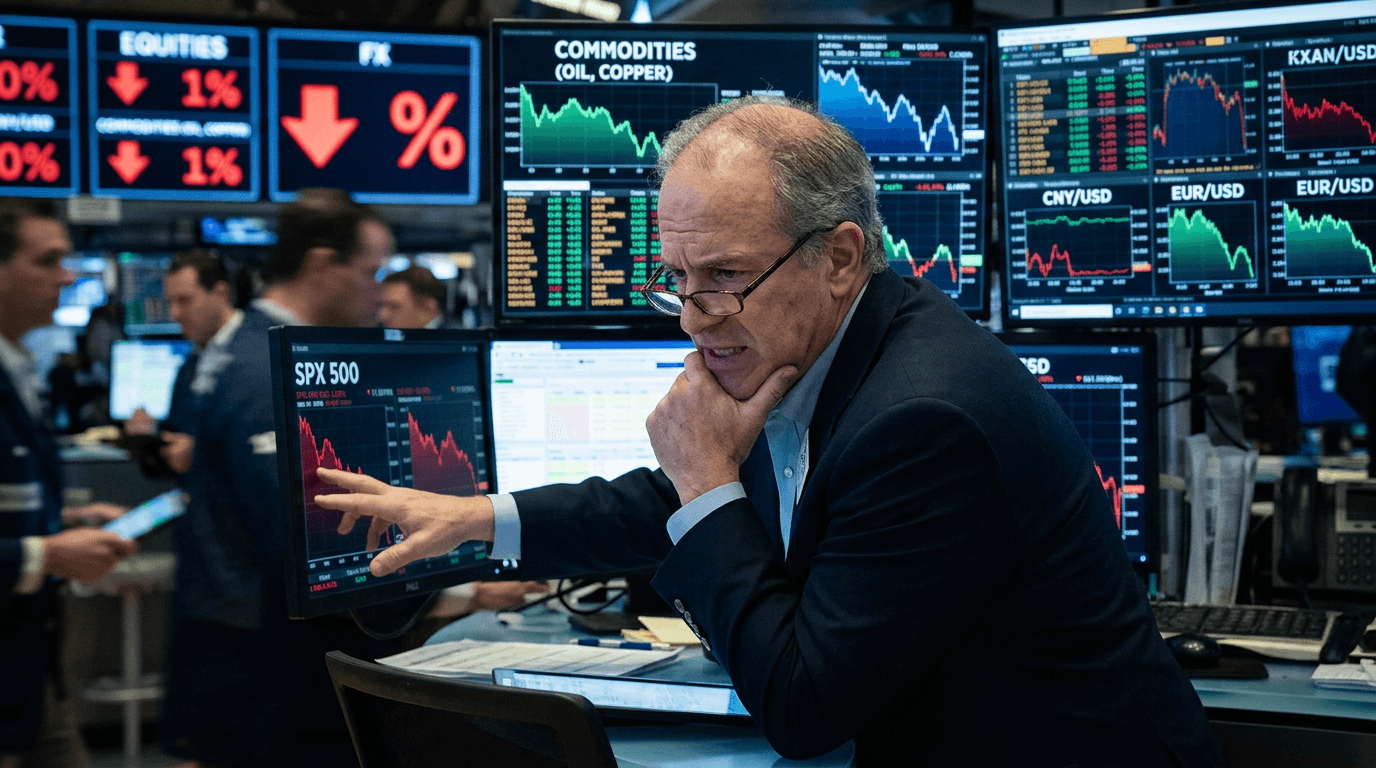
Global markets have been reminded that geopolitics still matters for pricing risk. China’s announcement of steep new tariffs of up to 125% on selected US goods marks a sharp escalation in trade tensions, sending a chill through global equities, commodity futures, and pro‑cyclical currencies. For traders, this is not just another headline—it’s a regime shift in the risk landscape that can reshape trends across asset classes.
Trade Tensions Flare Up Again
Tariffs are, at their core, a tax on cross‑border trade. When a major economy like China hikes duties on US imports to triple‑digit levels, it is signaling both economic retaliation and political resolve.
By pushing tariffs on US goods as high as 125%, Beijing is doing three things at once: raising costs for importers, discouraging specific categories of US exports, and signaling that it is prepared for a prolonged dispute rather than a quick compromise. The warning that China will “ignore Washington” if more tariffs are imposed underscores that this is not a one‑off measure, but part of a broader strategic posture.
This matters because tariffs are rarely isolated. They tend to trigger reciprocal moves, re‑pricing of supply chains, and shifts in corporate investment plans. Markets quickly move from asking “what is the tariff rate?” to “how far can this escalate—and how long can it last?”
WHY A 125% TARIFF MATTERS
Triple‑digit tariffs are more than a marginal adjustment; they are close to a functional barrier to trade in the affected products.
At 125%, many US goods become structurally uncompetitive in the Chinese market unless prices are drastically cut or supply chains are re‑engineered. This can hit sectors like agriculture, industrial machinery, and certain consumer goods particularly hard, depending on the final tariff list.
Higher tariffs have two key macro effects
First, they tend to be negative for growth. They raise costs, create friction in trade flows, and encourage duplication of supply chains, which can be inefficient.
Second, they can be inflationary in the short term, as tariffs are passed through to end prices, especially where alternative suppliers are limited.
For markets, that mix—slower growth, potentially higher prices, and elevated uncertainty—is textbook “risk‑off.” It encourages investors to demand a higher risk premium on equities and credit, while looking more favorably on defensive assets.
Market Reaction: Risk Assets Under Pressure
The immediate impact of tariff shocks is usually felt in three places: equities, commodities, and foreign exchange.
Equities tend to reprice on two fronts. Export‑sensitive firms and sectors directly exposed to US‑China trade see earnings expectations marked down, while broader indices adjust to a higher discount rate as geopolitical risk rises. Cyclical sectors such as industrials, autos, and semiconductors are often at the front line of these moves.
Commodity futures react both to the demand outlook and to the specifics of any tariff targeting. If agricultural products, metals, or energy goods are caught in the crossfire, hedging flows and speculative positioning can shift quickly. Even when specific commodities are not directly targeted, weaker trade growth expectations can weigh on prices.
In FX, pro‑cyclical currencies like AUD and CNH often bear the brunt of risk‑off sentiment. The Australian dollar is tightly linked to global growth and China’s demand for commodities, so a renewed trade shock can push AUD lower as traders price in slower regional activity. The offshore renminbi (CNH) typically weakens when investors expect China’s economy and capital flows to come under pressure.
Safe‑haven currencies and assets, such as USD, JPY, CHF and high‑quality government bonds, typically benefit from inflows as investors seek stability. Volatility indices and option implied vols tend to rise, reflecting increased demand for protection.
What This Means For Traders And Investors
For active traders and longer‑term investors alike, the key is to treat tariff announcements as catalysts rather than isolated events.
There are several practical implications
First, correlation patterns can shift. Equities in export‑oriented markets, commodity prices, and cyclical FX can move more tightly together as “global trade risk” becomes a dominant driver. Monitoring cross‑asset relationships becomes as important as analyzing any single chart.
Second, headline risk rises. Forward guidance from policymakers may become less reliable as decisions are influenced by domestic politics and negotiations rather than purely economic models. Intraday swings around speeches, press conferences, and leaks can be larger and more frequent.
Third, sector and factor performance can diverge. Quality, low‑volatility, and defensive sectors often outperform high‑beta cyclicals in periods of trade tension. Growth stocks with limited global supply‑chain exposure can behave very differently from multinational industrials.
From a risk‑management perspective, traders should review how much of their P&L depends on assumptions about stable trade relations. Concentrated exposure to one geography, sector, or theme can be more vulnerable than diversified portfolios with robust hedging.
Navigating Volatility In A Simulated Environment
For SimFi users, tariff shocks are excellent case studies for building and testing robust trading frameworks without real‑world capital at risk.
A simulated environment allows you to
- Recreate prior trade war scenarios and see how different assets behaved across phases of escalation and de‑escalation.
- Stress‑test strategies under volatility spikes, widening bid‑ask spreads, and sudden correlation regime changes.
- Practice event‑driven trading around policy announcements, including setting rules for position sizing, stop placement, and news filters.
- Explore macro themes—such as “global trade slows, domestic demand becomes more critical”—and translate them into multi‑asset positions.
You can construct simulated portfolios that overweight or underweight export‑sensitive equities, pair‑trade pro‑cyclical FX against safe‑haven currencies, or hedge commodity exposures with volatility instruments. By tracking performance through different tariff headlines, you build intuition about how markets digest geopolitical shocks over days, weeks, and months.
Key Takeaways For The Next Phase Of The Trade Dispute
The most important practical takeaways from China’s tariff announcement are:
- A 125% tariff is a clear signal of escalation, not routine policy noise.
- Risk assets—equities, commodities, and cyclical FX—are likely to remain sensitive to further headlines, making position management and sizing critical.
- Cross‑asset analysis becomes more valuable, as trade tensions propagate across equities, FX, rates, and commodities.
- Simulated trading offers a low‑risk way to develop and refine playbooks for dealing with sudden geopolitical shocks.
As the US‑China trade relationship moves into a more confrontational phase, traders who combine macro awareness with disciplined execution will be better positioned to navigate the volatility. Understanding how tariff shocks ripple through markets is no longer optional—it is a core competency in modern global trading.