
China’s decision to raise tariffs on US-origin goods to as high as 125% from April 12 marks a sharp escalation in the ongoing trade confrontation between the world’s two largest economies[10][8]. For traders, this is not just a diplomatic headline—it is a structural shock that can reshape pricing, volatility, and correlations across global markets in the weeks ahead.
Backdrop To The Tariff Escalation
The new measures are part of a third wave of Chinese retaliation that has unfolded in rapid succession in response to earlier US tariff hikes[10][7]. China first announced an additional 34% blanket tariff on all US goods, effective April 10, lifting overall charges on US imports well beyond their pre-dispute levels[10][12]. Within days, the retaliatory rate was raised to 84%, and now to 125% from April 12, creating one of the most severe bilateral tariff regimes seen in modern trade history[7][10].
This escalation is explicitly tit-for-tat. US duties on Chinese imports were already pushed into triple-digit territory, with some estimates putting effective tariffs on Chinese goods entering the United States at around 145% during this phase of the trade war[8][5]. Beijing’s move to 125% on US goods is therefore calibrated both as economic retaliation and political signaling—China is matching the scale of US action while publicly declaring there is little economic sense in going substantially higher[5][10].
WHAT A 125% TARIFF MEANS FOR REAL ECONOMIES
A tariff of 125% effectively more than doubles the price of affected US goods at the Chinese border, before local taxes and distribution costs are added[10]. For many US exporters, especially in price-sensitive sectors such as industrial machinery, autos, chemicals, and agricultural products, this makes their offerings uncompetitive overnight relative to alternative suppliers or domestic Chinese producers[10][12]. Contracts may be renegotiated, volumes reduced, or supply chains re-routed toward non-US partners.
The burden does not fall solely on US firms. Historical analysis of broad-based tariffs shows that higher duties tend to raise prices for both consumers and businesses, disrupt supply chains, and weigh on economic growth[13]. Importers face higher costs, which they can either pass on through higher end prices or absorb via thinner margins, while exporters see demand uncertainty rise. When tariffs are applied across nearly the entire bilateral trade relationship, as in this episode, the cumulative drag on investment and productivity can become material[12][13].
There are also global spillovers. Prior waves of US-China trade tensions have led to measurable declines in bilateral trade volumes, prompting exporters to seek new markets and pushing importers to diversify their sourcing[3][12]. This re-routing of trade raises transaction costs and can contribute to pockets of inflation as supply chains become less efficient[3]. For policymakers, the combination of slower trade growth and potential price pressures complicates the outlook, raising the risk of a stagflationary mix if the dispute persists.
Market Reaction: Risk-off Sentiment And Safe-haven Flows
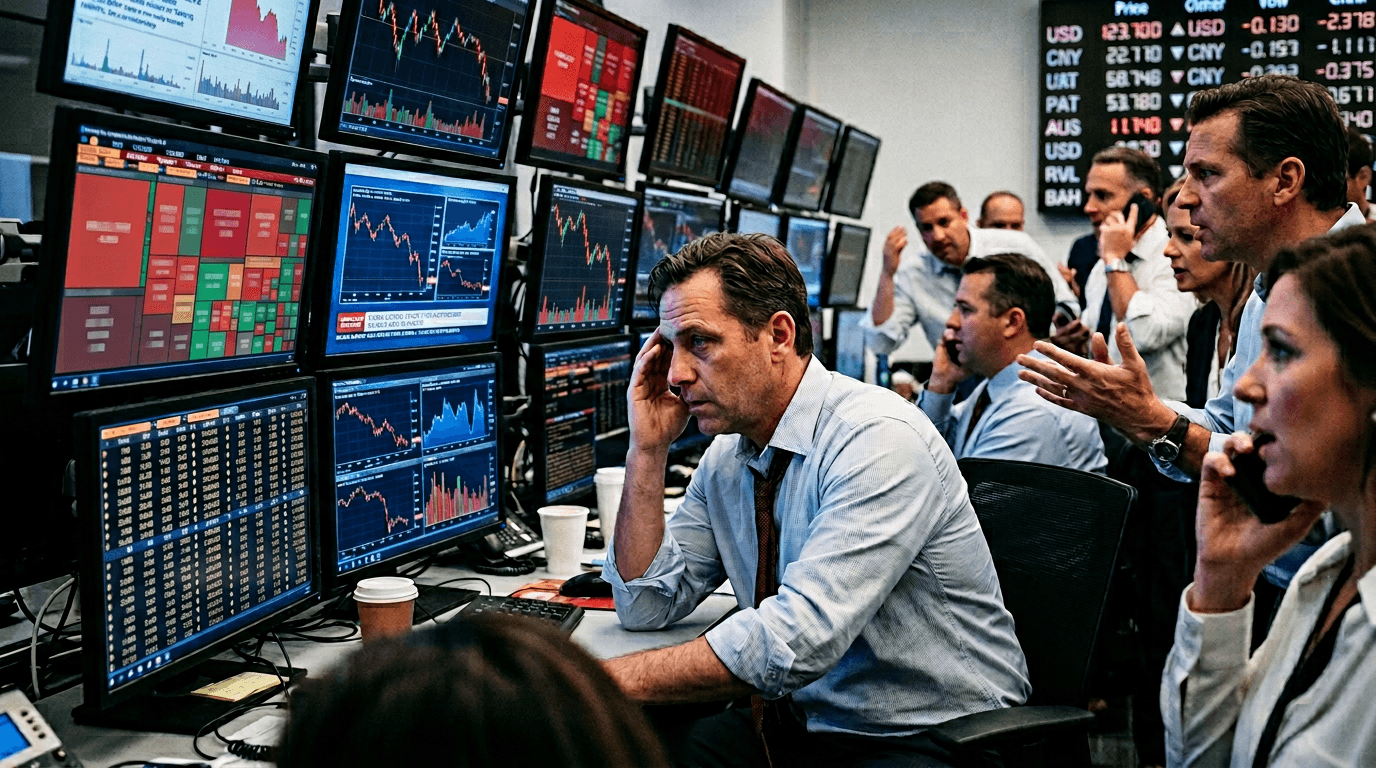
Financial markets tend to react quickly to tariff shocks, and this announcement is no exception. US-linked exporters and multinational firms with significant China revenue exposure are seeing pressure on their share prices as investors reassess earnings trajectories and supply chain resilience[4][13]. Equity indices with heavy weightings in global industrials and cyclical sectors are particularly vulnerable, as the market begins to price in weaker trade flows and softer capital spending.
In currency markets, episodes like this typically trigger safe-haven flows. The combination of policy uncertainty and growth risk tends to support currencies such as the Japanese yen and the Swiss franc, while those linked to global trade and commodities can underperform[3][9]. At the same time, interest-rate markets often interpret escalating tariffs as a negative for growth but a potential source of supply-side inflation. The result can be a tug-of-war along the yield curve, with front-end yields responding to central bank expectations and longer maturities reflecting growth and inflation risks[3][9].
Commodity markets are also in the crosshairs. Higher tariffs dampen demand for some industrial inputs, as manufacturers face weaker order books and seek to cut costs, while certain agricultural products may be directly targeted by Chinese measures[10][12]. Over time, however, supply reconfiguration and government support programs can partially offset these effects. For traders, the key point is that tariff headlines can inject sharp, event-driven volatility into otherwise trendless markets.
Trading Implications And Strategies To Consider
For active traders, the move to 125% tariffs is a reminder that policy risk can rival economic data in its ability to move markets. Event-aware risk management becomes essential. That means monitoring official statements, trade negotiation calendars, and related geopolitical developments as closely as macro releases and earnings reports.
From a strategy standpoint, several themes typically emerge in tariff-driven environments. Equity traders may look at relative performance between domestically focused companies and globally exposed exporters, or between sectors that are more sensitive to trade (like industrials and autos) and those that are structurally less exposed. FX traders can explore safe-haven versus high-beta currency pairs, while keeping in mind that sudden positive headlines—such as negotiation breakthroughs or tariff suspensions—can reverse risk-off moves quickly.
Position sizing and leverage deserve particular attention. Policy headlines can cause gap risk and slippage, especially around market opens and illiquid hours. Using options to express views—with defined downside—rather than leveraged linear exposure can be a way to participate in volatility while managing tail risk. Diversification across asset classes and regions can also help mitigate the impact of any single policy shock.
Using Simulated Finance To Navigate Policy Shocks
The current episode highlights why simulated finance (SimFi) platforms such as E8 Markets are valuable tools for traders and investors. Tariff announcements are inherently hard to forecast, yet they have recurring patterns in how markets respond. In a simulated environment, traders can stress-test portfolios against different tariff scenarios, experiment with hedging strategies, and build rule-based playbooks for risk-off events—all without risking real capital.
One practical approach is to study previous periods of US-China trade tension, such as the 2018–2019 dispute and earlier 2025 tariff waves, and recreate those environments using historical data[3][12]. Traders can analyze how correlations between equities, FX, rates, and commodities changed during those episodes, then design strategies that adapt to similar shifts. For example, they might back-test systematic rules that reduce exposure to highly trade-sensitive sectors when implied volatility spikes, or that rotate into currencies historically favored during risk-off moves.
SimFi platforms can also help traders refine execution tactics. Practicing how to adjust orders, manage slippage, and handle overnight risk around policy events builds confidence and discipline. Over time, these simulated exercises can translate into more consistent performance when similar headlines hit live markets.
Conclusion: Staying Nimble In A Policy-driven Market
China’s decision to raise tariffs on US goods to as much as 125% from April 12 is a significant escalation in the trade dispute and a meaningful shock for global markets[10][8]. Beyond its immediate impact on affected companies and sectors, it reinforces a broader reality: policy decisions can alter market regimes as quickly as economic cycles. For traders, the edge increasingly lies in combining macro awareness, robust risk management, and systematic preparation.
By treating tariff announcements as repeatable stress scenarios, using tools like simulated trading to rehearse responses, and maintaining a flexible framework that can incorporate new information rapidly, market participants can turn policy volatility from a threat into an opportunity. In a world where headlines move prices as much as fundamentals, staying nimble, data-driven, and well-prepared is no longer optional—it is core to effective trading.