
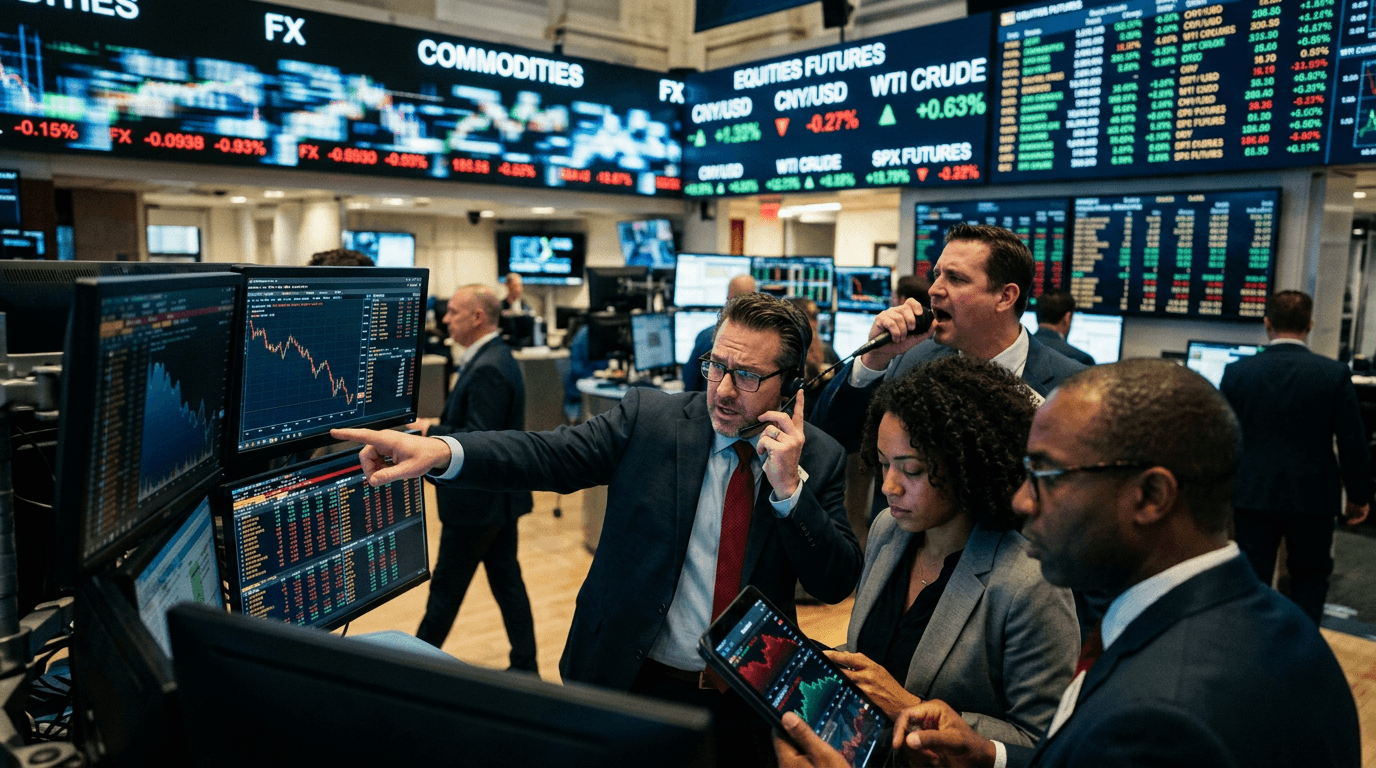
China’s latest announcement of steep retaliatory tariffs on US imports has injected a fresh wave of uncertainty into global markets. By lifting duties on certain American goods to as high as 125% and vowing to “ignore” Washington if it continues to escalate, Beijing has signaled that the trade confrontation is entering a more entrenched phase. For traders, this is not just another headline: it is a regime shift that affects currencies, commodities, and equity indices linked to global growth.
WHAT CHINA JUST DID – AND WHY IT’S DIFFERENT
Retaliatory tariffs are not new in the US–China relationship, but the scale and tone of this move stand out. China has announced additional duties of up to 125% on selected US goods, on top of existing tariffs, turning previously expensive imports into potentially uneconomic ones for Chinese buyers.[1][3][5] Historically, similar hikes have targeted politically sensitive sectors such as agriculture, energy, and high-profile industrial products, aiming to maximize pressure on US policymakers while minimizing critical damage at home.[1][3]
The rhetoric matters as much as the numbers. By saying it will “ignore” Washington if the US continues to impose trade measures, Beijing is signaling less willingness to compromise and more readiness for a prolonged standoff. That reduces the odds of a quick de-escalation driven by behind-the-scenes negotiations and raises the likelihood that tariffs remain in place long enough to alter supply chains and investment plans.
Key takeaway: This is not a symbolic response; it is a serious escalation that markets must treat as a medium-term structural risk, not a short-lived headline shock.
Why Tariffs Hit Risk Sentiment So Hard
Tariffs function like a tax on cross-border trade. Higher costs can reduce trade volumes, squeeze corporate margins, and slow global growth. When the world’s two largest economies are involved, the impact extends far beyond their borders. Past waves of US–China tariffs were associated with weaker global manufacturing data, slower trade volumes, and bouts of financial market volatility.[4][5]
Risk assets are pricing in those concerns again. When traders see steeper tariffs, they quickly adjust expectations for:
- Corporate earnings: Exporters, manufacturers, and global supply chain firms may face higher costs and weaker demand.
- Capex and hiring: Companies delay investment when policy uncertainty rises, which can weigh on growth-sensitive sectors.
- Central bank responses: If trade tensions significantly drag growth and confidence, policymakers may be forced to reassess their interest rate paths.
As uncertainty rises, investors typically reduce exposure to risky assets and rotate into safer ones. That pattern is already visible: safe-haven demand is supporting the US dollar and Japanese yen, while pro‑cyclical currencies and equity index futures tied to global growth are under pressure.
Key takeaway: Tariffs are not just a trade story; they are a global growth and earnings story, which is why markets react so quickly and broadly.
CURRENCY IMPACT: SAFE HAVENS VS PRO‑CYCLICAL FX
The FX market tends to react first and fastest to macro shocks, and this tariff escalation fits the classic “risk-off” template.
Demand for perceived safe-haven currencies such as the US dollar and Japanese yen tends to increase when geopolitical or trade risks spike. Investors unwind carry trades, reduce exposure to higher-yielding emerging market currencies, and seek liquidity and safety in USD and JPY, pushing those currencies higher.
On the other side, pro‑cyclical and trade‑sensitive currencies come under pressure. These include:
- Emerging market FX with large external funding needs or strong export exposure to global trade.
- Commodity currencies such as the Australian dollar or some Latin American currencies, whose economies are tightly linked to Chinese demand and global manufacturing cycles.
A stronger dollar can tighten global financial conditions, particularly for countries and firms with dollar-denominated debt, amplifying the stress on EM FX. For traders, that creates trends but also raises volatility, especially around key data releases or further policy headlines.
Key takeaway: Expect a stronger bias toward USD and JPY in risk-off episodes, and heightened vulnerability in EM and trade‑linked currencies until there is credible progress toward de-escalation.
Commodities And Equity Index Futures: Trade-linked Assets In The Crosshairs
Commodity markets are closely tied to global trade and industrial activity, making them highly sensitive to tariff shocks. When trade tensions rise, markets start to price the risk of weaker demand for:
- Industrial commodities like copper, iron ore, and energy products that depend on global manufacturing and construction.
- Agricultural commodities if tariffs directly target farm exports, as has happened in previous US–China flare‑ups.[1][3]
Futures curves can flatten or shift lower as traders discount slower demand growth. At the same time, safe‑haven commodities such as gold may benefit as investors look for hedges against macro uncertainty and potential currency volatility.
Equity index futures linked to global growth—such as US indices with heavy multinational exposure, European benchmarks, and Asia‑Pacific indices—often react quickly to tariff headlines. Sectors most exposed include:
- Industrials and capital goods companies reliant on global supply chains.
- Semiconductors and tech hardware, where supply chains are deeply intertwined between the US and Asia.
- Autos and chemicals, which are both trade‑intensive and cyclical.
Volatility indices and options markets typically reprice higher as traders seek downside protection, raising hedging costs but also creating opportunities for volatility strategies.
Key takeaway: Trade-sensitive commodities and global equity indices sit on the front line of tariff risk; position sizing, diversification, and volatility management become critical.
How Traders Can Navigate This Environment
For traders operating in a simulated finance (SimFi) environment or live markets, the challenge is to turn macro uncertainty into a structured trading framework rather than reacting emotionally to every headline.
A few practical approaches
1. Build a macro map: Identify which assets are “risk-off beneficiaries” (USD, JPY, gold, certain sovereign bonds) and which are “growth‑sensitive” (EM FX, commodity currencies, industrial metals, global equity indices). Use this map to anticipate cross‑asset moves when trade news breaks.
2. Trade scenarios, not predictions: Instead of betting on one outcome, define scenarios such as “further escalation,” “status quo,” and “surprise de‑escalation.” For each, specify probable moves in key pairs (e.g., USD/JPY, AUD/USD, EM FX baskets) and indices, then look for trades that have favorable risk‑reward across multiple scenarios.
3. Respect volatility and correlations: Tariff headlines can change correlations quickly. Assets that usually diversify a portfolio may move together during intense risk‑off episodes. Use simulated environments to test how your portfolio behaves under stress and adjust leverage accordingly.
4. Focus on risk management first: Wider spreads and faster moves mean stop placement, position sizing, and diversification matter more. In a SimFi context, this is an ideal environment to practice disciplined risk rules without capital at stake—tightening stops, reducing size into major announcements, and planning exits before entries.
5. Watch policy signals, not just market moves: Trade tensions are fundamentally political. Monitoring official statements, scheduled negotiations, and policy calendars is as important as watching charts. Markets often reprice sharply when rhetoric softens or hardens unexpectedly.
Key takeaway: You cannot control trade policy, but you can control your process. Using structured scenarios, robust risk management, and simulation tools can turn a volatile headline environment into a learning and opportunity set.
As China and the US dig in with higher tariffs and tougher language, markets are reminded that geopolitics can reshape the trading landscape in a matter of hours. For active traders, the goal is not to predict every twist but to understand the mechanisms—how tariffs feed into growth, earnings, and cross‑asset flows—and to build strategies that are robust to surprise. In that sense, this latest escalation is more than news; it is a real‑time stress test of your trading framework.