
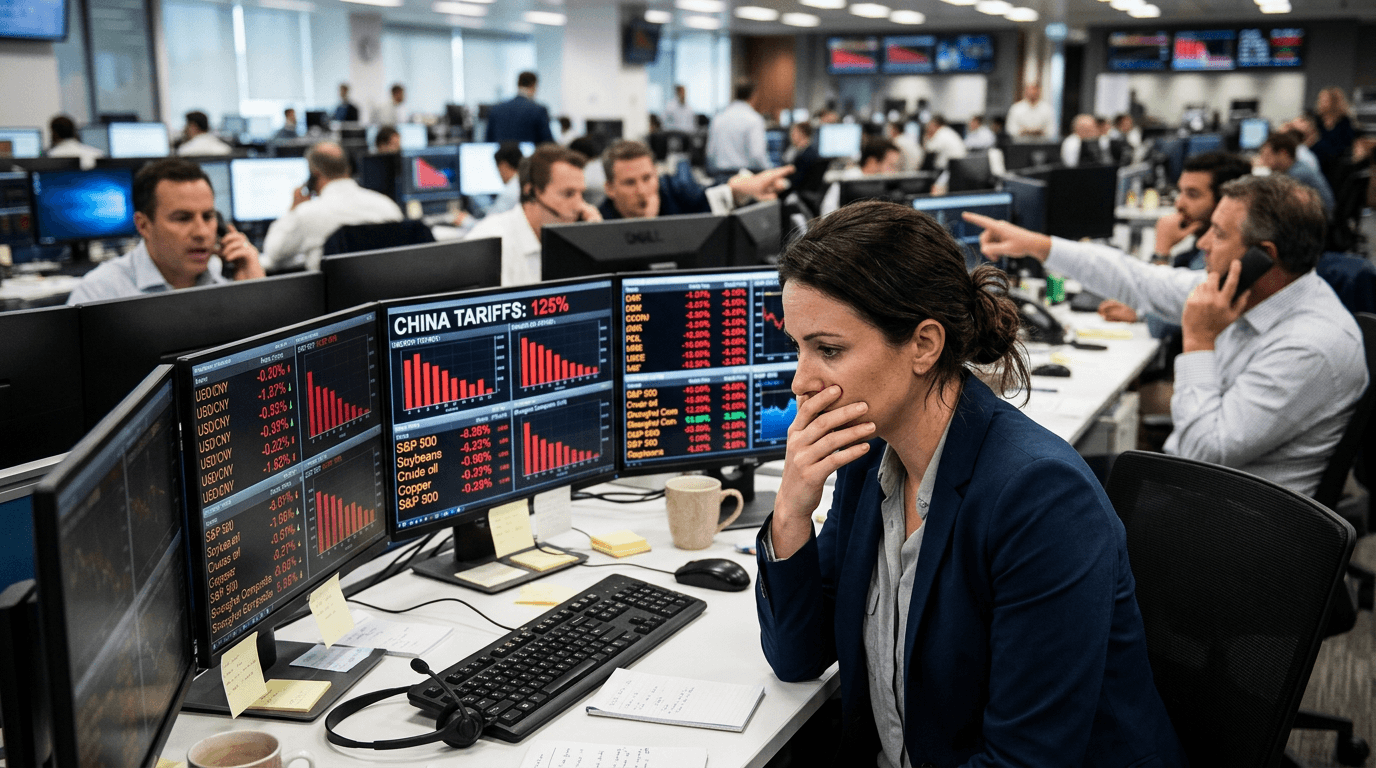
China’s latest move in the trade standoff with Washington has jolted global markets: Beijing has unveiled steep retaliatory tariffs of up to 125% on a wide range of US-origin goods, effective April 12, in response to sharply higher US duties on Chinese imports.[2][7][8] The escalation has injected fresh volatility into trade-sensitive assets, fuelled safe-haven flows in FX and commodities, and pressured equities and cyclical sectors as investors reassess the growth and policy outlook.
What China Just Did
China has raised its retaliatory tariff rate on US-origin goods from 84% to as high as 125%, following the US decision to hike tariffs on Chinese goods to roughly 145%.[2][7][8] This is not a narrow, symbolic move; it targets a broad swath of American exports and effectively prices many products out of the Chinese market.
This latest step builds on an earlier announcement in early April of an additional 34% tariff on all US imports, on top of existing duties, effective April 10.[2] At the same time, Beijing has leaned on non-tariff tools: new export restrictions, adding US defense and tech firms to its Export Control List and Unreliable Entity List, and suspending some agricultural imports.[2] Together, these measures aim to increase US pain points across energy, agriculture, autos, and advanced manufacturing.
Crucially, Chinese officials have signaled that if Washington pushes ahead with further tariff increases, Beijing will “ignore” US demands and continue to respond in kind. That raises the risk that this is not a one-off spike in tariffs but a renewed, iterative escalation cycle.
Why These Tariffs Matter For Markets
Tariffs of 80–125% are not marginal adjustments—they are effectively prohibitive. Research on prior rounds of China’s retaliatory tariffs between 2017 and 2019 finds that higher import duties led to large drops in both the value and volume of imports from the US.[4] One study estimates that a 1% rise in tariffs cut import quantity and value by about 1.6%, underscoring how powerful these measures can be.[4]
Another analysis of earlier agricultural retaliation estimated that China’s tariffs wiped out about $14.9 billion in US agricultural export sales over 12 months, with soybeans taking the biggest hit.[5] That history suggests today’s move is likely to again hurt US farmers, energy producers, and manufacturers that rely heavily on Chinese demand.
From a macro perspective, steep tariffs are effectively a tax on trade. They can: - Disrupt global supply chains and reorder trade flows - Raise imported input costs and pressure corporate margins - Weigh on business confidence and investment decisions - Complicate central banks’ inflation and growth trade-offs
As investors digest the potential hit to global trade and growth, risk assets typically de-rate, while hedges and safe havens gain in appeal.
Fx Reaction: Safe Havens Vs Risk Fx
Trade shocks and tariff headlines tend to reverberate quickly through FX markets. The pattern seen in earlier US–China flare-ups is re-emerging:
Safe-haven currencies such as the Japanese yen (JPY) and Swiss franc (CHF) tend to attract inflows as investors unwind carry trades and reduce exposure to high-beta currencies. US–China tariff escalation often coincides with USD/JPY heading lower, as risk-off sentiment dominates and Japanese investors repatriate capital.
The US dollar’s reaction is more nuanced. On one hand, the dollar can benefit from safe-haven demand and US asset depth. On the other, if markets interpret the tariffs as undermining US growth or accelerating deglobalisation, expectations for Fed policy can shift dovishly, limiting upside in the dollar against low-yielding havens.
Risk-sensitive FX—such as the Australian dollar (AUD), New Zealand dollar (NZD), and many emerging market currencies—typically underperforms when global trade tensions spike. These economies are deeply integrated into Asian supply chains and commodity exports, making them vulnerable to any slowdown in China-related demand.
For traders, this environment often means: - Higher intraday volatility in major FX crosses - Fatter tails around trade- and China-sensitive pairs - More frequent gaps around policy headlines and official comments
Impact On Commodities And Equities
Commodities feel the impact of tariffs both directly and indirectly. Energy products like US LNG and crude oil have been specific targets of China’s retaliatory tariffs in prior rounds, with extra duties of 10–15% on coal, LNG, and crude.[2] When those tariffs bite, China often shifts purchases toward alternative suppliers (e.g., Russia, the Middle East, Latin America), leaving US exporters scrambling for new markets.
Agricultural commodities are another flashpoint. Previous Chinese retaliation against US soybeans, pork, and other farm products led to a sharp rerouting of global grain flows and periods of depressed US farm incomes.[5] Renewed triple-digit tariffs revive those concerns and can: - Pressure US export prices as producers try to stay competitive - Support prices for alternative suppliers (Brazilian soybeans, for example) - Increase basis and spread volatility as trade flows adjust
On the equity side, the immediate pressure typically falls on: - Exporters heavily exposed to China (US industrials, autos, machinery) - Semiconductor and tech hardware names tied into Sino–US supply chains - Shipping, logistics, and trade-finance stocks
By contrast, perceived beneficiaries can include: - Non-US competitors to sanctioned US suppliers - Domestic-focused firms less reliant on cross-border trade - Select defense and cybersecurity names, if geopolitical risk premia rise
One common by-product of trade scares is a rotation into defensive sectors (utilities, staples, healthcare) and quality factors (strong balance sheets, stable earnings), as investors prioritize resilience over cyclical upside.
What Traders Can Do Now
For active traders and SimFi participants, intensifying tariff risks are not just a headline—they are a volatility engine that can create opportunity if handled with discipline.
A few practical angles to consider
1. Treat tariff dates and official announcements as event risk Policy timelines around tariff implementation and review dates often become catalysts for outsized moves. Build an economic and political calendar that includes not just central bank meetings and data releases, but also: - Tariff effective dates and transitional exemptions[2] - WTO filings, export-control announcements, and sanctions lists[2]
2. Focus on cross-asset correlations Trade escalations rarely stay contained in a single market. Watch how: - USD/JPY, AUD/USD, CNH crosses react alongside S&P 500 futures - Gold and other safe-haven assets respond to equity drawdowns - Industrial metals and energy track changes in growth expectations
Using SimFi environments, you can rehearse how your strategy behaves when correlations spike or break down.
3. Stress-test portfolios and strategies for trade shocks Backtest performance during prior tariff episodes (2018–2019 and earlier rounds in this cycle) to see: - How your preferred FX pairs, indices, and commodities moved - Where your drawdowns clustered around news dates - Whether your risk management rules (stops, position sizing, hedges) would have held up
4. Lean into volatility, don’t chase it Headline-driven markets can tempt traders into overtrading. Instead of reacting to every headline: - Define levels in advance where you are willing to engage - Focus on liquid instruments with tight spreads during fast markets - Use options (or option-like payoff structures in SimFi) to express directional views with defined risk
Taken together, China’s move to lift tariffs on US goods up to 125% is more than a diplomatic signal—it is a material shock to the global trade architecture that can reshape flows across FX, commodities, and equities. For prepared traders, it is also a reminder that understanding policy risk is as important as reading a chart.