
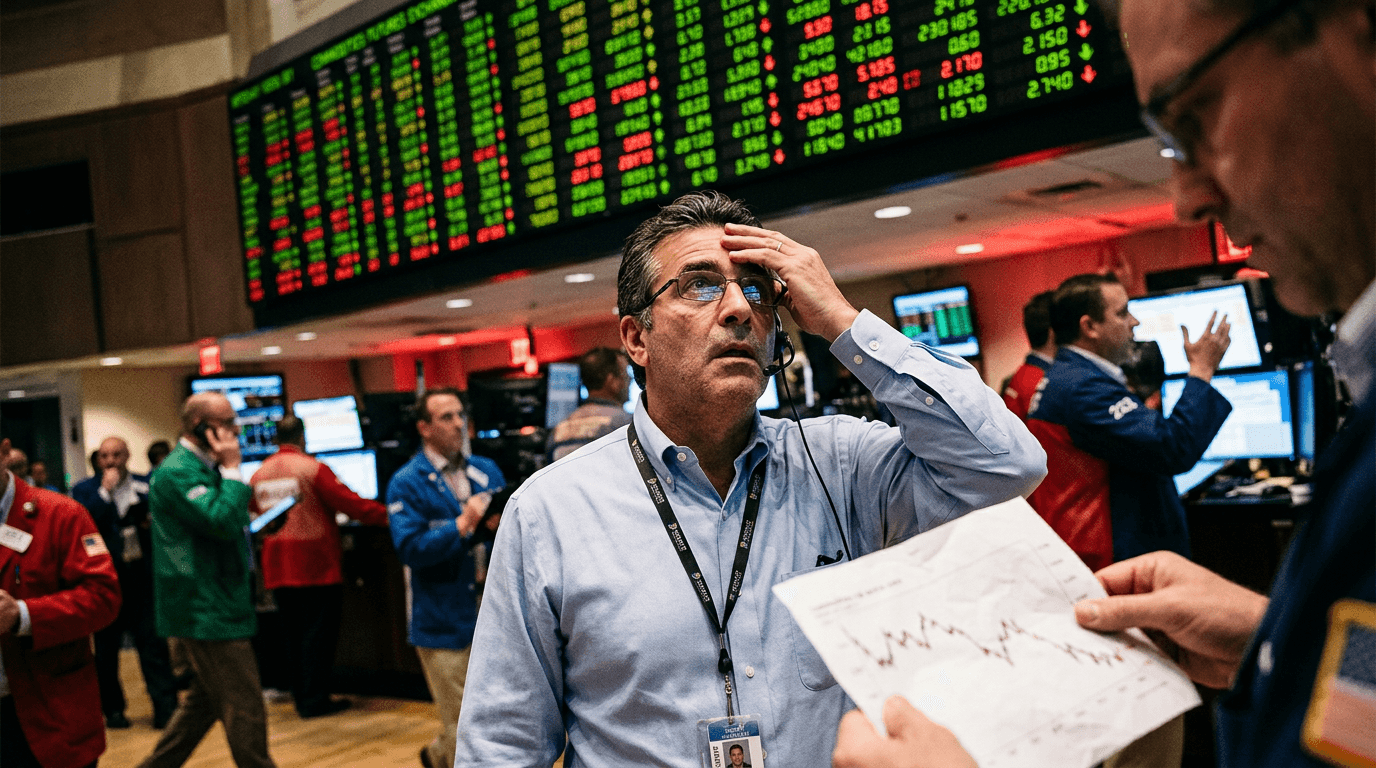
China’s decision to raise tariffs on U.S. goods to 125% marks a sharp escalation in the trade confrontation between the world’s two largest economies and has immediately fed into risk-off sentiment across global markets.[1][4] At these levels, tariffs are effectively close to prohibitive for many products, with Chinese officials themselves signaling that there is “effectively no market” for many U.S. imports under such duties.[1] For traders, this is not just a political headline; it is a macro shock that can reshape flows in FX, equities, commodities, and bond markets in the weeks ahead.
Trade War Escalation In Focus
China’s move to lift tariffs on U.S. imports from 84% to 125% comes as a direct retaliation to steep U.S. tariffs on Chinese goods that have climbed as high as 145% in recent rounds of tit-for-tat measures.[1][4][5] In practical terms, both sides have moved beyond traditional tariff ranges (10–25%) into levels that function more like trade barriers than mere taxes.
Historically, average U.S. tariffs on Chinese exports were in the low single digits before the trade war, but they have risen dramatically in recent years, with the Peterson Institute tracking average U.S. tariffs on Chinese goods above 40% at various points.[6] China’s average tariffs on U.S. exports have also climbed, though from a lower base, and now cover essentially all bilateral trade.[6]
At a 125% headline rate, many U.S. goods—from agricultural products to industrial inputs and consumer items—become uneconomical in the Chinese market unless prices are deeply discounted or supply chains are re-routed.[1] Chinese officials have suggested that further U.S. tariff increases would be “pointless,” implying that trade volumes, not rates, are now the main variable.[1] That raises the risk that the conflict shifts from a tariff skirmish into a prolonged decoupling of supply chains.
For traders, the key takeaway is that this is not a marginal tweak to trade policy. It is a regime shift toward highly restrictive bilateral trade, with second-order effects on growth expectations, corporate margins, and global capital flows.
Market Reaction: Fx, Rates, And Safe Havens
The immediate market response has been textbook risk-off, but with a twist. The escalation has pressured the U.S. dollar while boosting demand for classic safe havens such as the Japanese yen, Swiss franc, and high-grade government bonds. This reflects the fact that the shock is U.S.-centric—investors are reassessing growth and policy risks specifically tied to the U.S. and China, rather than a generalized global shock.
Higher trade barriers tend to weigh on growth and corporate investment, which can pull forward expectations of easier monetary policy. Expectations of lower U.S. policy rates, or at least a more cautious Federal Reserve, can drag down U.S. yields and the dollar simultaneously, even as safe-haven flows support Treasuries.
Key FX and rates dynamics to monitor
1) Dollar behavior versus safe havens The dollar may weaken against the yen and Swiss franc while holding steadier against higher-yielding or risk-sensitive currencies. Traders should watch whether USD/JPY and USD/CHF respond more to risk sentiment or to relative rate expectations.
2) Global yield curves Falling long-end yields in the U.S., euro area, and core Asia typically confirm a genuine risk-off move. A bull flattening of yield curves (long yields down more than short) often signals that markets are pricing weaker growth and rising odds of future easing.
3) Volatility and funding markets Rising implied volatility in FX and rates options, along with widening credit spreads, can reinforce risk-off behavior and trigger de-risking from leveraged players.
For macro and FX traders in a simulated environment, this is an opportunity to practice structuring relative value trades—such as long yen versus high-beta EM currencies—or testing scenarios where the dollar sells off even in a risk-off move because the U.S. is at the center of the shock.
EQUITIES AND COMMODITIES: WHO FEELS IT MOST?
Equities are directly in the line of fire. Higher tariffs raise input costs, reduce export competitiveness, and inject uncertainty into corporate planning. Sectors with heavy U.S.-China exposure—technology hardware, semiconductors, autos, machinery, and agriculture—are particularly sensitive.
Potential equity market implications
Export-oriented names U.S. firms deriving a meaningful share of revenue from China, and Chinese firms reliant on U.S. demand or technology, face earnings risk as volumes decline or margins compress. Equity risk premia for these companies tend to widen in prolonged trade disputes.
Supply-chain plays Companies embedded in the U.S.-China supply chain—logistics, specialized parts, contract manufacturing—can see near-term volatility as markets try to identify winners from re-shoring or diversification and losers from lost volume.
Domestic demand proxies In a deeper trade war, investors often rotate into domestically focused sectors less exposed to global trade—utilities, staples, local services—particularly in the most affected countries.
On the commodities side, trade tensions can reshape demand expectations and price dynamics:
Agriculture Historically, Chinese tariffs on U.S. agricultural products have led to significant volatility in soybeans and other key crops, as Chinese buyers seek alternative suppliers while U.S. exporters look for new markets.[1] A 125% tariff essentially forces a re-routing of flows.
Industrial metals Copper, aluminum, and other cyclicals are sensitive to growth expectations. If markets start to price a meaningful hit to global manufacturing and investment, industrial metals can face headwinds.
Energy Oil often trades more on global growth expectations than on bilateral trade measures, but a severe slowdown in trade can pressure demand forecasts and weigh on prices.
For equity and commodity traders, the practical lesson is to map tariff-sensitive sectors and cross-check them against current positioning and valuation. In a simulated setting, you can test how different asset classes respond not just on day one of the headline, but as analysts revise earnings estimates and macro forecasts over weeks and months.
What Traders Should Watch Next
Although tariff rates have surged, previous episodes show that both sides can de-escalate when economic costs mount. In 2025, after a spike to reciprocal 125% tariffs, the U.S. and China temporarily reduced duties back to around 10% following negotiations, signaling that these measures can be tactical rather than permanent.[5][7][8] The question for markets is whether this episode follows a similar pattern or marks the start of a more entrenched standoff.
Key signposts to monitor
Official rhetoric Any shift from confrontational language toward “constructive dialogue” can quickly stabilize risk sentiment, even before policies change.
Economic data Softening PMIs, trade volumes, and earnings guidance from globally exposed firms will influence how seriously markets take the growth hit.
Policy response Hints of fiscal support or monetary easing, especially from the U.S. or China, can cushion asset prices and spark powerful relief rallies.
Implications For Your Trading Approach
For discretionary and systematic traders alike, this kind of macro shock is a live-fire exercise in risk management and scenario planning.
Practical takeaways
Build a clear narrative Define your base case (e.g., prolonged tariffs vs. quick de-escalation) and alternative scenarios. Align your positions with the probabilities you assign to each, and be ready to adjust as new information arrives.
Focus on correlation shifts Trade war headlines can change cross-asset correlations. For example, the dollar may not behave like a classic safe haven if the U.S. is the epicenter of the risk. Use simulated trades to explore how your portfolio behaves when historical correlations break down.
Size and timing over direction Even if you correctly anticipate the direction of the move, poor sizing or mistiming can still lead to losses. Practicing in a SimFi environment allows you to test how quickly to scale into risk-off trades, when to take profits, and how to hedge event risk.
Separate the first move from the second The initial reaction to news like 125% tariffs is often driven by positioning and emotion. The second move—after earnings revisions, data releases, and policy responses—can be more durable. Design strategies that account for both the knee-jerk phase and the slower repricing of fundamentals.
By approaching the latest escalation in U.S.-China tariffs not just as a headline but as a complex macro event, traders can turn volatility into a learning opportunity. Whether you are trading live capital or honing your edge in a simulated environment, the core skills are the same: understand the transmission channels, map the vulnerable assets, and manage risk with discipline as the trade war story evolves.