
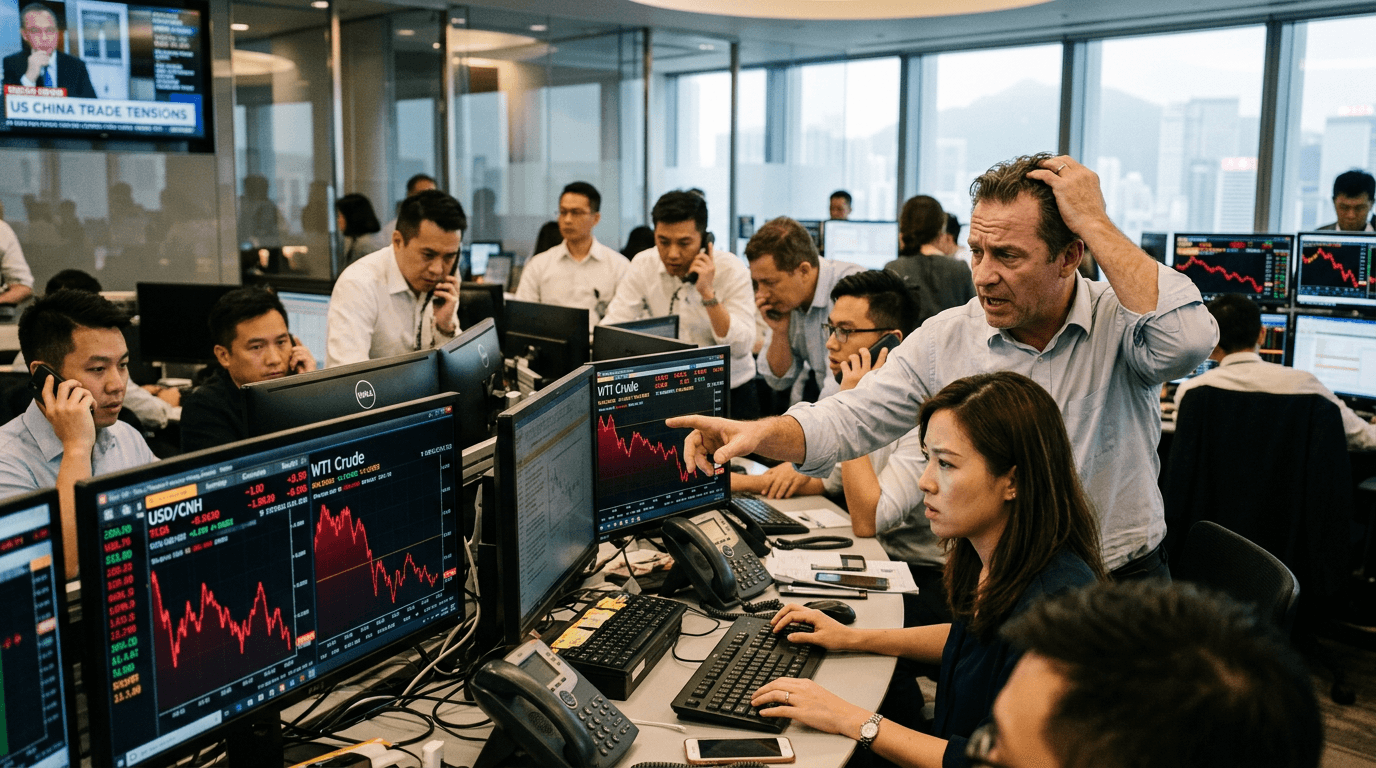
China’s latest tariff escalation on US goods has pushed trade tensions back to the forefront of market risk, sending ripples through global growth expectations and adding another layer of volatility to commodity-linked currencies and risk-sensitive FX pairs.[3] With some Chinese tariffs on US products reportedly rising as high as 125%, traders are reassessing cross‑border capital flows, supply chain resilience, and how durable the recent risk rally really is.[3][4]
GLOBAL CONTEXT: A NEW PHASE IN THE US–CHINA TARIFF CYCLE
The move by China to sharply lift tariffs on US imports is the latest step in a multi‑year tariff cycle that has periodically flared and then partially cooled, but never fully normalized.[2][3] Since the first wave of the US–China trade war, both sides have regularly adjusted duties, weaponizing tariffs to gain leverage in negotiations or to respond to perceived unfair practices.[2][3]
Public trackers of the dispute note that earlier rounds ultimately produced extremely high effective tariff rates, with the US at one point imposing tariffs totaling around 145% on some Chinese goods and China responding with tariffs of up to 125% on American products.[3][4] More recently, US tariff policy has focused heavily on strategic sectors such as electric vehicles, solar cells, batteries, and critical minerals, with some individual lines facing rates of 100%–245%.[3][4] In parallel, China has previously targeted energy, agricultural goods, and selected industrial products from the US, layering additional tariffs across categories like crude oil, LNG, coal, machinery, and agricultural commodities.[2]
The latest announcement fits this pattern of targeted escalation: by raising duties to punitive levels on specific US exports, Beijing signals a willingness to absorb short‑term economic pain to maintain negotiating leverage while discouraging further US tariff action.[2][3] Officials’ comments that they may simply “ignore” future US measures underline how entrenched both sides have become.[2]
For markets, the key message is not just the tariffs themselves, but the signal that the trade relationship remains a structural source of uncertainty rather than a resolved issue. That uncertainty is now being repriced across equities, bonds, commodities, and especially FX.
How Tariffs Feed Into Global Growth And Commodities
Tariffs act as a tax on cross‑border trade, and when rates jump into triple digits, they can render some flows uneconomic almost overnight.[2][4] For exporters, higher tariffs can mean:
- Lost market access or sharply lower margins
- Incentives to re‑route trade through third countries or adjust supply chains
- Reduced investment, hiring, and capex tied to affected sectors
For importers and consumers, the impact is higher prices, squeezed demand, and potential substitution toward domestic or third‑country suppliers.[2] Over time, these frictions can dampen global trade volumes, slowing growth and weighing on risk assets.
Commodity markets are especially sensitive to this dynamic. Past Chinese tariff hikes on US coal, LNG, and crude oil created distortions in energy trade flows, with cargoes re‑routed and price differentials widening between regions.[2] If fresh tariffs once again fall heavily on energy, agriculture, or industrial goods, traders can expect:
- Shifts in demand between US and non‑US suppliers
- Increased volatility in benchmark futures (for example, WTI vs. Brent, CBOT vs. other grain benchmarks)
- Wider and more unstable basis spreads as physical and derivative markets adjust
All of this tends to amplify uncertainty around global growth and inflation, factors that FX markets respond to quickly.
Fx Market Reaction: Where Volatility Is Likely To Show Up
The renewed tariff escalation is already contributing to choppy trading in FX, especially in currencies linked to global trade and commodities, as well as higher‑beta “risk” pairs.[2][4] A few key channels to watch:
1. Commodity‑linked FX Currencies such as AUD, NZD, CAD, and NOK are highly sensitive to shifts in global risk appetite, trade volumes, and commodity demand. When markets fear weaker world growth due to trade frictions, these currencies often trade lower against the US dollar and other safe havens, even if their domestic data remains solid.
2. Risk‑sensitive and carry pairs High‑yielders and EM FX funded by low‑yield currencies (for example, carry trades funded in JPY or CHF) can see sharp unwinds when trade headlines hit and risk sentiment deteriorates. Tariff headlines can quickly generate risk‑off episodes, triggering position reduction and driving outsized intraday moves.
3. Safe‑haven flows Periods of trade stress have historically supported the US dollar, Japanese yen, and Swiss franc as investors seek liquidity and perceived safety. However, the USD’s role is nuanced: if markets begin to price in material downside for US growth or a policy response from the Federal Reserve, the dollar can decouple from the traditional “safe haven” pattern.
4. CNY and regional Asia FX Although China manages its currency closely, heightened trade tension tends to put depreciation pressure on the yuan, which then spills over into regional currencies with tight trade links to China, such as KRW, TWD, and SGD. Traders monitor the pace of CNY moves and official guidance as a key barometer of how seriously authorities view the growth hit.
For discretionary FX traders, the message is clear: tariff risk is once again a first‑order driver of direction and volatility, not just background noise.
Trading Implications: How To Adapt Strategies To Tariff Risk
For active traders and portfolio managers, the escalation in tariffs and the associated FX volatility call for adjustments in both strategy design and risk management:
1. Re‑evaluate macro assumptions If you are running macro or trend‑following strategies, revisit assumptions about global growth, trade volumes, and policy paths. Trade friction can alter central bank trajectories by affecting inflation, growth, and financial conditions; that in turn can shift rate differentials, a core driver of FX.
2. Separate structural themes from headline noise Tariffs can trigger intense but short‑lived headline moves, followed by longer structural shifts in trade flows and investment. Traders should differentiate between: - Short‑term event trades around key announcements, and - Medium‑term positioning based on altered growth and policy outlooks.
3. Use volatility to refine execution Rising implied volatility can widen spreads and increase slippage, but it also creates more attractive entry and exit points for patient traders. Consider: - Scaling into positions rather than entering all at once - Using limit orders and time‑based execution rules to avoid the worst of headline spikes - Adjusting stop‑loss levels to account for higher intraday ranges
4. Stress‑test portfolios for trade shocks Scenario analysis is essential. Ask: - How would my portfolio perform if risk sentiment deteriorates sharply for a week on a renewed tariff cycle? - What if CNY weakens materially and drags regional FX lower? - How sensitive are my commodity‑linked positions to a drop in global trade volumes?
Simulated trading environments can be particularly useful here, allowing traders to test strategies across historical trade‑war episodes and synthetic “what if” scenarios without real capital at risk.
Risk Management And Practical Takeaways
In volatile trade environments, survival often comes down to disciplined risk management rather than forecasting precision. Some practical takeaways:
- Position sizing: Reduce gross and net exposure in pairs most directly exposed to tariff headlines, especially if liquidity is thin.
- Correlation awareness: Recognize that during trade shocks, correlations across risk assets tend to rise. Positions that looked diversified in calm markets can suddenly move together.
- News and calendar discipline: Map out key policy dates, official meetings, and potential announcement windows. Avoid concentrating risk into periods where headline surprises are most likely.
- Time horizon clarity: Decide whether you are trading the short‑term volatility around news or the longer‑term macro impact—and structure your entries, stops, and take‑profit levels accordingly.
The broader lesson from China’s latest tariff escalation is that geopolitical and trade risks remain embedded features of the current market regime. For traders, that means building strategies and risk frameworks that can withstand sudden shocks, adapt to shifting policy landscapes, and exploit volatility when it appears, rather than being surprised by it.