
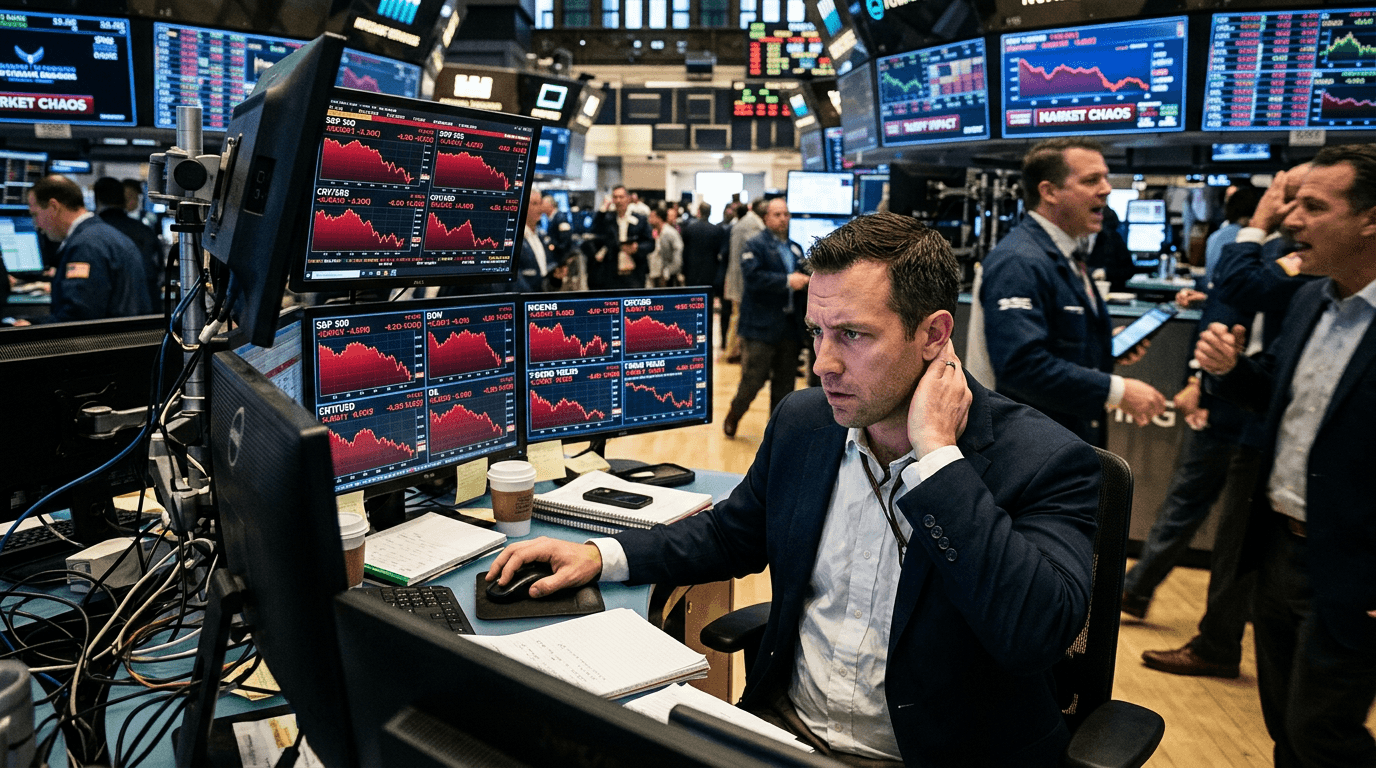
China’s decision to raise tariffs on U.S. goods to as much as 125% marks a sharp escalation in an already fraught trade relationship, signalling that Beijing is prepared to absorb near-term pain to gain leverage in negotiations.[1][7][8] Officials have coupled the move with warnings that any further U.S. measures will be met by ignoring Washington and letting the United States “bear responsibility” for economic fallout, reinforcing a more confrontational tone.[8][11] For traders, this is not just political theatre—it reshapes global risk sentiment across equities, commodities, FX, and index futures.
GLOBAL CONTEXT: ESCALATING TARIFFS BETWEEN THE WORLD’S LARGEST ECONOMIES
China’s latest announcement lifts its levies on a range of U.S. imports from around 84% to 125%, matching and countering a series of U.S. tariff hikes that have pushed effective duties on Chinese goods well above 100%.[1][4][7] With both sides imposing triple-digit tariff rates on key categories, traditional trade flows between the two largest economies risk becoming economically unviable.[8][11][9] This is the clearest sign yet that the post‑2025 “truce” was a pause, not a resolution, and that structural tensions over technology, security, and supply chains continue to drive policy decisions.[6][10][13]
The messaging accompanying the tariffs is just as important as the numbers. By stating that U.S. exports are becoming “no longer marketable” at these levels and vowing to disregard additional U.S. hikes, Beijing is positioning this step as both a deterrent and a signal of policy resolve.[8][11] Markets tend to react not only to the economic impact of tariffs but also to the perceived collapse in communication channels, which increases uncertainty premiums and volatility.
WHAT 125% TARIFFS MEAN IN PRACTICE
Tariffs at 125% effectively more than double the landed cost of U.S. goods entering China, making many products uneconomic for Chinese buyers unless prices are deeply discounted or supply is critical.[1][7][8] Sectors likely to feel the brunt include industrial machinery, autos and parts, select agricultural products, and energy-related exports that had previously benefited from tariff relief or exemptions.[7][9][12] For U.S. firms with significant China exposure, this translates into margin compression, potential loss of market share to non‑U.S. competitors, and pressure to reroute supply chains.
On the U.S. side, higher reciprocal tariffs on Chinese imports—now widely above 100% in aggregate for targeted categories—continue to raise costs for downstream manufacturers and consumers.[4][9][12] This may support some domestic producers in the short term but risks eroding competitiveness and complicating inflation dynamics. In practical terms, traders should treat 125% tariffs as a regime change rather than a temporary headline: even if rates are adjusted later, the precedent of extreme protectionism has been set.
Market Reaction: Risk Sentiment, Commodities, And Fx
Historically, major tariff escalations between the U.S. and China have led to risk‑off moves in global equity markets, wider credit spreads, and bouts of elevated volatility as investors reassess growth and earnings assumptions.[7][10][11] Indices with heavy exposure to trade‑sensitive sectors—industrial cyclicals, semiconductors, autos, and global logistics—tend to underperform as revenue forecasts are marked down and supply chain risks are repriced.[6][9][10]
Commodity markets are also in the crosshairs. Higher tariffs on U.S. agricultural products can redirect Chinese demand toward alternative suppliers, impacting prices for soybeans, corn, and other key crops.[7][9] Energy flows may see similar substitution effects if tariff‑burdened U.S. exports lose share to Middle Eastern or regional producers, influencing spread relationships in crude and refined products.[9][12] In FX, episodes of trade tension have historically weighed on pro‑cyclical, trade‑linked currencies while supporting safe‑haven flows into the dollar and yen, although the net dollar effect can be more nuanced when U.S. policy is the shock source.[6][10]
For traders in SimFi environments, these moves offer a live case study in cross‑asset contagion: a seemingly “single-issue” tariff headline can ripple across equity sectors, commodities, and currency pairs in a matter of hours.
Implications For Index Futures And Simulated Finance Traders
Index futures tied to U.S. benchmarks with heavy China exposure—such as those with large weights in global industrials, tech hardware, and consumer brands reliant on Chinese demand—are particularly sensitive to renewed trade frictions.[6][10] Earnings revisions for these companies often lag the policy announcements, creating a window where sentiment leads fundamentals, and futures markets can overshoot in both directions.
Simulated finance platforms like E8 Markets give traders a controlled environment to stress‑test these dynamics before committing real capital. By building scenarios around different tariff paths—such as “tariffs stay at 125%,” “partial rollback,” or “full escalation with broader tech sanctions”—traders can observe how index futures, sector rotation strategies, and volatility hedges behave in each regime. Using simulated portfolios, it becomes possible to map which industries are most vulnerable and which exhibit defensive characteristics when trade risk intensifies.
Key takeaway: trade headlines can drive multi‑day trends in index futures, but the most durable opportunities often lie in understanding sector dispersion and relative performance rather than trying to predict the next political statement.
How Traders Can Navigate Heightened Trade Risk
When trade tensions spike, disciplined process matters more than quick reactions. A pragmatic framework for traders includes:
1. Identify direct and indirect exposure Direct exposure covers companies whose revenue or cost structure depends heavily on U.S.–China trade; indirect exposure includes suppliers, logistics firms, and financials funding cross‑border activity. Mapping this ecosystem helps in building more focused long/short or spread strategies.
2. Watch volatility and correlation shifts Trade shocks often push correlations higher across risk assets, reducing the benefit of simple diversification. Monitoring implied volatility in equity index options and futures can guide position sizing and hedge selection.
3. Use scenarios, not single-point forecasts Rather than betting on a specific policy outcome, construct a range of plausible scenarios and test how portfolios respond within a SimFi environment. This reduces dependence on political timing and emphasizes robustness.
4. Prioritize risk management Set clear rules for maximum drawdowns, use stop‑losses thoughtfully, and consider asymmetric trades—such as options or spread trades—that cap downside while retaining upside participation.
Conclusion: Turning Policy Shocks Into Learning Opportunities
China’s move to hike tariffs on U.S. goods up to 125% is a reminder that the U.S.–China economic relationship remains a central source of global market risk, not a resolved chapter in history.[1][7][11] For traders, the challenge is less about predicting every twist in the trade narrative and more about understanding how such shocks propagate across indices, commodities, FX, and volatility. Simulated finance provides a valuable proving ground to convert headline risk into structured strategies, helping traders refine decision‑making before it is tested in live markets. In an era of recurring policy surprises, those who systematically study these episodes will be best positioned to navigate the next wave of trade headlines—whatever shape they take.