
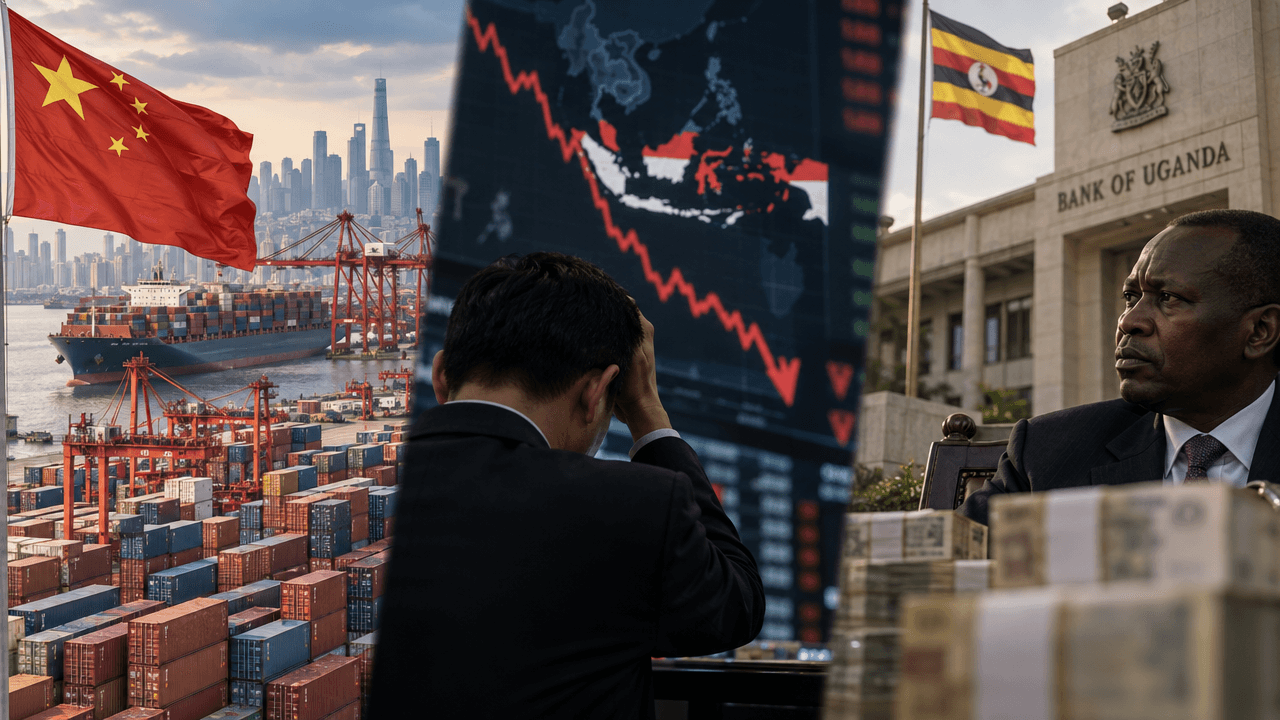
China’s export machine is accelerating just as financial stress is spreading across emerging markets. September exports jumped 36.3% from a year earlier, the fastest growth since February, while the country’s trade surplus reached $133.5 billion for the month. With the cumulative surplus approaching $940 billion through the first nine months, China is on course to exceed the previous annual record of roughly $1.2 trillion. [8]
The contrast is striking. China is benefiting from strong overseas demand, particularly for electronics, semiconductors, and automobiles. Meanwhile, Indonesia has suffered its worst stock-market rout since 1998 after MSCI questioned whether the country still qualifies as an emerging market. Uganda has taken the more traditional defensive route, delivering an emergency interest-rate increase to support its currency. Together, these events show how uneven the global market environment has become.
CHINA’S EXPORT SURGE AND THE GLOBAL IMBALANCE
China’s September export growth was not merely a modest improvement. Shipments rose to approximately $447.2 billion, compared with 25% growth in August. The increase was supported by demand for technology-related products and vehicles, with the global artificial-intelligence investment cycle helping sustain orders for electronics and semiconductors. [5][12]
The result is a trade surplus that is expanding faster than many policymakers in other economies would prefer. September’s surplus widened from $119.1 billion in August, while the January-to-September total reached $938.1 billion. If the current pace continues, China could surpass its 2025 full-year record before the end of the year. [8]
For markets, this has several implications. Strong exports can support Chinese industrial profits, manufacturing activity, and foreign-exchange earnings. They may also reduce pressure on policymakers to provide aggressive stimulus to the export sector.
However, an exceptionally large surplus can create diplomatic and economic friction. Trading partners may respond with tariffs, anti-dumping measures, investment restrictions, or demands for greater domestic consumption in China. Investors should therefore distinguish between short-term export strength and the longer-term sustainability of China’s external growth model.
Why Emerging-market Stress Is Intensifying
Indonesia illustrates how quickly investor confidence can deteriorate when market-access concerns appear. The Jakarta Composite Index fell 11.57% in one session, its largest daily decline since January 1998. The selloff followed MSCI’s warning that Indonesia’s continued classification as an emerging market was no longer appropriate. [3]
MSCI cited concerns involving market transparency, ownership structures, suspected coordinated trading, and broader market dysfunction. It has begun a consultation on potentially reclassifying Indonesia as a standalone market rather than an emerging or frontier market. A final decision is expected after the consultation process, with investors watching for evidence of improvements in governance and market functioning. [1][3]
The significance extends beyond a single trading session. Many investment funds use MSCI benchmarks to determine country allocations. A downgrade could force benchmark-tracking funds to reduce or eliminate Indonesian holdings, while active managers may also reassess the cost and reliability of participating in the market.
That creates a feedback loop: concerns about liquidity can trigger selling, heavy selling can worsen liquidity, and falling prices can increase doubts about the market’s investability. For traders, the episode is a reminder that index classification is not a technical footnote. It can directly influence capital flows, volatility, and currency sentiment.
UGANDA’S CURRENCY DEFENSE
Uganda’s response demonstrates a different form of emerging-market pressure. After the shilling fell to a record low, the central bank held an emergency meeting and raised its benchmark interest rate by the largest amount in 15 years. The move was designed to defend the currency and discourage further capital outflows. [13]
The initial market reaction was powerful. The shilling gained as much as 4% against the dollar, moving below the psychologically important 4,000 level for the first time in eight trading sessions. [13]
Emergency rate hikes can stabilize a currency by improving the return on local assets and signaling that policymakers are prepared to act. But they also impose costs. Higher rates increase borrowing expenses for households and businesses, potentially slowing economic growth and weakening equity valuations.
This is the policy dilemma facing many emerging economies: allowing a currency to weaken can increase imported inflation, while defending it through higher rates can damage domestic demand. The appropriate response depends on the country’s reserves, inflation outlook, debt structure, and credibility with investors.
What Traders Should Watch Next
The most important question is whether China’s export strength remains broad-based. Traders should monitor future export data, import growth, manufacturing surveys, shipping volumes, and evidence of new trade restrictions. If exports continue to surge while imports remain comparatively weak, pressure on China’s trading relationships is likely to increase.
In Indonesia, watch for clarification from MSCI, regulatory reforms, foreign fund flows, and the behavior of the rupiah. A technical rebound in stocks would not necessarily mean that the underlying governance concerns have disappeared. Volatility may remain elevated while investors assess the probability and timing of reclassification.
For Uganda and other vulnerable markets, interest-rate decisions should be read alongside foreign-exchange reserves and inflation data. A rate hike can produce an immediate currency rally, but maintaining that strength may require continued policy support.
The broader lesson is that emerging markets are not a single trade. China is demonstrating export resilience, Indonesia is facing a market-structure shock, and Uganda is using monetary policy to defend financial stability. Investors who treat all emerging-market assets as interchangeable risk overlooking major differences in liquidity, governance, external balances, and policy credibility.
Conclusion
The latest data presents a divided global picture: China’s exporters are gaining momentum, while several emerging markets are confronting capital-flow, currency, and governance pressures. That divergence is likely to remain a major source of opportunity and risk.
For SimFi traders, the practical takeaway is to track catalysts rather than rely on broad regional labels. Export data can move currencies and commodities; index decisions can trigger forced equity flows; and emergency rate changes can reshape bond and foreign-exchange markets in minutes. A disciplined trader should define risk before entering, avoid assuming that a sharp selloff must immediately reverse, and watch how policy announcements translate into actual market liquidity.