
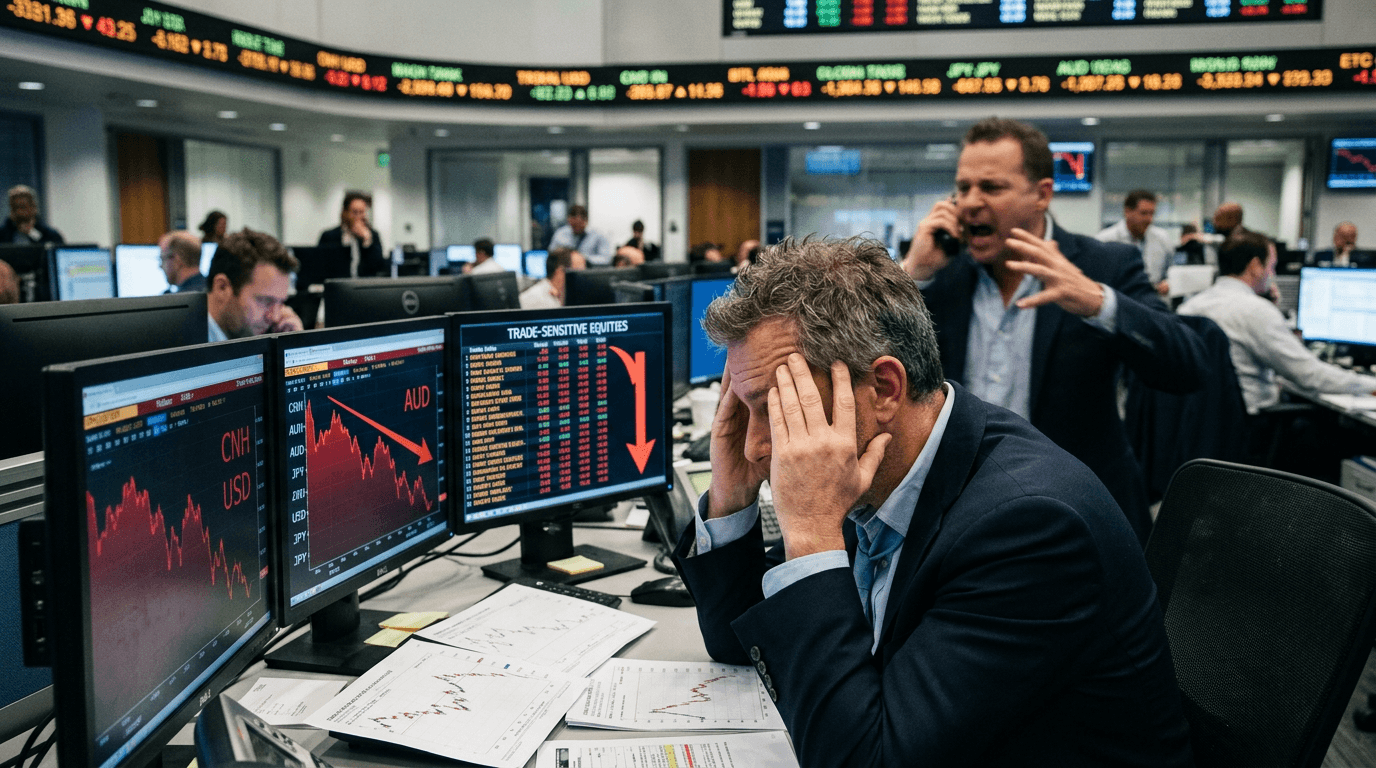
China’s decision to slap steep additional tariffs on US goods, reportedly as high as 125%, has jolted markets back into a trade-war mindset, with knock-on volatility in key FX pairs and risk assets. The new levies land on top of an already elevated tariff regime between the world’s two largest economies, reigniting concerns about global growth, supply chains, and the outlook for trade‑sensitive equities.[1][2][4]
WHAT CHINA’S NEW TARIFFS MEAN
Tariffs are essentially a tax on imports, and raising them to triple‑digit levels transforms many targeted products from commercially viable into effectively shut out of the market. Chinese officials have indicated that at current tariff levels, many US exports have “no viable market” in China, and warned they may simply stop responding if Washington continues to ratchet up duties, calling repeated US hikes a “numbers game” and a potential “joke in the history of the world economy.”[1]
This latest move fits into a broader pattern of tit‑for‑tat measures since the US–China trade conflict first escalated in 2018. Back then, China retaliated with supplemental tariffs of 5% to 25% on around US$60 billion of US imports.[3] More recently, in 2025, China imposed tariffs of 15% and 10% on certain US agricultural goods and later a 34% tariff on all US goods to match a US reciprocal tariff.[2] The new measures lifting some rates as high as 125% are a clear escalation in both size and rhetoric.[1][2]
On the US side, tariff pressure has also intensified. Various actions in recent years have pushed average US tariffs on Chinese exports to about 47.5%, covering essentially all Chinese goods, more than 15 times higher than pre‑trade‑war levels.[4] Specific sectors such as electric vehicles, semiconductors, steel, and solar cells have faced increases into the 50–100% range as Washington targets areas seen as strategically important.[2] Against this backdrop, China’s latest announcement looks less like an isolated move and more like another turn of the screw in a long‑running economic confrontation.
WHY MARKETS REACTED – FROM CNH TO SAFE HAVENS
Currency markets tend to react quickly to any sign that trade tensions could worsen. The offshore renminbi (CNH) is particularly sensitive to US–China news because tariffs directly impact China’s export outlook and growth expectations. Fresh tariff headlines often translate into CNH weakness as traders price in potential pressure on Chinese earnings, investment, and capital flows.
The fallout does not stop at CNH. The Australian dollar (AUD) frequently trades as a liquid proxy for China risk, given Australia’s deep commodity and export ties with the Chinese economy. When markets fear a slowdown in Chinese demand, AUD often sells off as investors anticipate weaker commodity exports and softer regional growth. Meanwhile, the Japanese yen (JPY) tends to benefit from “risk‑off” episodes, as investors unwind carry trades and seek perceived safe havens. The combination of CNH pressure, AUD softness, and JPY strength is a classic signature of rising trade anxiety.
Beyond FX, safe‑haven flows can also support US Treasuries and weigh on global equity indices, especially trade‑sensitive futures such as those tied to industrials, semiconductors, autos, and global logistics. Higher tariffs raise input costs, disrupt supply chains, and depress corporate margins, which in turn can dampen equity valuations and spur volatility.
TRADE WAR 2.0? LESSONS FROM PAST TARIFF ESCALATIONS
To understand the risk, it helps to look at how quickly past tariff cycles escalated. During earlier phases of the dispute, relatively modest moves—such as China’s 5–25% tariffs on US$60 billion of US goods—were soon followed by broader and higher-rate measures from both sides.[2][3] In 2025, after the US introduced a “fentanyl” tariff on all Chinese goods and then a reciprocal tariff of 34%, Beijing responded with its own increases, including a blanket 34% tariff on US goods.[2]
In some instances, the US later raised reciprocal tariff rates as high as 125%, bringing the combined tariff burden on certain Chinese imports to 145%.[2] This pattern shows how quickly “temporary” or “targeted” tariffs can morph into a comprehensive and deeply entrenched trade barrier regime. The Peterson Institute has documented that average US tariffs on Chinese exports rose by 26.8 percentage points during the second Trump administration alone, pushing them to 47.5% and cementing a structural change in the trading relationship.[4]
Historically, these episodes have weighed on global trade volumes, dampened business investment, and added a layer of uncertainty that firms struggle to hedge. Manufacturers with cross‑border supply chains face higher costs and planning complexity, while export‑oriented economies—particularly in Asia and commodity exporters like Australia—become more vulnerable to sentiment swings. Equity and FX markets tend to oscillate between relief rallies on any hint of de‑escalation and sharp sell‑offs whenever new measures are announced.
What This Means For Fx And Equity Traders
For traders, the key takeaway is that tariff shocks are not just about the immediate economic impact of a tax on goods—they are catalysts for broader regime shifts in risk sentiment.
In FX, the typical pattern in a fresh trade‑war scare looks like this: CNH weakens, AUD and other China‑sensitive currencies come under pressure, JPY and other safe havens strengthen, and the US dollar can benefit from safe‑haven demand against high‑beta and EM currencies. Volatility tends to spike in pairs such as USD/CNH, AUD/USD, and USD/JPY as traders rapidly reprice risk.
In equity futures, sectors and indices with high exposure to global trade and capex—industrial-heavy indices, Asian equity benchmarks, semiconductor and auto futures—are often hit first. Multiples can compress as investors reassess earnings under higher cost and slower‑growth scenarios. At the same time, defensive sectors and low‑beta indices may outperform on a relative basis.
For traders operating in a Simulated Finance (SimFi) environment as well as live markets, tariff headlines are invaluable stress‑test scenarios. They allow you to see how your strategies behave when correlations change abruptly—when, for example, AUD decouples from traditional drivers and trades almost purely on China risk, or when JPY’s safe‑haven role dominates its yield disadvantage.
How Traders Can Navigate Heightened Trade Risk
A practical way to approach this environment is to build a simple trade‑war playbook around three scenarios:
1) Contained tensions: Tariffs rise but dialogue continues. FX volatility is elevated but manageable, and ranges can be traded with clear technical levels.
2) Escalation spiral: Both sides respond with ever‑higher tariffs, rhetoric hardens, and markets price in weaker global growth. Trend‑following strategies in CNH, AUD, and JPY pairs, alongside cautious positioning in trade‑sensitive equities, may dominate.
3) Surprise de‑escalation: Announcements of talks, exemptions, or partial rollbacks trigger relief rallies, short squeezes in risk assets, and reversals in safe‑haven flows.
Regardless of the scenario, risk management is central. Consider reducing leverage ahead of high‑risk announcement windows, widening stop‑losses to reflect higher volatility rather than ignoring risk altogether, and diversifying across instruments so a single shock does not dominate your P&L. Monitoring cross‑asset signals—FX, rates, credit spreads, and equity futures together—can help confirm whether the market is genuinely shifting into or out of a trade‑war regime.
Using a simulated environment to rehearse these scenarios can be particularly valuable. You can test how your strategy handles gap risk on headline shocks, how quickly you adapt position sizing to volatility changes, and whether your correlation assumptions still hold when policy risk becomes the dominant driver.
Ultimately, China’s latest tariff announcement is a reminder that geopolitics and trade policy remain central macro drivers, not background noise. For traders across FX and equity markets, the challenge is to turn headline risk from a source of surprise into a set of well‑rehearsed scenarios—so that when the next round of tariffs hits, your trading plan is already one step ahead.