
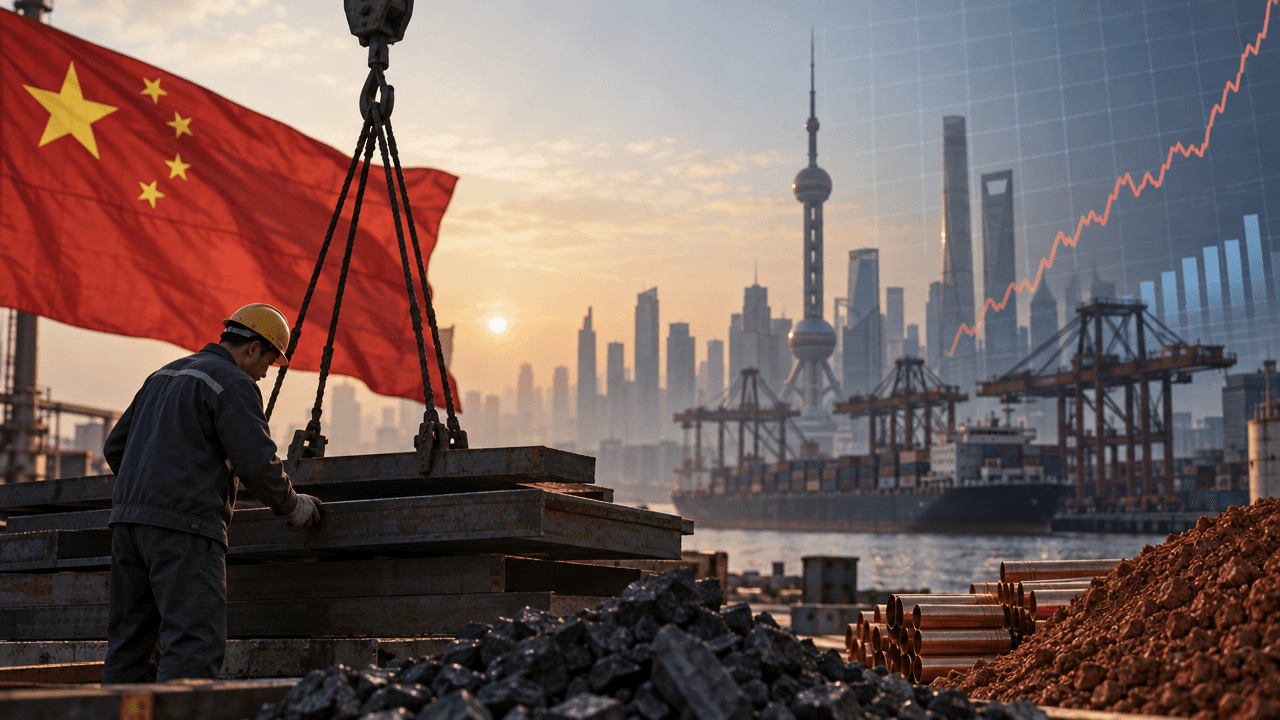
China’s producer inflation accelerated sharply in October, highlighting a growing split between rising industrial costs and subdued household demand. The producer price index, or PPI, increased 5.7% from a year earlier, up from September’s 5.0% gain and above the 5.3% consensus forecast. It was the strongest annual increase since June 2022 and marked the eighth consecutive month of producer-price growth. [1]
For markets, the report is important because factory-gate prices sit at the intersection of energy, commodities, manufacturing margins, monetary policy and regional risk sentiment. The headline suggests stronger pricing pressure across China’s industrial economy, but the accompanying weakness in consumer inflation means policymakers face a complicated balance: containing cost pressures without undermining already fragile domestic demand.
What The Data Shows
The October PPI increase was broad enough to attract immediate attention, but energy prices appear to have been a major driver. Higher global oil prices raised costs for mining, raw materials and manufacturing companies, pushing upstream prices higher. On a monthly basis, China’s producer prices rose 0.7% in October, although that was slower than the 1.2% increase recorded in September. [3]
The annual acceleration is significant because it extends a clear trend. China’s factory-gate inflation has risen for eight straight months, with the October reading representing the third consecutive monthly increase in the pace of annual growth. Mining and raw-material industries recorded particularly sharp price increases, according to market reports. [6]
At the same time, consumer inflation moved in the opposite direction. China’s consumer price index rose 0.7% year over year in October, down from 0.9% in September, while core inflation eased to 0.8% from 1.0%. [4] This combination indicates that manufacturers are paying more for key inputs even as consumers remain cautious about spending.
Why The Ppi-cpi Gap Matters
A rising PPI does not automatically mean that China’s economy is overheating. Producer prices measure what businesses receive for goods at the factory gate, while consumer prices measure what households pay for goods and services. When PPI accelerates but CPI remains weak, companies may struggle to pass higher costs on to customers.
That pressure can affect corporate profitability in several ways. Commodity producers and upstream industrial companies may benefit from higher selling prices, particularly when demand for energy and raw materials remains firm. Downstream manufacturers, retailers and consumer-facing companies may face narrower margins if their input costs rise faster than their ability to raise prices.
The divergence also provides an important signal about the quality of economic growth. Strong producer inflation alongside soft core consumer inflation can point to an economy where industrial activity, exports or infrastructure-related demand are stronger than household consumption. It may also reflect supply constraints or imported inflation rather than broad-based domestic pricing power.
For investors, the key question is whether higher factory-gate prices eventually feed into consumer prices. If they do, China’s inflation picture could become more balanced. If they do not, the PPI surge may remain concentrated in upstream industries and continue to expose weakness in domestic demand.
Policy Implications
The data complicates expectations for Chinese economic policy. Weak consumer inflation generally creates room for additional support, because subdued household demand suggests that the economy is not experiencing broad consumer overheating. However, accelerating producer inflation may make policymakers more cautious about measures that could intensify commodity demand or add to cost pressures.
The policy response will likely depend on the source and persistence of the inflation. If the increase is mainly driven by oil and other internationally traded commodities, officials may view it as an external shock rather than a sign of excessive domestic demand. In that case, targeted support for households, employment and private investment could remain preferable to broad stimulus.
If producer inflation continues spreading across industrial categories, policymakers may need to monitor second-round effects more closely. These include higher transportation costs, increased prices for manufactured goods and pressure on businesses to lift wages or reduce production. A temporary energy-driven increase is easier to absorb than a sustained cycle in which costs and selling prices reinforce each other.
Market Impact: Commodities, Equities And Currency
Industrial commodities are among the most direct market beneficiaries of stronger Chinese producer inflation, although the relationship is not automatic. Higher PPI can signal healthier demand for metals, energy and intermediate goods. Oil, copper, iron ore and other materials may receive support if traders interpret the data as evidence of stronger factory activity.
The risk is that higher input prices eventually damage demand. If manufacturers respond by cutting output or delaying investment, the initial commodity boost could fade. Traders should therefore compare PPI with industrial production, fixed-asset investment, exports and property-related indicators rather than treating the inflation figure in isolation.
Asia-Pacific equity futures may react in opposing directions. Commodity producers and selected industrial companies could benefit from higher selling prices, while manufacturers dependent on imported energy or raw materials may face margin pressure. Consumer stocks may remain sensitive to the weak CPI and core-inflation readings, which suggest that households are not yet responding with broad-based spending strength.
Currency markets may also focus on the policy dilemma. Expectations of continued economic support can weigh on the yuan, while stronger export pricing or firmer industrial activity may provide some offset. The broader effect will depend on whether markets interpret the report as a temporary commodity shock or the beginning of a more durable reflation cycle.
Practical Takeaways For Simfi Traders
First, separate annual and monthly data. The 5.7% annual PPI gain is striking, but the monthly increase slowed to 0.7%. That distinction can help traders avoid assuming that momentum is accelerating in every timeframe.
Second, monitor the PPI-CPI spread. A widening gap can favor upstream producers while creating risks for downstream companies. A narrowing gap would provide stronger evidence that inflation is becoming more widespread.
Third, watch energy markets and Chinese industrial demand together. If oil prices remain elevated while manufacturing and exports hold up, producer inflation may stay firm. If energy prices retreat or factory demand weakens, the PPI increase could lose momentum.
Finally, manage event risk. Economic releases can create sharp moves in index futures, commodities and currency pairs even when the longer-term trend remains uncertain. In a SimFi environment, traders can use smaller position sizes, predefined stop levels and scenario-based planning to test how different markets respond to the same data.
China’s October PPI report is best understood as a warning about industrial cost pressure, not proof of a broad consumer-led inflation rebound. Factory-gate prices are rising at their fastest pace in more than four years, but weak consumer inflation shows that households and downstream businesses may not yet have the power to absorb those costs. [8]
The next market signal will come from persistence. If producer inflation remains elevated and begins lifting consumer prices, expectations for Chinese policy and regional markets could shift materially. If the PPI surge remains concentrated in energy and upstream materials, its effects may be more selective—supportive for some commodities and producers, but challenging for manufacturers and consumers.