
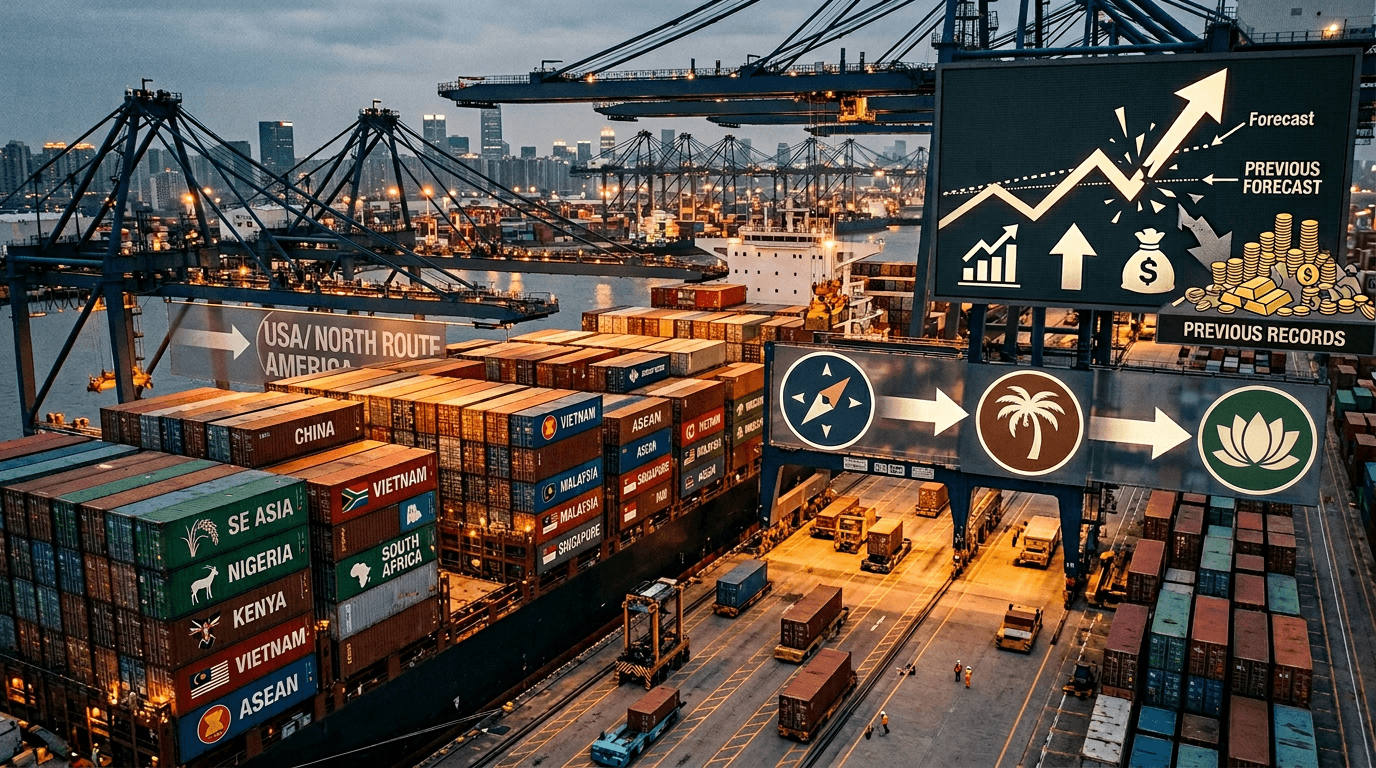
China's record-breaking trade performance in the opening months of 2026 is reshaping expectations about the world's second-largest economy and challenging conventional wisdom about the impact of tariffs and trade tensions. With exports surging nearly 22 percent year-on-year in January and February—far exceeding economist forecasts of 7.2 percent—China has demonstrated remarkable resilience despite facing a contentious trade environment.[3] The resulting trade surplus of approximately $214 billion represents an all-time high for this two-month period, underscoring Beijing's continued dominance in global commerce and raising important questions about the trajectory of international trade dynamics in 2026.[3]
What Drove The Explosive Growth
The acceleration in Chinese exports during early 2026 reveals a fundamental shift in how China's trade machine operates in response to external pressures. While the headline growth rate of nearly 22 percent is impressive on its surface, the underlying story is more nuanced. Imports also surged, rising approximately 20 percent year-on-year, indicating that China's economy is experiencing broader momentum rather than exports alone driving the numbers.[3] This synchronized growth in both trade flows suggests domestic demand may be strengthening, even as persistent concerns about China's property sector and consumer confidence continue to weigh on economic sentiment.
The export surge was heavily concentrated in technology and manufactured goods—categories that have increasingly become central to China's strategic positioning in global supply chains. Strong demand for computer chips, electronic devices, and the materials required to manufacture them sustained momentum throughout the period.[2] Additionally, Chinese automakers continued their aggressive expansion into international markets, contributing meaningfully to the overall export growth figures.
Geographic Reorientation Accelerates
Perhaps the most telling aspect of China's January-February performance is the stark geographic divergence in trade flows. While exports to the United States declined 11 percent during this period, shipments to the rest of the world surged.[3] This represents a calculated pivot away from American markets toward regions offering greater opportunity and fewer trade barriers—a pattern that has become increasingly pronounced since elevated tariffs returned to center stage in 2025.
Africa emerged as the standout performer, with Chinese exports surging nearly 50 percent, the fastest increase globally.[3] This exceptional growth reflects China's long-term strategic investments in African infrastructure, manufacturing, and resource extraction, now paying dividends through expanded bilateral trade. Southeast Asian nations in ASEAN followed closely, recording export growth exceeding 29 percent.[3] The European Union, often seen as a more contested market for Chinese goods, still absorbed increased shipments, with exports climbing nearly 28 percent.[3]
This geographic diversification is not accidental. Chinese exporters, facing significant headwinds in their largest developed market, have deliberately repositioned inventory and sales efforts toward emerging markets and developing economies where Chinese products face less competition and stronger demand. The strategy appears to be working remarkably well, more than compensating for lost American business.
What The Data Reveals About China's Economy
The strength of these trade figures offers mixed signals about China's underlying economic health. On one hand, the ability to expand exports at such a rapid pace while simultaneously increasing imports suggests resilience and operational efficiency. On the other hand, it reflects persistent imbalances within China's economy—the recurring challenge that has defined recent years.[1] Weak domestic consumption relative to production capacity continues to push Chinese manufacturers toward export markets, creating surpluses that attract scrutiny from trading partners worldwide.[1] The property sector downturn, triggered by government crackdowns on excessive borrowing, continues to suppress consumer confidence and dampen domestic demand.[2]
Policymakers in Beijing have attempted to address weak consumption through targeted stimulus measures, including government trade-in subsidies encouraging purchases of new appliances and vehicles.[2] However, these efforts have produced only modest results so far, with economists noting that policy boosts appear weaker than in prior years.[2]
Market Implications And Forward Outlook
The strength of China's early-2026 trade data carries significant implications for financial markets and economic policy across Asia. Strong export momentum reduces the immediate pressure on Chinese policymakers to implement aggressive stimulus measures, which in turn affects expectations for interest rates and monetary accommodation. This dynamic has rippled through regional equity markets, with Asian indices like South Korea's KOSPI and Japan's Nikkei responding positively to data suggesting China may not need to inject additional economic support.[1]
Looking forward, economists remain cautiously optimistic about China's export trajectory, though growth is expected to moderate from these exceptional January-February levels. Forecasts suggest exports will grow approximately 3 percent in 2026, down from the 5.5 percent achieved in 2025.[2] Nevertheless, most analysts expect the trade surplus to remain above the $1 trillion annual threshold, maintaining China's position as a historic outlier in global commerce.[2]
As trade tensions persist and geopolitical risks continue to simmer, China's ability to sustain robust export growth while reorienting trade flows toward new markets will be critical. The January-February data suggests this adaptation is not merely possible—it is already well underway.