
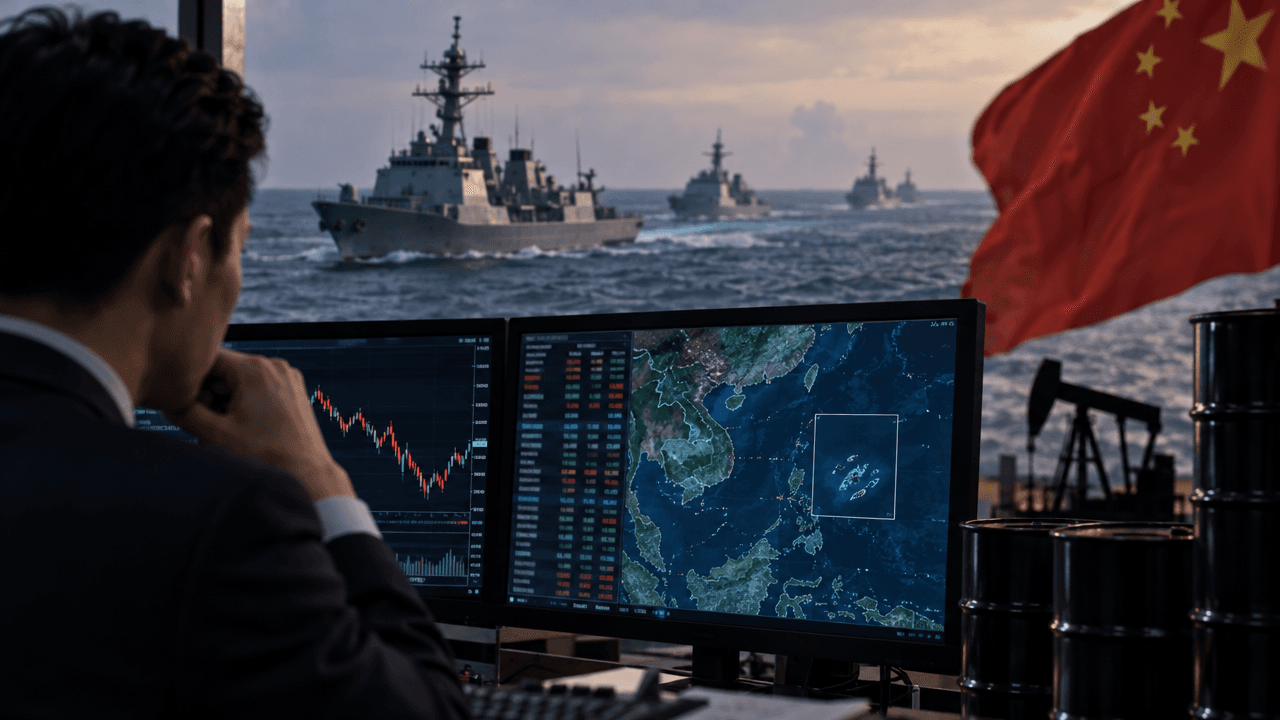
China’s latest joint naval and air exercises around Scarborough Shoal add another layer of tension to one of Asia’s most contested maritime flashpoints, just as global markets weigh the balance between geopolitical risk and macro fundamentals.[1][5][11] For traders and investors, the move is less about immediate price swings and more about how risk premia across Asian FX, regional equities, energy, and safe-haven assets could recalibrate as markets reopen.
Background: Why Scarborough Shoal Matters
Scarborough Shoal, a small reef in the South China Sea claimed by both China and the Philippines, has been a recurring focal point in regional maritime disputes since at least the 2012 standoff that saw Chinese vessels effectively gain control of the area.[4][9][10] China refers to the shoal as Huangyan Dao, while in the Philippines it is known as Panatag Shoal or Bajo de Masinloc, underscoring competing sovereignty narratives.[3][6][12] The area is strategically important not only for fishing rights but also for its location near key shipping routes and potential energy reserves, making any military activity there highly sensitive.[4][9][15]
In the latest development, China’s Southern Theater Command reports that it has conducted joint naval and air training exercises in the waters and airspace around the shoal, involving vessels and combat aircraft.[1][5][11] Official statements frame the drills as necessary actions to “test and enhance combat capabilities” and safeguard territorial sovereignty and maritime rights, language consistent with previous patrols and combat-readiness exercises in the area.[6][8][14] These drills follow a pattern of increased Chinese military and coast guard activity near the shoal, often in response to perceived provocations or increased presence by Philippine and U.S. forces.[7][10][13]
Geopolitical Risk Premiums And Asian Currencies
Geopolitical risk premia refer to the extra compensation investors demand to hold assets exposed to political or security uncertainty, typically expressed through wider credit spreads, weaker currencies, or higher implied volatility. In Asia, South China Sea flashpoints like Scarborough Shoal can influence sentiment toward currencies such as the Philippine peso (PHP), Chinese yuan (CNY), and other regional units, even when fundamentals remain intact.
Episodes of heightened tension near disputed maritime areas have historically led to short-lived bouts of risk aversion, with regional currencies sometimes weakening against the U.S. dollar or the Japanese yen as investors reduce exposure to perceived hot spots. While the latest drills have been described by Chinese authorities as routine training to test combat readiness and joint air-sea coordination, markets often interpret such announcements as signaling a willingness to escalate or at least sustain pressure.[1][3][14] The lack of an immediate confirmed price reaction in early reporting suggests that investors may still be prioritizing macro drivers—like inflation paths and central bank policy—over event risk, but the headline will sit in the background of risk models and trading decisions in the near term.
For FX traders, the key watchpoints will be:
- Any sharp move in PHP or other ASEAN currencies versus USD or JPY on reopening, especially if local headlines amplify the risk narrative.
- Changes in implied volatility for regional FX options, as dealers and asset managers adjust hedging around South China Sea headlines.
- Potential safe-haven flows into the dollar, yen, or Swiss franc if follow-up incidents or rhetoric suggest escalation beyond exercises.
Regional Equities, Energy, And Safe-haven Demand
Equity futures tied to Asian markets are likely to treat the drills as a negative headline risk, but the magnitude depends on whether the story evolves into sustained confrontation or remains a static military posture. Prior periods of South China Sea tension have led to modest risk-off moves in sectors with direct exposure to trade routes, defense, and tourism, rather than broad-based equity selloffs.[4][7][9] For now, the characterization of the exercises as training to improve combat readiness and safeguard sovereignty fits within an existing pattern rather than representing a clear break with prior behavior.[1][6][11]
Energy markets may be more sensitive at the margin. The South China Sea hosts critical sea lanes for crude and LNG shipments, and any perception of greater military risk can translate into slightly higher risk premia embedded in oil benchmarks and regional refining margins.[4][9][15] However, traders typically distinguish between drills—especially those announced in advance or framed as defensive—and actual disruptions to shipping. If the exercises remain localized around Scarborough Shoal with no reports of interference with commercial vessels, the impact on crude or refined products is likely to be more about sentiment than supply.
Safe-haven demand is another channel to watch. Gold, U.S. Treasuries, and the yen are typical beneficiaries when geopolitical headlines unsettle investors. Even modest South China Sea tensions can encourage incremental allocation to these assets, particularly from regional accounts seeking diversification. At the same time, global investors increasingly weigh such event risks against a crowded macro calendar; when central bank meetings or major data releases dominate, isolated regional security events may move markets more by influencing positioning than by driving outright trend reversals.
How Traders Can Frame The Risk
For discretionary and systematic traders alike, the Scarborough Shoal situation is best approached as a scenario analysis rather than a single binary event. The drills themselves are a known quantity; the uncertainty lies in follow-through—additional exercises, coast guard encounters, or diplomatic escalations between China and the Philippines.[3][10][12] Structured thinking around these scenarios helps traders avoid overreacting to headlines while still respecting the potential for tail events.
Practical framing for live or simulated trading could include:
1. Baseline scenario: Drills remain contained, with no new incidents involving Philippine vessels or U.S. forces. Market impact stays modest, confined to short-term noise in Asian FX and local equities. 2. Escalation scenario: Reports emerge of close encounters, blocked access for Philippine fishermen, or sharper diplomatic language. Risk premia widen, with PHP, regional equities, and possibly CNY under pressure; safe havens outperform. 3. De-escalation scenario: Multilateral statements emphasize dialogue and rules-based behavior in the South China Sea. Event risk fades, and assets retrace any headline-driven moves.
By assigning probabilities and potential P&L impacts to each scenario, traders can build playbooks that are robust to uncertainty rather than dependent on a single outcome.
Simfi Applications For E8 Markets Traders
For E8 Markets users, this is exactly the type of geopolitical event that lends itself to structured experimentation in a simulated environment. SimFi allows traders to test how different strategy archetypes—trend-following, mean reversion, carry, options volatility selling or buying—respond to real-world headline risk without putting capital at immediate risk.
Concrete ways to use the Scarborough Shoal news in simulation include:
- Designing FX strategies that react to changes in volatility and correlation between Asian currencies and safe-haven pairs around the event window.
- Stress-testing equity index futures strategies with shock scenarios for regional benchmarks, then evaluating whether risk controls (stops, position sizing, diversification) adequately contain drawdowns.
- Modeling modest risk premia in energy prices and seeing how commodity-linked strategies cope with a blend of geopolitical and macro drivers.
- Building event-driven playbooks that incorporate not only the initial drill headline but also secondary developments—statements from defense ministries, alliance exercises, or changes in shipping behavior.
By running these scenarios in SimFi, traders can learn how their frameworks behave under geopolitical stress, refine their rules, and improve readiness for when similar situations arise in live markets.
Conclusion
China’s military exercises near Scarborough Shoal underscore how localized territorial disputes can ripple into global market thinking, even in the absence of immediate price dislocation.[1][3][11] For traders and investors, the key is not to treat every headline as a crisis, but to recognize that such events feed into the broader tapestry of geopolitical risk premia affecting FX, equities, energy, and safe-haven flows. Using structured scenarios and simulated environments, market participants can convert a potentially unsettling news story into a learning opportunity—testing strategies, refining risk management, and preparing for the next time regional tensions intersect with global capital markets.