
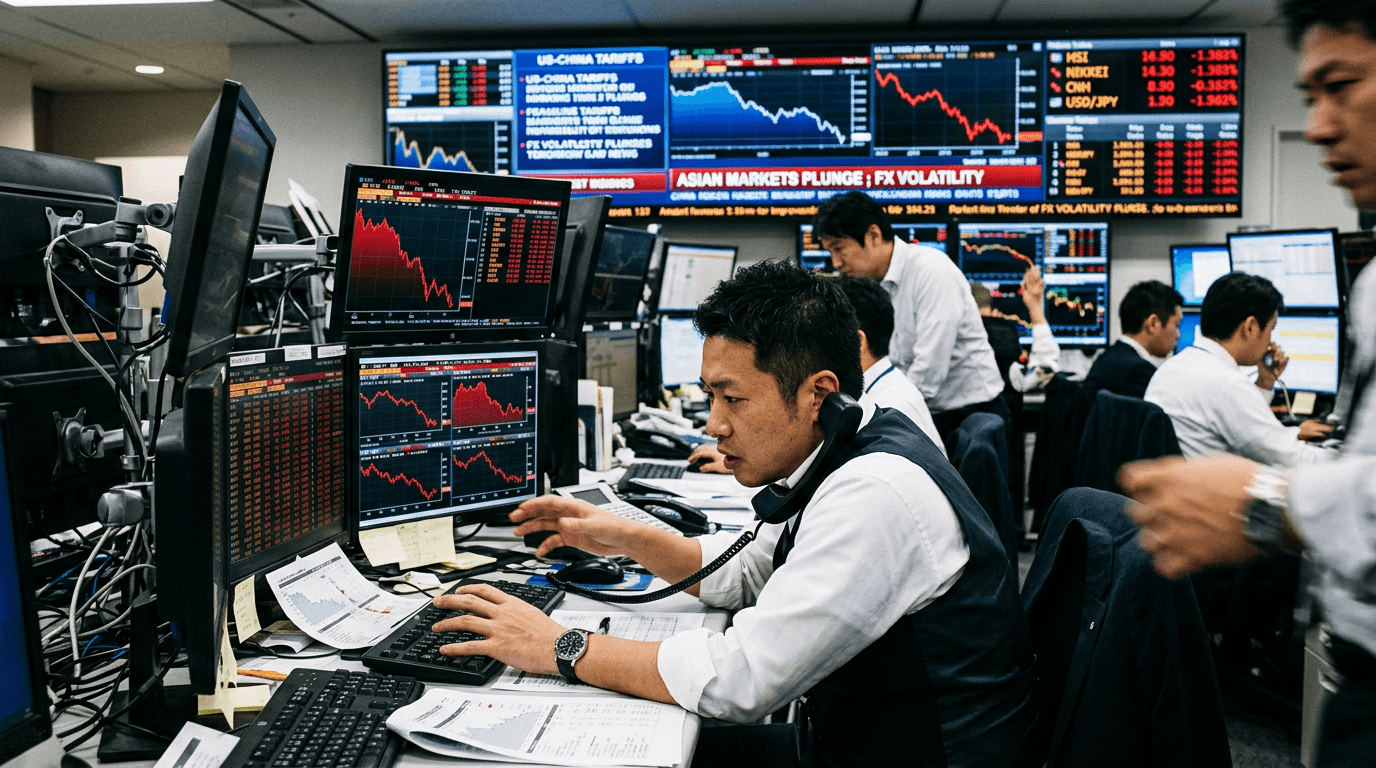
China’s abrupt decision to slap additional tariffs of up to 125% on US goods marks a sharp escalation in the long-running trade tensions between the world’s two largest economies. Beyond the politics, this move is immediately feeding global risk aversion, unsettling Asian currency markets, and triggering risk‑off flows across equities and futures. For traders, this is not just another headline—it is a regime‑shift signal that demands a clear framework for response.
Global Risk Sentiment Shifts
Tariffs at this scale are effectively a tax on cross‑border trade and corporate profitability. When a major economy raises barriers this aggressively, investors instinctively reassess growth, earnings visibility, and policy stability. The result is classic risk‑off behavior: rotation out of equities and higher‑beta assets into perceived safe havens, tighter financial conditions, and wider risk premia across credit and equity markets.
The fact that Beijing has signaled it will ignore further tariff moves from Washington intensifies uncertainty. It suggests less willingness to negotiate and more tolerance for prolonged economic friction. Markets dislike open‑ended conflicts; when there is no clear path to de‑escalation, volatility risk is repriced higher across asset classes, from FX to commodities to equity volatility indices.
Historically, major US‑China tariff rounds have materially increased average tariff levels and weighed on trade volumes and sentiment.[5] The difference now is the magnitude of China’s response—tariffs up to 125% on US goods—and the explicit political messaging that future US actions will be met with indifference rather than compromise. That combination is why risk aversion has intensified so quickly.
Why Tariffs Hit Currencies First
Currency markets often react first and most efficiently to geopolitical and trade shocks. In this case, Asian FX is bearing the brunt of the initial adjustment. Investors are marking down growth expectations for export‑oriented economies in the region and reassessing capital flows, leading to pressure on regional currencies versus the US dollar and other safe‑haven units.
Higher tariffs can weaken a country’s export competitiveness, disrupt supply chains, and compress corporate margins—all factors that can weigh on the domestic currency over time. When the shock involves both the US and China, second‑round effects ripple out across Asia, where many economies are deeply integrated in value chains tied to both markets. That is why correlations between Asian FX pairs tend to spike during trade‑war episodes.
At the same time, traditional safe‑haven currencies and assets—such as the US dollar, Swiss franc, Japanese yen, and developed‑market government bonds—often benefit from risk‑off flows. Even if the US is party to the conflict, global funds still gravitate toward liquidity and perceived safety. Traders should expect heightened two‑way volatility in FX: weakness in trade‑sensitive currencies, plus sharp, sometimes counterintuitive moves in safe havens as positioning becomes crowded.
For simulated traders on platforms like E8 Markets, this environment is ideal for stress‑testing FX strategies: exploring how carry trades behave under risk‑off, how correlation regimes shift, and how quickly liquidity can thin in less‑traded pairs when volatility surges.
Equities, Futures And Volatility
Equity markets typically respond to tariff escalations through sector rotation and valuation compression. Companies with high exposure to US‑China trade—industrial exporters, technology hardware, autos, and selected consumer brands—are vulnerable to margin pressure and demand uncertainty. Investors may de‑rate earnings, widen discount rates, and move capital toward more defensive sectors such as utilities, staples, or domestic‑focused services.
In futures markets, the impact shows up in several ways:
- Index futures may gap lower as traders hedge cash equity exposure.
- Volatility futures and options tend to re‑price higher implied volatility.
- Commodity futures can react unevenly: industrial metals may weaken on growth concerns, while some agricultural contracts may see support if supply chains are disrupted.
For active traders, the key is not just direction but structure. Tariff shocks often produce fast, headline‑driven moves, followed by choppy consolidation as markets reassess. That favors disciplined short‑term strategies, clear risk limits, and a focus on liquidity. Simulated environments allow traders to test how different futures strategies behave under gap risk, margin calls, and volatility spikes without real capital at stake.
Implications For Simulated Traders
SimFi platforms like E8 Markets are built for precisely this kind of regime shift. When macro uncertainty and policy risk dominate, the learning value of simulation rises sharply. Traders can design and test playbooks around several core themes:
- Risk‑off FX rotation: Long safe‑haven currencies versus baskets of Asian FX and trade‑sensitive units.
- Sector rotation in equities: Simulating factor strategies that tilt toward low‑beta, quality, and dividend‑paying sectors during tariff escalations.
- Volatility strategies: Exploring when to buy volatility as protection, when to sell it tactically, and how to manage tail‑risk scenarios.
- Cross‑asset contagion: Modeling how shocks propagate from FX to equities, credit, and commodities.
Because simulations can incorporate historical episodes—such as prior US‑China tariff escalations[5]—traders can calibrate expectations for move sizes, duration, and correlations. They can also practice scaling exposure up or down as policy signals change, a critical skill in environments dominated by headline risk.
Key Takeaways For Risk Management
The most important lesson from a sudden tariff shock is that risk management must adapt faster than headlines. Several practical takeaways apply:
- Reassess leverage: Elevated volatility and gap risk argue for reduced leverage and tighter position sizing.
- Diversify across asset classes: Concentrated exposure to a single region or sector linked to US‑China trade increases vulnerability.
- Focus on liquidity: In risk‑off phases, liquidity can deteriorate quickly in peripheral markets; simulated trading helps highlight where execution risk is highest.
- Use scenarios, not forecasts: Instead of trying to predict the exact policy path, build multiple scenarios (further escalation, partial compromise, prolonged stalemate) and map portfolio outcomes to each.
For developing traders, practicing these disciplines in a simulated setting can accelerate the transition from reactive trading to structured, process‑driven risk management—essential in any macro‑driven market.
Conclusion And Outlook
China’s decision to sharply escalate tariffs on US goods, combined with its signal that it will disregard further US actions, has pushed markets into a more cautious, risk‑averse stance. Asian FX is under pressure, equities and futures are repricing growth and earnings risks, and volatility is likely to remain elevated as long as the policy trajectory is uncertain.
For traders and investors, this is not merely a temporary shock; it is a reminder that geopolitical and trade policies can rapidly reshape market regimes. Those who invest time in understanding the mechanics of tariffs, the transmission channels across asset classes, and the practical tools of risk management will be better positioned to navigate whatever comes next—whether in live markets or on a SimFi platform designed to turn complex macro events into structured learning opportunities.