
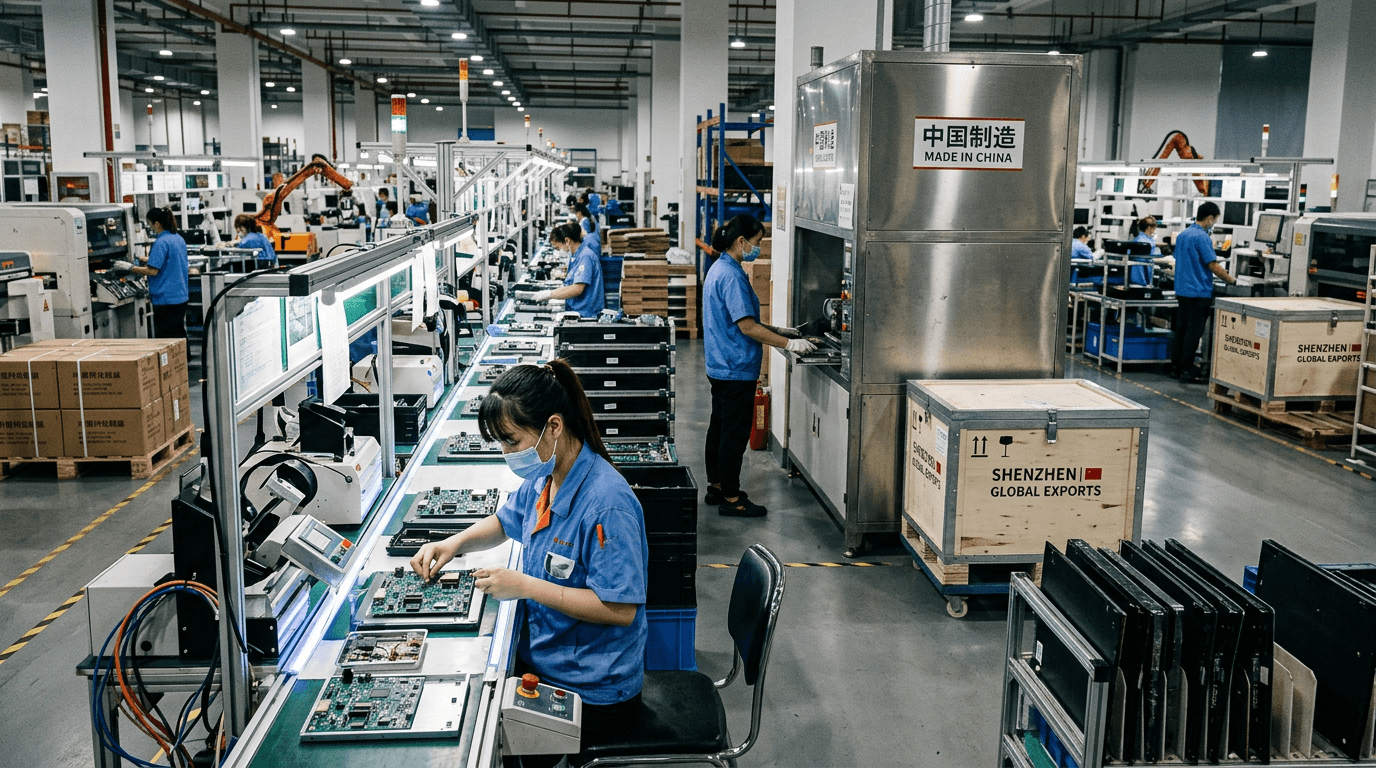
China’s latest manufacturing data delivered a modest upside surprise, with factory activity accelerating in June on the back of strong demand for technology exports. That improvement is small in absolute terms but significant for global markets, because even incremental strength in China’s industrial engine tends to support risk assets from Asian equities to commodities and China‑sensitive currency pairs.
CHINA’S FACTORY PICKUP: SMALL SURPRISE, BIG SIGNAL
Purchasing Managers’ Index (PMI) readings suggest China’s factory activity returned to expansion territory in June, edging above the 50 level that separates growth from contraction and doing slightly better than economists expected.[5] While the pickup is described as “meagre” in some surveys, markets care less about the absolute level and more about the direction of travel—after months of sluggish readings, any acceleration is seen as a signal that industrial momentum is stabilising rather than slipping.[5]
Hard data reinforce the story of gradual improvement. China’s industrial production grew 4.5% year‑on‑year in May 2026, up from 4.1% in April and ahead of market expectations.[1] Manufacturing output itself increased 4.4%, with particularly strong contributions from electricity and utilities—often a sign of rising activity in heavy industry.[1] The National Bureau of Statistics also reported that industrial profits at major firms rose 18.8% year‑on‑year over the first five months of the year, with growth accelerating compared with the January–April period.[3] That profit rebound, driven by electronics linked to artificial intelligence, suggests the improvement in activity is translating into better corporate fundamentals.[3]
From a global macro perspective, this matters because China remains a central driver of trade volumes and manufacturing demand across Asia and beyond. Even a modest upgrade to its factory outlook nudges consensus growth expectations higher, easing fears of a deeper slowdown and providing a tailwind to risk sentiment in futures and currency markets.
Tech Exports At The Core Of The Rebound
Crucially, this acceleration is not being powered by traditional low‑cost manufacturing, but by tech‑heavy export demand. China’s exports rose 14% year‑on‑year in the first quarter of 2026 to about $978 billion, with a notable shift in composition toward higher‑value goods.[6] According to official and analytical reports, developing markets bore the brunt of this export surge, and China’s “China Shock 2.0” is increasingly associated with advanced electronics and equipment rather than basic consumer goods.[6]
Two themes stand out
- AI‑related electronics and smart devices: Industrial profits have been buoyed by robust demand for electronics products tied to artificial intelligence, such as servers, networking equipment and high‑end consumer devices.[3] This aligns with a broader global investment cycle in data centres and AI infrastructure, where Chinese manufacturers play a significant role in supplying hardware.
- Semiconductors and advanced components: China’s own demand for high‑end semiconductor imports has surged as domestic firms ramp up AI investment, but it is also exporting more technology‑intensive products that embed those components.[6] That reinforces a feedback loop in global tech supply chains, linking Chinese factory utilisation directly to capex cycles in the US, Europe and other parts of Asia.
For traders, the key insight is that China’s manufacturing health is increasingly a proxy for the global tech cycle. When export orders for electronics and semiconductors strengthen, Chinese factories run hotter, and the ripple effects are felt across technology equities, industrial metals, and “China‑beta” currencies.
Ripple Effects On Global Risk Assets
The June acceleration in factory activity has already improved sentiment toward a wide range of risk assets, even if the macro surprise is only moderate in scale.
Asian equities: Equity markets in North Asia tend to respond quickly to signs of improving Chinese demand. Tech‑heavy indices in markets like South Korea and Taiwan are tightly linked to global electronics trade, while mainland and Hong Kong‑listed industrial and technology names benefit from both higher export volumes and better margin prospects. Stronger factory data can therefore support valuations in these markets via higher earnings expectations and reduced recession risk.
Commodities: China’s role as the world’s largest consumer of many industrial commodities means any upward revision to its factory outlook matters for metals and energy. Higher activity in manufacturing and AI‑related infrastructure is supportive for copper, aluminium and other base metals used in wiring, cooling and equipment housing. Better‑than‑expected Chinese production and export data can also steady demand expectations for oil and refined products, nudging commodity futures curves away from the most bearish scenarios.
FX and rates: Currencies leveraged to Chinese and global growth—such as the Australian dollar, New Zealand dollar, Korean won and some emerging‑market FX—typically strengthen when China’s industrial data surprise to the upside. Improved sentiment toward the offshore yuan (CNH) can also damp local volatility, encouraging carry trades into Asia. In rates markets, a slightly firmer Chinese outlook may push yields higher at the margin in growth‑sensitive economies, as traders re‑price the probability of a more resilient global cycle.
In short, even incremental improvements in China’s factory activity act as a “risk‑on” catalyst, particularly when driven by tech exports that signal durable demand rather than short‑term stimulus.
What Traders Should Watch Next
For active traders and portfolio managers, the current backdrop is an opportunity to refine their China‑related playbook rather than simply chase the latest data print. Several indicators deserve close attention:
- High‑frequency PMIs vs. hard data: PMIs provide a timely read on sentiment and new orders, while industrial production and profit figures confirm whether that optimism is translating into real output and earnings.[1][3][5] Divergences between the two can create both risk and opportunity.
- Export composition, not just headline growth: The 14% export growth in early 2026 is meaningful, but the shift toward higher‑value tech goods is even more important for asset pricing.[6] A sustained tilt toward electronics, semiconductors and capital goods strengthens the link between China’s data and global tech valuations.
- Policy and geopolitics: Manufacturing momentum is unfolding against a backdrop of geopolitical tensions and industrial policies that may influence supply chains.[6] Traders should consider how export controls, tariffs or domestic incentives could amplify or blunt the impact of better factory data.
For systematic and discretionary strategies alike, building scenarios around these factors—rather than reacting only to headline numbers—supports more robust positioning.
Simulated Finance: A Practical Lab For China Themes
In a SimFi environment, traders can turn this macro narrative into concrete, testable strategies without putting real capital at risk. The current data on China’s factory acceleration and tech export strength lends itself to several scenario‑based simulations:
- Equity rotation: Model a shift into Asian tech and industrial names that benefit from stronger Chinese demand, while hedging with global indices to isolate regional beta.
- Commodity sensitivity: Explore how different paths for Chinese industrial output affect copper, aluminium and oil prices, and test hedging strategies using futures curves.
- FX cross‑currents: Simulate long positions in China‑sensitive currencies (AUD, NZD, KRW) against funding currencies, adjusting for volatility spikes around Chinese data releases.
By stress‑testing these ideas across varying assumptions—such as a slowdown in tech exports or a policy shock—traders can better understand how robust their strategies are to changes in underlying Chinese momentum.
Conclusion
China’s factory activity in June did not deliver a blockbuster growth surprise, but the fact that it accelerated and beat expectations—driven by strong technology export demand—has meaningful implications for global markets.[5][6] With industrial production and profits showing gradual improvement, particularly in AI‑related electronics, the world’s manufacturing hub is again providing a modest but important tailwind to risk assets.[1][3]
For traders, the lesson is clear: monitoring the quality and drivers of Chinese growth matters as much as tracking the headline numbers. As the global cycle increasingly hinges on tech and data‑center investment, China’s factory floors are an early warning system for shifts in risk appetite across equities, commodities and FX—and an ideal testing ground for sophisticated strategies in simulated and live markets alike.