
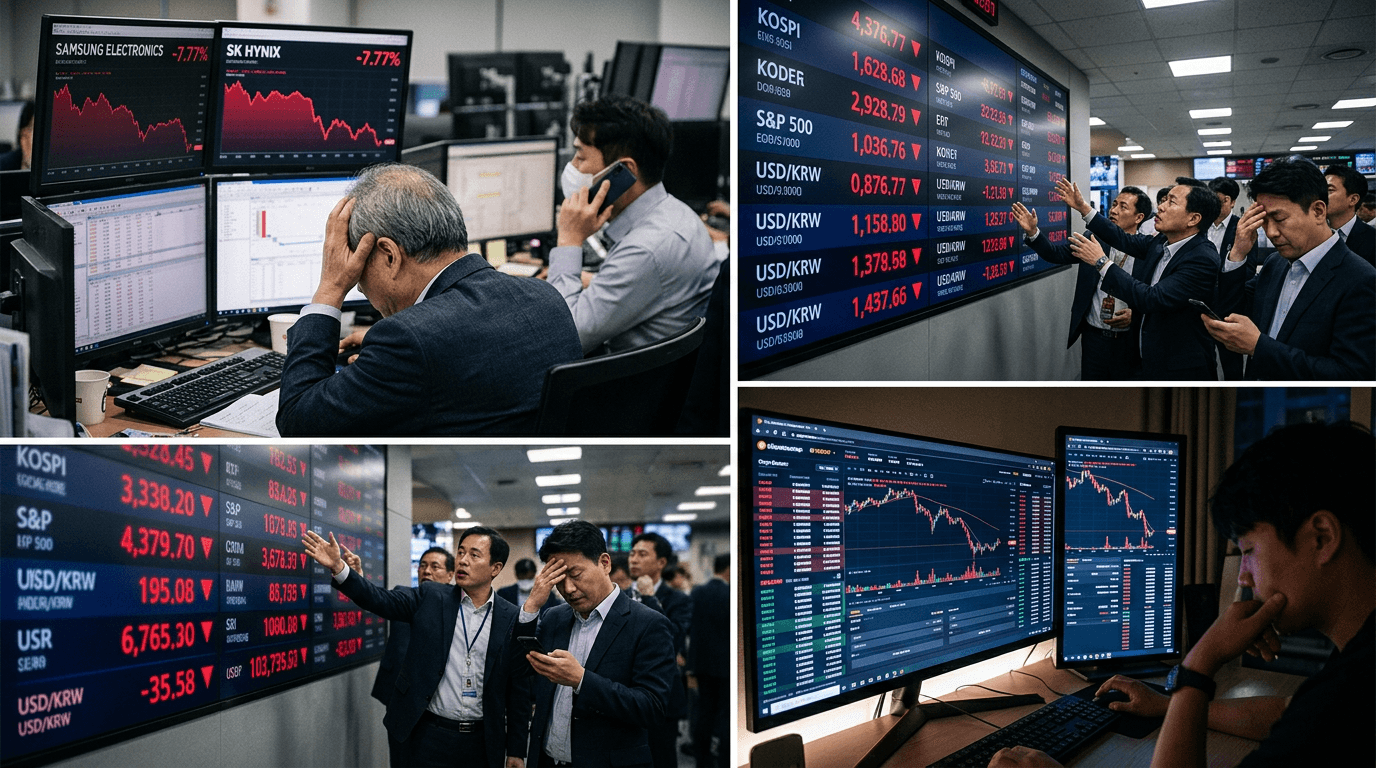
Korean chip giants Samsung Electronics and SK Hynix have just reminded markets that even the brightest AI stories can wobble, with both stocks dropping more than 7% in a single session amid a broader semiconductor rout and mounting concerns about stretched AI‑related valuations.[5][7] This pullback hit the KOSPI hard, dragged down tech‑heavy indices globally, and rippled into FX and crypto markets as traders reassessed how much AI optimism is already priced into risk assets.[1][2] For investors and simulated traders alike, this kind of move is less a random shock and more a live case study in how narrative, valuation, and market structure interact.
Market Move In Context
South Korea’s KOSPI index has become one of the world’s most AI‑sensitive benchmarks because of the outsized weight of Samsung and SK Hynix in the country’s equity market.[2][5] When these two names sell off, the impact on the headline index is amplified, particularly during periods of concentrated momentum trading in semiconductor and AI‑linked stocks.[2][9]
Recent sessions have seen sharp swings: in one notable tech rout, the KOSPI fell around 10% as Samsung and SK Hynix slid more than 12%, triggering a temporary trading suspension on the Korea Exchange due to extreme volatility.[1][2][9] In another episode, Samsung dropped over 5% and SK Hynix nearly 7% in early trade, again making them the biggest drags on the KOSPI.[5] Seen against that backdrop, a fresh 7%‑plus decline is part of an emerging pattern of high‑beta behavior in Korean chip names tied to AI sentiment rather than a one‑off anomaly.[5][7]
The context that matters most: SK Hynix is up well over 300% year‑to‑date and Samsung nearly 200%, far outpacing the so‑called “Magnificent 7” U.S. tech leaders.[7] After such explosive gains, even a moderate shift in sentiment can drive outsized downside moves as investors lock in profits and question how much future AI growth has already been capitalized into prices.[3][7]
Why Chip Stocks Are Under Pressure
The selloff in Samsung and SK Hynix is part of a broader semiconductor and AI‑linked correction, driven by several overlapping forces.
First, there is simple profit‑taking after an extraordinary rally. Both stocks have been among the global leaders in the AI hardware trade, riding expectations that demand for high‑bandwidth memory (HBM), advanced DRAM, and AI‑optimized chips will surge as data centers and cloud providers scale up AI workloads.[3][5][7] When a narrative becomes crowded, even a small disappointment—or just a lack of new positive catalysts—can spark a wave of profit‑taking.
Second, valuation concerns are escalating. As AI‑hardware names rerated higher, investors tolerated richer multiples on the assumption that earnings would “catch up” to the story.[3][5] A broad tech selloff, including weakness in U.S. megacaps, has forced markets to reassess how much of the AI growth curve is already priced in and whether current valuations leave enough margin of safety.[1][3]
Third, regulatory and geopolitical risk continues to hang over the sector. In prior episodes, Samsung and SK Hynix shares dropped after the United States tightened rules on exporting chipmaking equipment to China, revoking licenses that allowed them to upgrade Chinese facilities.[4] While that specific policy shock is not the direct catalyst for the latest 7% move, it remains part of the risk backdrop investors must price into Korean semiconductor names, especially given their exposure to global supply chains and Chinese demand.[4]
Finally, positioning and leverage are amplifying volatility. After a strong AI‑driven run, momentum funds and short‑term traders often pile into the same names, increasing correlation and making exits more crowded when sentiment turns.[1][9] In that environment, price moves can become self‑reinforcing as technical levels break and risk‑management rules force de‑risking.
Ripple Effects Across Global Markets
The latest drop in Samsung and SK Hynix did not stay confined to Korea. Tech‑heavy indices globally felt the impact as the selloff reinforced a broader reset in AI‑related names, contributing to weakness in U.S. indices such as the Nasdaq Composite and sectors heavily exposed to semiconductors.[1][3][9]
In equity markets, Korean stocks pulling back from recent record highs triggered a reassessment of how sustainable the global AI rally is, given that Korea has been one of the biggest relative winners.[2][7] When a market leader stumbles, it often prompts investors to question peer valuations and sector‑wide assumptions.
FX markets picked up the stress through risk sentiment channels. Historically, sharp equity drawdowns in export‑heavy economies like South Korea tend to weigh on their currencies as traders scale back carry trades and cyclical exposures.[2] Risk‑off shifts also affect demand for higher‑beta currencies and can push flows into perceived safe havens.
Crypto markets, increasingly traded as high‑beta risk assets, also react to broad shifts in risk appetite. When tech and growth equities sell off, some traders reduce crypto exposure to manage overall portfolio volatility, while others may move into or out of “AI‑themed” tokens that have traded in sympathy with semiconductor and data‑infrastructure stories.[6] In that sense, an AI‑valuation scare in listed chip stocks can indirectly influence sentiment in crypto, particularly among participants focused on macro and cross‑asset momentum.
IS SOUTH KOREA TOO DEPENDENT ON THE AI BOOM?
The question raised by these moves is whether South Korea’s market has become overly dependent on the AI boom and a narrow set of semiconductor champions.[5] The heavy weighting of Samsung and SK Hynix in the KOSPI means that sector‑specific stress quickly becomes index‑level volatility, even if other parts of the economy are more stable.[2][5]
At the same time, Korea’s policy trajectory underscores its long‑term commitment to the chip industry: major investment plans totaling well over a trillion dollars for semiconductor capacity and infrastructure have been announced, signaling that the country intends to remain at the center of global chip supply.[6] Interestingly, shares of Samsung and SK Hynix have previously dropped despite such large investment commitments, which some traders interpret as a signal of weak near‑term risk appetite or concern about capital intensity and return profiles.[6]
For long‑term investors, this dual reality—structural strength in chips but near‑term valuation and volatility risk—makes Korea both an opportunity and a source of macro noise. For simulated traders, it is an ideal environment to test strategies that balance growth narratives with risk controls.
What Traders And Simulated Investors Should Watch
For traders using simulated environments, this episode offers several practical lessons:
- Monitor concentration risk: When a single sector or a handful of stocks dominate an index, sector‑specific shocks can look like broad market stress. Simulating scenarios where Samsung and SK Hynix drop 10–15% in a day helps illustrate how concentrated exposure can affect portfolio drawdowns.[2][5][9]
- Track narrative shifts, not just prices: AI and semiconductor stories move in waves. Build simulated strategies that respond to changes in earnings guidance, regulatory headlines, valuation metrics, and positioning data, not just to daily price moves.[1][3][4]
- Stress‑test cross‑asset correlations: Use SimFi tools to model how an AI‑driven equity selloff might influence FX pairs linked to export economies and high‑beta crypto assets. This can help refine risk‑management rules that account for simultaneous moves across equities, currencies, and digital assets.[2][6]
- Distinguish structural from cyclical: Korea’s long‑term chip investment plans point to structural strength, but cyclical valuations can still overshoot and correct.[6] Simulated strategies that separate long‑horizon views from short‑term trading signals tend to be more robust when narrative‑heavy sectors experience sharp pullbacks.
Ultimately, the 7%‑plus drop in Samsung and SK Hynix is less about the end of the AI story and more about the market re‑pricing how fast and how profitable that story will be. For active traders and SimFi participants, it is a timely reminder that even the strongest themes come with cycles—and that disciplined scenario analysis is the best way to turn volatility into a learning opportunity rather than a surprise.