
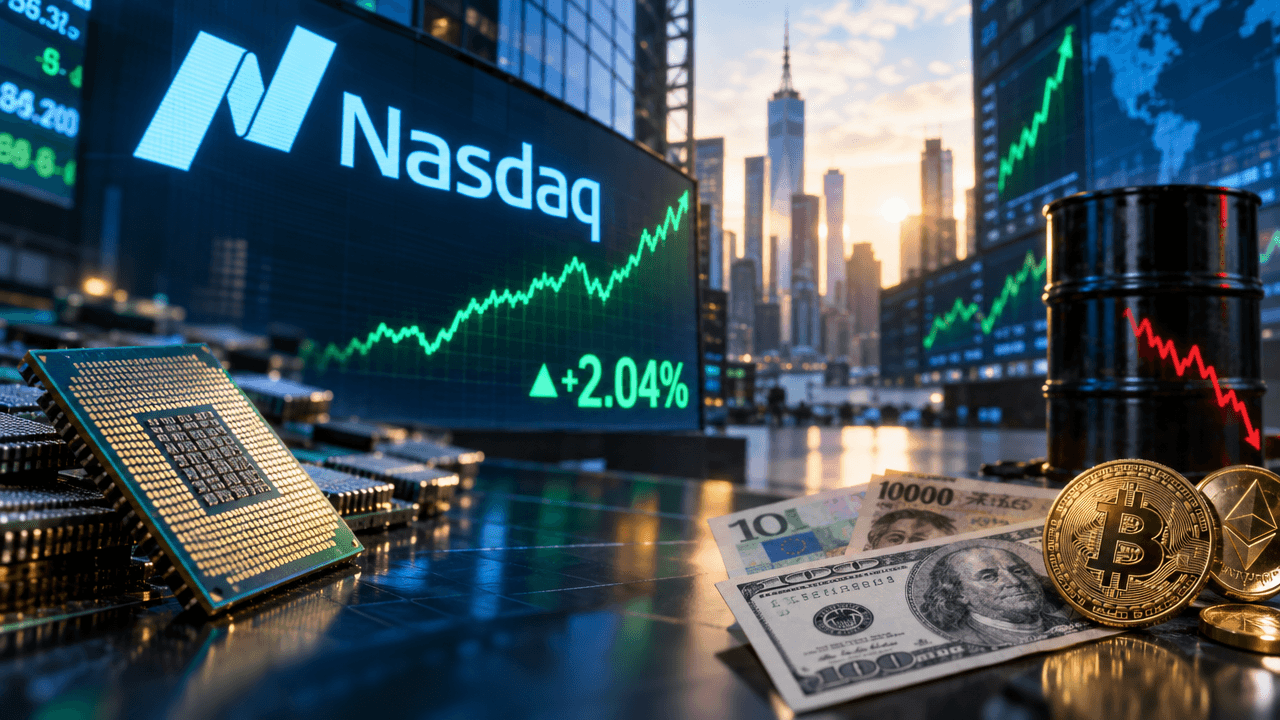
Nasdaq futures are surging around 2% in global trading, powered by a broad rally in semiconductor and AI‑linked chip stocks, while S&P 500 futures are also firmly in the green.[5][7][14] Falling US Treasury yields and softer crude oil prices are easing macro pressure on risk assets, helping equity index futures recover after recent volatility.[1][7][10]
Risk-on Mood In Global Futures
The current move in futures markets marks a clear swing back toward risk‑on sentiment after a period in which higher yields and rising energy prices weighed on equities.[9][13] As benchmark 10‑year US Treasury yields edge lower from the psychologically important 5% area, duration‑sensitive growth stocks and indices like the Nasdaq tend to react first.[7][10][11] Softer oil prices reduce inflation anxiety at the margin, further supporting the case for equity inflows as traders reassess the odds of more aggressive central‑bank tightening.[1][6][10]
For index traders, this kind of session is a classic example of how macro drivers and sector micro‑stories intersect. The futures market allows participants to express views quickly on broad baskets like the Nasdaq 100 and S&P 500 before cash equities open, using information from overnight moves in bonds, commodities, and global risk sentiment.[2][4] On a SimFi platform such as E8 Markets, these dynamics can be modeled and practiced without capital at risk, helping traders build robust playbooks for risk‑on and risk‑off environments.
Chip Rally And Nasdaq Leadership
Semiconductor stocks are once again at the center of the move, with AI‑related names and memory makers fueling outperformance in the Nasdaq complex.[5][14][15] Episodes in recent months have shown that even amid geopolitical tension and inflation concerns, strong demand for chips tied to cloud, data centers, and AI infrastructure can drive powerful rallies that overshadow macro worries.[5][15] As chips rebound, index futures that are heavily weighted toward technology and growth, like the Nasdaq 100, naturally amplify the upside.[7][14]
This sector leadership matters because chips sit at the crossroads of multiple themes: AI, industrial production, geopolitics, and the digital economy. A sustained rally in semiconductors often signals optimism about future tech spending and global growth, and it can pull broader indices higher as passive and systematic strategies chase momentum.[5][15] For SimFi traders, tracking how chip strength filters through to index futures is an opportunity to refine relative‑value trades—going long Nasdaq versus more value‑tilted benchmarks, or structuring sector rotation strategies inside a simulated environment.
Macro Backdrop: Yields, Oil, And Policy Expectations
The slide in Treasury yields and moderation in oil prices are not random; they reflect shifting expectations about inflation and central‑bank policy.[1][6][10] When longer‑dated yields fall, the discount rate applied to future cash flows drops, increasing the present value of growth companies whose profits are expected further out in time.[7][10] At the same time, cheaper crude reduces input costs and the probability of upside inflation surprises, which can temper fears of additional rate hikes.[1][6]
In practice, traders interpret the combination of lower yields and softer oil as a green light to re‑engage in risk assets, at least tactically. Index futures respond quickly because they are among the most liquid instruments tied directly to major benchmarks, allowing large players to adjust exposure in milliseconds. On a SimFi platform, participants can stress‑test scenarios where yields move back up or oil reverses higher, examining how quickly index futures re‑price and how different strategies—trend‑following, mean reversion, or volatility‑selling—would have performed.
Cross-asset Ripple Effects: Fx Carry And Crypto
The improvement in risk appetite is not confined to equities. Lower bond yields and reduced macro tension typically support FX carry trades, in which investors borrow in low‑yielding currencies to buy higher‑yielders, as perceived tail risks decline.[1][7] Crypto assets also tend to benefit in these windows, as investors rotate toward higher‑beta expressions of risk when financial conditions feel less restrictive and volatility appears more manageable.[1][7]
For traders, understanding these cross‑asset linkages is critical. A session where Nasdaq futures jump on a chip rally, S&P 500 futures grind higher, and yields and oil slip can coincide with a stronger carry basket and firmer major cryptocurrencies.[1][7][10] SimFi environments allow users to build and test multi‑asset strategies—pairing equity index positions with FX or crypto risk—without the operational complexity and leverage of live markets.
How Simfi Traders Can Navigate This Environment
Risk‑on days like this can be tempting for traders to chase, but they also offer a rich opportunity to practice disciplined playbooks within simulation. A structured approach might include:
- Map the driver hierarchy: identify whether today’s move is primarily about chips, yields, oil, or earnings headlines, and track which indices are most sensitive.
- Define entry triggers: use objective levels in futures (previous highs, key moving averages, overnight ranges) rather than emotion to guide participation.
- Plan risk boundaries: set position size, maximum drawdown, and exit rules before entering simulated trades, then review adherence post‑session.
- Test relative trades: compare long Nasdaq versus long S&P 500, or chips versus broader tech, to see which expressions provide the best risk‑adjusted payoff.
- Run “what‑if” scenarios: simulate outcomes if yields unexpectedly jump back above recent highs or oil spikes, and analyze how quickly to rotate from risk‑on to defense.
On a platform like E8 Markets, these steps can be repeated across many different market days, building a statistical understanding of how often chip‑led rallies with falling yields and softer oil evolve into sustainable trends versus short‑lived squeezes.[1][5][7] Over time, this data‑driven practice helps traders move from reacting to headlines to systematically executing well‑tested strategies.
Conclusion
The surge of roughly 2% in Nasdaq futures on the back of a chip rally, alongside higher S&P 500 futures, illustrates how quickly market tone can swing when macro headwinds like rising yields and expensive oil ease.[1][5][7] Semiconductors remain a pivotal sector, amplifying moves in growth indices and shaping sentiment across equities, FX carry, and crypto as investors reassess risk.[5][7][14] For SimFi traders, days like this are ideal laboratories—conditions where theory meets practice, correlations shift, and disciplined, simulated execution can lay the groundwork for more confident decision‑making when similar setups emerge in live markets.