
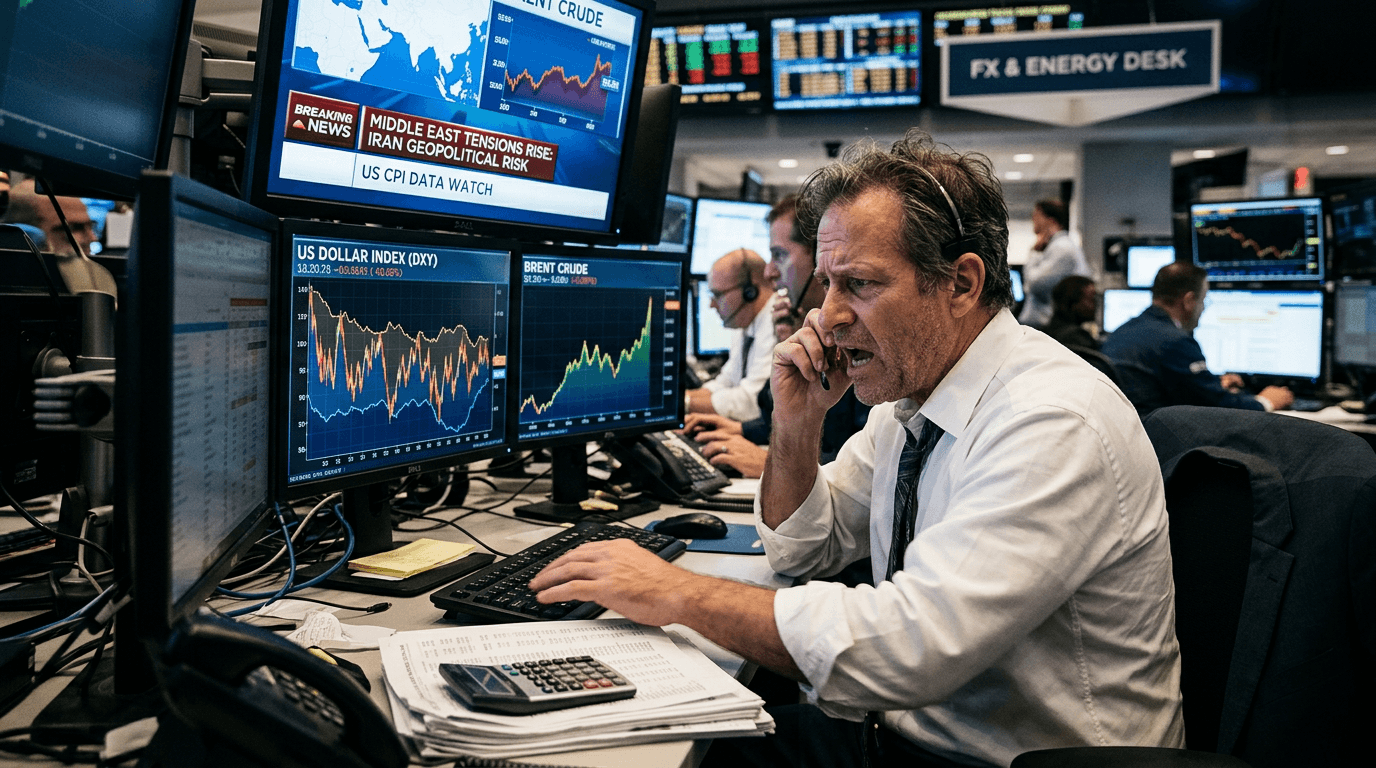
The U.S. dollar is trading in a narrow but volatile range as markets juggle two powerful catalysts: a pivotal U.S. inflation release and rising geopolitical risk linked to Iran. With the dollar index hovering near recent highs yet failing to break decisively in either direction, price action has turned choppy and intraday moves are increasingly driven by headlines rather than clear trends. For traders, this is a classic “wait-and-see” environment where positioning, risk management, and scenario planning matter more than trying to predict the next tick.
Market Backdrop: Choppy Dollar Ahead Key Data
In recent sessions, the dollar index has held close to its upper range, reflecting lingering demand for the greenback after months of tight monetary policy and elevated inflation prints. The last major U.S. CPI report showed annual inflation at 4.2%, the highest in three years, driven largely by energy prices[1]. That backdrop keeps the dollar supported, but the lack of fresh information before the next release has produced uneven, directionless trading.
Major FX pairs such as EUR/USD, GBP/USD, and USD/JPY are experiencing two-way volatility, with moves that extend during one part of the day only to reverse as new flows hit the market. Risk-sensitive currencies, including commodity-linked FX like AUD, CAD, and NOK, have been particularly reactive to oil price swings and geopolitical headlines. Safe-haven flows into the dollar are appearing, fading, and reappearing quickly, contributing to intraday noise rather than a clear trend.
For traders on both live and simulated platforms, this environment rewards flexibility over conviction. The market is effectively marking time, but it is doing so with notable volatility inside the range, which can be both an opportunity and a risk depending on how positions are sized.
WHY U.S. INFLATION DATA MATTERS FOR FX
U.S. CPI is one of the most important data releases for global markets because it feeds directly into expectations for Federal Reserve policy. When inflation is above target and trending higher, traders tend to price in tighter policy for longer—higher rates, a slower path to cuts, or even the risk of renewed hikes. That typically supports the dollar by increasing its yield advantage and reinforcing its role as a defensive asset.
The previous inflation report showed annual CPI at 4.2%, with much of the pressure coming from a sharp rise in energy costs[1]. Core CPI, which excludes food and energy, was more subdued[1]. This mix matters: if upcoming data confirm that headline inflation is being pushed up mainly by energy, while underlying price pressures remain contained, the Fed may be more tolerant of temporary overshoots. If, however, core inflation re-accelerates, markets could quickly adjust to a more hawkish policy path.
FX traders will be focused on three dimensions of the release:
First, the headline year-on-year and month-on-month figures relative to consensus. A beat or miss of just 0.1 percentage points can trigger sharp moves as algorithmic and discretionary traders react simultaneously.
Second, the core CPI measures, which are more closely watched as indicators of underlying inflation trends.
Third, the composition of inflation—how much is coming from shelter, services, and energy, each of which has different implications for the Fed and for the persistence of price pressures.
The dollar’s choppy behaviour reflects the fact that markets are trying to price two possible regimes: one where inflation stays sticky and the Fed remains restrictive, and another where inflation finally eases and a clearer path to lower rates emerges.
Iran Tensions, Oil And Currency Flows
While inflation data dominate the macro narrative, geopolitical tensions involving Iran are adding a second layer of complexity. Rising tensions have pushed oil prices to a four-week high, amplifying concerns about energy supply disruptions and risk premia in commodity markets. Because the previous CPI report showed energy as a major driver of headline inflation[1], further oil gains raise the prospect that inflation could stay elevated for longer.
Higher oil prices tend to generate mixed reactions in FX:
Oil-exporting currencies, such as CAD and NOK, often benefit from stronger terms of trade. However, when geopolitical risk drives the move, investors may prefer the safety of the dollar and other havens rather than chase commodity FX.
Oil-importing economies, notably in Europe and parts of Asia, can see their currencies pressured by deteriorating trade balances and concerns about growth.
Global equity sentiment can weaken when geopolitical risks rise, which often supports the dollar as investors seek liquidity and safety.
The result is the kind of two-way volatility currently visible across FX markets. Traders are constantly reassessing whether the oil move is a transient spike or the start of a more persistent risk premium that could alter inflation dynamics and growth forecasts.
How Traders Are Positioning In A Two-way Market
In this environment, positioning structures are often more revealing than spot moves. Many traders are keeping core dollar-long exposure but reducing leverage, reflecting constructive but cautious views on the currency. Others are using options to express directional views around the CPI release while limiting downside with defined risk.
Common strategies include
Buying short-dated straddles or strangles in major pairs to benefit from a volatility spike around the data release, regardless of direction.
Maintaining small tactical positions in risk currencies that are sensitive to oil, while hedging with partial dollar longs or safe-haven assets.
Using simulated trading environments to test CPI and geopolitical scenarios—how EUR/USD, USD/JPY, and oil-sensitive crosses might react to specific combinations of inflation surprises and headline risk.
Because safe-haven flows into the dollar are fluctuating intraday, traders who rely on very short-term momentum signals need to be especially disciplined. Signals can flip quickly, and thin liquidity around news can produce false breaks and sharp reversals.
Practical Takeaways For Simulated And Live Traders
For traders on platforms like E8 Markets, this is a valuable learning setup: the macro narrative is clear—inflation and geopolitics—but the market outcome is uncertain. That makes it ideal for stress-testing strategies, refining risk rules, and building playbooks for future events.
A few practical takeaways stand out
First, treat key data releases as volatility events, not as guaranteed directional trades. Build scenarios for upside and downside surprises and predefine how you will respond in each.
Second, pay attention to correlations. When oil, equities, and the dollar all move together, it often signals a macro theme—such as “inflation plus geopolitical risk”—that can persist longer than a single data print.
Third, respect ranges. In choppy conditions, markets can trade back and forth inside well-defined levels for longer than expected. Overtrading within a range often leads to unnecessary losses, while patiently waiting for a genuine break—with confirmation—can improve risk-adjusted returns.
Finally, use simulated environments to practice execution around high-volatility windows. Slippage, spreads, and order behaviour can all change when the tape is fast. The more familiar you are with how your strategy behaves in those moments, the more prepared you will be when the real opportunity appears.