
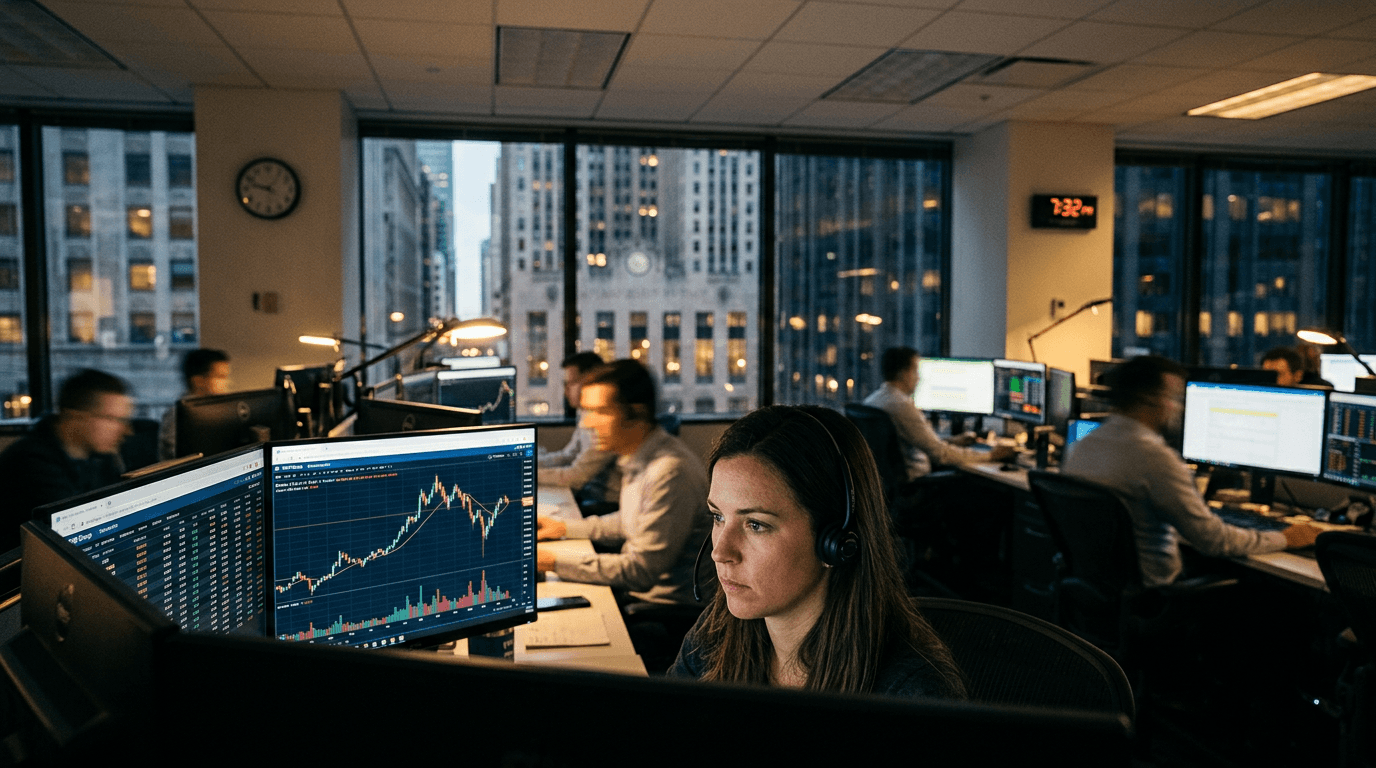
When cryptocurrency first emerged, it traded nonstop while traditional markets slept — a structural divide between crypto-native venues and legacy finance. CME Group’s decision to move its regulated cryptocurrency futures and options to a 24/7 schedule closes that gap, giving institutional traders continuous access to Bitcoin and other digital assets on one of the world’s most established derivatives platforms.[2][4] This shift has the potential to reshape liquidity, volatility, and risk management across both spot and derivatives markets.[4][5][7]
WHAT EXACTLY DID CME CHANGE?
CME Group announced that its regulated cryptocurrency futures and options will trade 24 hours a day, seven days a week on the CME Globex electronic platform, beginning May 29, pending regulatory review.[2] That means its crypto suite — including flagship Bitcoin and Ether futures and options — will be available continuously instead of pausing over weekends and holidays as before.[2][8]
Under the new model, CME will still perform a brief weekly maintenance period over the weekend, but trading access will otherwise be continuous.[2] All holiday or weekend trading from Friday evening through Sunday evening will carry a trade date of the following business day, with clearing, settlement, and regulatory reporting processed on that next business day.[2] In other words, the trading screen never sleeps, but post-trade infrastructure still anchors to the traditional business calendar.
Previously, CME’s crypto products observed legacy market hours, closing over weekends even while spot Bitcoin and other digital assets traded 24/7 on crypto-native exchanges.[1][4] This created visible “weekend gaps” on institutional futures charts whenever spot prices moved significantly while CME was closed.[3] Once CME’s continuous schedule is fully in place, those gaps effectively disappear because the institutional futures market itself no longer shuts down.[3]
WHY 24/7 MATTERS FOR INSTITUTIONAL ACCESS
For large asset managers, hedge funds, banks, and corporates, the ability to hedge risk around the clock in a regulated environment is a meaningful structural upgrade. CME is positioning its 24/7 crypto trading explicitly to meet rising institutional demand for digital asset exposure and risk management.[2][7] The exchange reported that its crypto products generated nearly $3 trillion in notional trading volume in 2025, underscoring how deeply institutional activity has already penetrated this market segment.[6]
Until now, institutions relying on CME for crypto exposure faced a coverage gap: they could not adjust futures or options positions during weekend volatility without turning to less-regulated venues.[1][4][7] With continuous trading, they can manage basis risk, rebalance hedges, and respond to news flow in real time, regardless of whether it is a Tuesday morning or a Sunday night.[2][7] That brings institutional workflows closer to the way crypto-native firms have operated for years.
This move also lowers operational friction for large players who need to coordinate between spot holdings, ETFs, and derivatives. For example, Bitcoin ETF issuers and authorized participants can now more closely align futures hedges with the 24/7 behavior of the underlying asset, potentially improving tracking and risk control.[6][7] For institutions that were previously constrained by traditional market hours, 24/7 CME access may be the catalyst that brings more of them into the crypto derivatives space.[7]
Impact On Liquidity, Volatility And Price Discovery
Structural changes in trading hours can have second-order effects on how markets trade. By offering a continuous, regulated venue that overlaps with both U.S. and global crypto activity, CME’s 24/7 schedule is likely to alter liquidity patterns across spot and futures markets.[4][5][7] As more institutional flow is able to react in real time to weekend or overnight news, liquidity could deepen during previously thin time zones.[5][7]
One immediate consequence is the elimination of the traditional CME weekend price gap. Historically, when spot Bitcoin moved sharply on Saturday or Sunday while CME was closed, the futures market would “jump” at the Sunday open, creating a visible gap on charts.[3] With continuous trading, price adjustments will be smoothed across the weekend as futures respond to spot moves in real time, which may reduce some technical distortions and gap-driven strategies.[3][5]
More continuous institutional hedging could also have a stabilizing effect on volatility — though the direction is not guaranteed. Some analysts argue that 24/7 access for large funds will help dampen extreme weekend price swings by bringing in professional liquidity providers and arbitrageurs.[5][7] Others note that when leverage and derivatives liquidity increase, volatility can spike during stress events, even if day-to-day moves narrow.[5][7] What is clear is that CME’s move integrates crypto markets more tightly with the global derivatives ecosystem, enhancing the role of futures prices in overall price discovery.[1][4]
Risks And Operational Challenges
Around-the-clock trading does not just create opportunities; it also introduces operational and risk-management challenges. Institutions must rethink staffing, monitoring, and governance processes for a market that can move materially at any hour. Risk teams will need to define who has authority to adjust positions on a Saturday night, and under what conditions, to avoid both under-reaction and overtrading.
There are also nuances in how 24/7 trading interacts with traditional clearing and reporting cycles. Even though trades can be executed continuously, weekend and holiday activity is still reported and processed with a trade date of the next business day.[2] That can affect how P&L, margin, and regulatory reporting are managed internally, especially for firms with strict daily close processes.
From a strategy perspective, some existing approaches that relied on CME weekend gaps, or on predictable liquidity droughts around exchange closures, will need to be re-evaluated.[3][5] At the same time, continuous trading can amplify behavioral risks: traders may feel pressured to “always be on,” which can lead to fatigue and poor decision-making if not managed with clear rules and automation.
How Traders Can Prepare
Whether you are an institutional desk or an advanced individual trader, this structural change calls for a fresh look at your crypto derivatives playbook. Start by mapping out CME’s new schedule and identifying how it overlaps with your existing crypto exposure across spot, futures, and options. Build or update a 24/7 risk framework that defines position limits, escalation thresholds, and who is responsible for monitoring markets during off-hours.
Next, reassess your strategies around weekends and major event risk. Many playbooks were built for a world where CME was closed for a significant portion of the week; those assumptions now need to be revisited. Backtest how your approaches would have behaved under continuous futures trading, and look at how basis, funding, and implied volatility might evolve as institutional liquidity redistributes across time zones.
Finally, consider using simulated trading environments to adapt before committing real capital. In a SimFi setup, you can test new 24/7 hedging rules, algorithmic triggers, and weekend playbooks against live or historical data without the emotional and financial pressure of real P&L. This kind of structured experimentation can help you identify where continuous access genuinely improves your edge — and where it simply tempts you into taking unnecessary risk.
Looking Ahead
CME’s launch of 24/7 crypto futures and options trading is more than a minor scheduling tweak; it is a step toward fully integrating digital assets into the global derivatives framework.[2][4][7] By giving institutional traders continuous, regulated access to crypto exposure, it narrows the gap between traditional finance and the always-on nature of blockchain-based markets.[2][4]
As liquidity, hedging behavior, and market structure evolve under this new regime, the edge will belong to traders and institutions that adapt quickly. Those who understand how 24/7 futures change volatility, correlations, and risk transmission across spot and derivatives will be best positioned to navigate — and potentially profit from — this next phase of the crypto market’s maturation.