
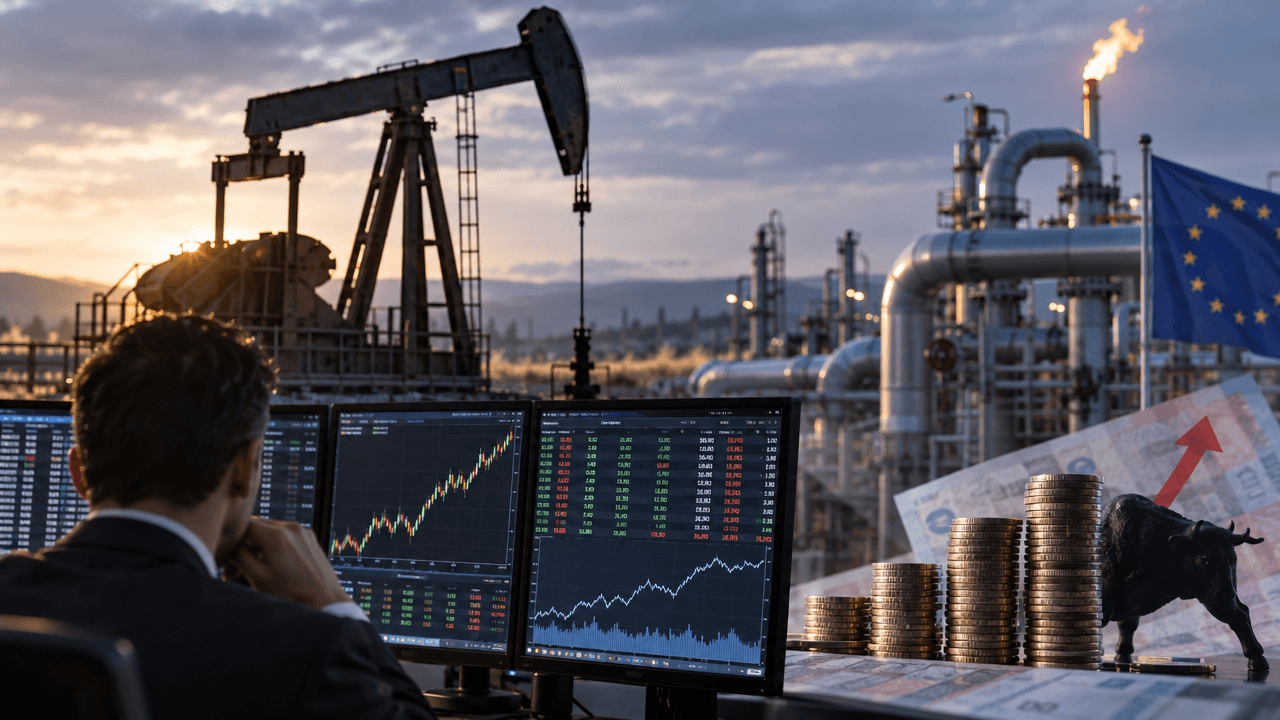
Oil is back above $100 and European gas is climbing again, reminding markets that the energy story is not over and that inflation risks remain firmly on the radar. With Brent crude trading around $105.54 per barrel and benchmark European gas futures near €75.23 per megawatt-hour, the latest move in energy prices is feeding concerns that the “higher for longer” interest-rate narrative could persist and continue to weigh on bonds and rate-sensitive futures.
Energy Shock Back In Focus
The current rise in oil and gas prices comes on top of a year in which energy has already re-emerged as a key driver of global inflation dynamics.[7][13][15] Central banks had seen encouraging signs of disinflation as energy prices eased earlier in the year, with euro area headline inflation briefly moving closer to target.[1][15] However, renewed energy volatility linked to supply disruptions and geopolitical tensions has reversed some of that progress.[2][7][13]
In Europe, policymakers have emphasized that inflation risks are tilted to the upside, driven in large part by energy costs.[4][6][13] Eurosystem staff projections now see headline inflation in the euro area averaging around 3.0% in 2026, mainly due to higher energy prices.[14] Energy inflation itself is projected to peak in double digits, reflecting assumptions of elevated oil prices and tight gas and power markets.[14]
Globally, the World Bank expects average energy prices to rise by about 24% in 2026 compared with the prior year, underscoring the scale of the shock.[7] In the United States, regional Federal Reserve analysis points to higher energy costs pushing headline PCE inflation towards 3% by the end of 2026 before gradually easing.[10] These projections frame the latest rally in crude and European gas as more than a short-lived blip; they are part of a broader energy-driven inflation story.
How Oil And Gas Feed Into Inflation
Higher oil prices transmit to inflation through fuel costs, transport, and industrial input prices, with the pass-through typically appearing quickly in headline measures.[9][10] In the euro area, previous analysis suggests that a sustained 20–30% increase in oil prices can add roughly 1.5–2.5 percentage points to inflation, mainly via fuel and heating bills.[9] When crude is above $100 for a prolonged period, that transmission mechanism becomes a central concern for policymakers and investors.[11][12]
Gas plays an even more pivotal role in Europe because of its tight link to electricity prices.[3][9][11] In many European markets, power prices are set by the marginal gas-fired generator, meaning moves in gas futures feed rapidly into household and industrial electricity costs.[9][11] The European Central Bank has highlighted that recent gas price spikes have amplified the inflation shock, evoking memories of the 2021–22 energy crisis, even if the current episode is smaller in scale.[3][15]
Importantly, while headline inflation reacts quickly to energy, core inflation (excluding food and energy) tends to respond more slowly and less directly.[1][5][14] Recent analysis suggests that the pass-through from energy to non-energy components has been more contained than in past episodes, thanks to improved energy efficiency and stronger competition.[5][8] Nonetheless, persistent energy cost pressure can gradually seep into broader price-setting via higher transport, production, and wage demands.[9][10][14]
Implications For Central Bank Policy And Bonds
As energy prices climb, central banks face a difficult trade-off between supporting growth and re-anchoring inflation near target.[4][6][10] For the ECB, the new energy shock has led staff to project inflation staying above 3% into next year, largely because of elevated energy inflation.[14] Meeting accounts show policymakers explicitly warning that inflation risks remain skewed to the upside, with renewed shocks from oil and gas a key concern.[4][6]
In practice, this means rate cuts may be slower, smaller, or pushed further into the future than markets previously anticipated.[4][10][14] If inflation expectations rise or become less anchored, central banks may even feel compelled to keep policy tight despite signs of softer growth.[8][10] That “higher-for-longer” stance weighs on sovereign bonds, particularly at longer maturities, as investors demand higher yields to compensate for both inflation risk and policy uncertainty.[8][10]
For traders, this environment tends to favor short-duration positioning and active management of interest-rate exposure. Yield curves can re-steepen if markets price in more persistent inflation and a steadier path of policy rates.[8][10][14] Inflation-linked bonds may benefit from renewed demand as investors seek protection against upside surprises in headline inflation, driven by energy.[9][10]
Impact On Rate-sensitive Futures And Risk Assets
Rate-sensitive futures—such as equity index futures heavily exposed to growth and duration, and interest-rate futures tied to expectations for policy moves—are particularly vulnerable to energy-driven inflation shocks. Higher oil and gas prices bolster the case for restrictive policy, which tends to pressure growth stocks, real-estate exposures, and long-duration assets.[8][10]
Equity markets also see sector-level dispersion. Energy producers and select industrials linked to the energy supply chain can benefit from higher prices, while energy-intensive manufacturers, transport companies, and some utilities face margin compression.[11][12] In Europe, the tight link between gas prices and electricity costs increases pressure on power-intensive industries and households, potentially dampening consumption and earnings.[3][9][11]
Derivative markets respond by re-pricing volatility and skew around policy meetings and key inflation data releases. Options on bond futures and equity indices often build in higher implied volatility when energy prices are unstable, as traders hedge the risk of hawkish surprises from central banks.[8][10][14] For SimFi participants, this creates a rich environment to practice scenario analysis and volatility strategies without capital at risk.
Practical Takeaways For Traders And Simfi Participants
1. Track energy benchmarks as macro indicators Brent crude and European gas futures have become leading indicators for inflation expectations and rate-path pricing. Monitoring these markets alongside inflation swaps, breakevens, and policy-sensitive futures helps build a more coherent macro view.[7][9][11][14]
2. Link energy moves to central bank reaction functions Use ECB and Federal Reserve projections and speeches as a map for how policymakers respond to energy shocks at different inflation levels.[4][6][10][13][14] In SimFi environments, this can be translated into simulated trades around meetings, inflation releases, and energy price milestones.
3. Stress-test bond and rates portfolios against energy scenarios Apply scenarios such as “oil sustains above $100” or “European gas spikes before winter” to see the impact on bond yields, curve shape, and rate futures. Historical episodes and current projections provide useful parameters for such exercises.[3][7][9][10][14]
4. Look through to sector and factor impacts Energy shocks rarely hit all equities equally. Simulate sector rotation strategies—overweight energy and underweight energy-intensive industries—and compare performance under different energy price paths.[8][11][12] Factor exposures such as value versus growth or high versus low duration can also be tested.
Conclusion: Navigating An Energy-linked Inflation Market
The latest rise in crude oil and European gas prices is a timely reminder that the inflation story is still heavily influenced by energy, even as broader disinflation trends take hold. With Brent near $105 and European gas futures elevated, central banks face renewed upside risks to inflation and markets must adapt to the possibility that restrictive policy will persist longer than previously hoped.[4][7][11][14] For traders, this environment demands a disciplined focus on energy benchmarks, central bank communication, and the transmission from oil and gas into bonds, rate-sensitive futures, and sector performance.[8][9][10][11]
Simulated finance platforms offer an ideal sandbox for learning how energy shocks ripple through the macro landscape, allowing participants to practice building scenarios, stress-testing portfolios, and refining trading strategies without real-world capital at risk. By treating crude and gas not just as commodity prices but as powerful macro variables, traders can better navigate markets where inflation risk is once again driven by the energy complex.