
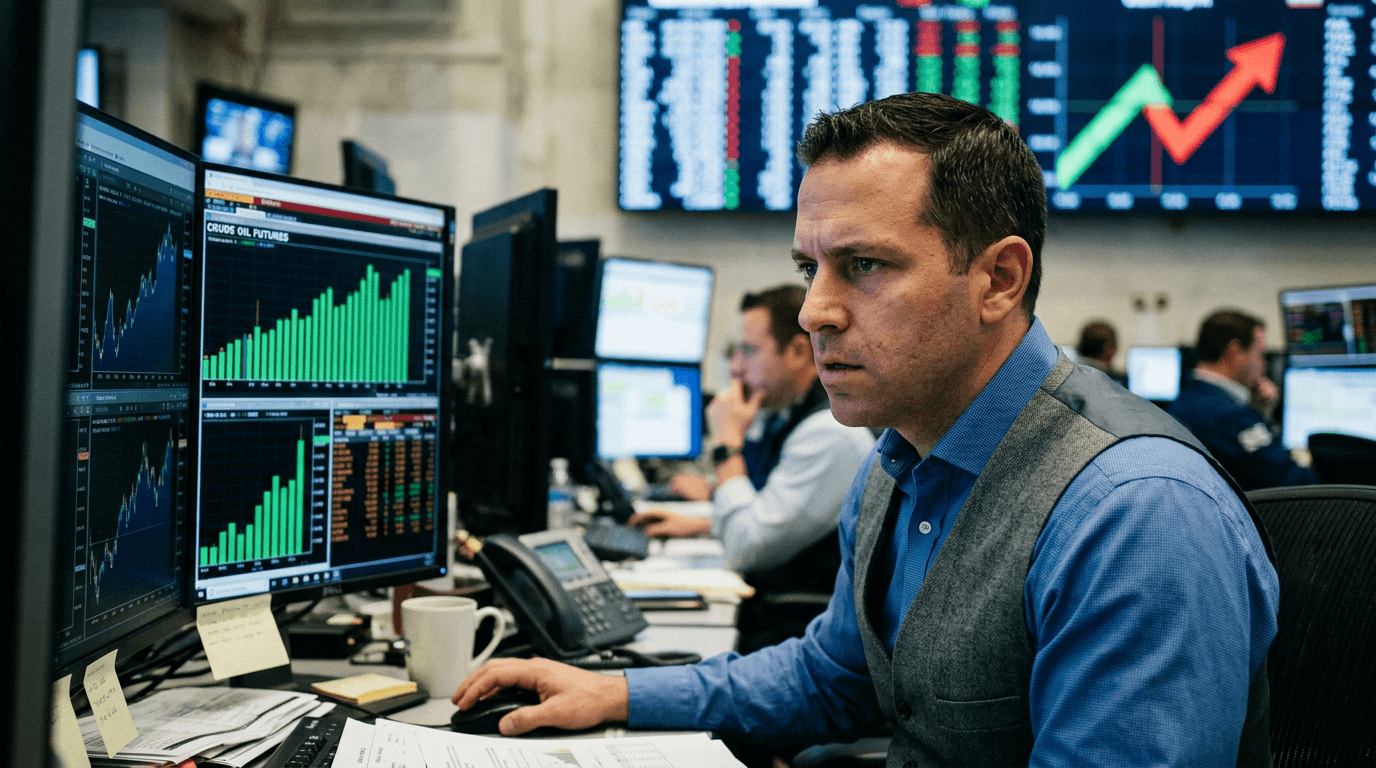
Crude oil’s persistence at elevated levels is a signal that geopolitical risk is once again a key driver of global markets, not just a side story.[2][13][14] Tensions between the United States and Iran, concerns over shipping routes in the Middle East, and ongoing disruptions in other producing regions have added a visible risk premium to energy prices, keeping crude as a central macro variable for traders across forex, futures, and broader risk assets.[2][8][13] For market participants, including simulated traders on platforms like E8 Markets, understanding how geopolitics flows through the energy complex is essential to interpreting inflation expectations and risk sentiment.
Geopolitical Risk Premium In Crude Oil
The concept of a “geopolitical risk premium” describes the additional price traders are willing to pay for crude when they perceive a higher probability of supply disruption, even if physical flows have not yet been severely curtailed.[10][14] Surveys of economists and analysts show that ongoing geopolitical tensions have padded oil prices by roughly $4–$10 per barrel compared to where they might trade in a calmer environment, highlighting that risk perception itself can be monetized in futures curves.[14] Recent episodes of heightened U.S.–Iran tension, alongside conflict in other producing regions such as Russia and Ukraine, have reinforced this premium by raising uncertainty around both current supply and future export capacity.[11][13] Academic work supports this framework, finding that most geopolitical shocks tend to push crude prices higher, with their impact evolving over time as markets reassess how durable the disruption might be.[5][6]
While geopolitical news often triggers knee-jerk moves, the relationship between events and prices is not always linear or immediate.[1] Historical data show cases where significant political headlines produced only modest price swings, particularly when spare capacity, inventories, or weak demand cushioned the shock.[1][7] That nuance matters for traders: not every headline justifies a large repricing, but periods of persistent tension—like the current U.S.–Iran backdrop—tend to sustain a higher trading range as markets repeatedly price and reprice the probability of more serious supply interruptions.[3][8]
Strait Of Hormuz And Supply Risks
The Strait of Hormuz, one of the world’s most critical chokepoints for crude and liquefied natural gas, sits at the center of current supply-risk narratives.[8][9][12] Escalating hostilities and threats to restrict traffic through the strait have reintroduced a significant geopolitical risk premium into both energy and shipping markets, pushing benchmark prices higher as traders hedge against worst-case scenarios.[9][15] During previous Middle East crises that effectively closed or severely constrained this route, Brent crude prices have surged from levels just below $70 a barrel to peaks around $120, illustrating how quickly the market can move when a major artery of global supply is threatened.[12][15]
More recent episodes confirm this sensitivity: oil prices have jumped more than 6% on the first trading day following direct military strikes involving the U.S. and Iran, with benchmarks like West Texas Intermediate spiking toward multi-year highs as traders priced in possible disruption to regional exports.[4][9] At times, WTI crude has traded in the $105–$110 range, with U.S. gasoline costs rising to their highest levels since 2022 as the risk premium filtered through to consumers.[9] Even when physical flows continue, slower shipping traffic, higher insurance costs, and rerouting of tankers can tighten effective supply, keeping prices elevated and volatility high.[2][9]
Macro Transmission: Inflation, Fx, Risk Sentiment
Elevated crude does not stay confined to the energy complex; it feeds into inflation expectations through higher input costs for transportation, manufacturing, and eventually consumer goods.[8][9][12] Analysts estimate that a prolonged period of oil trading near $100 per barrel could add roughly 0.6–0.7 percentage points to global inflation, a meaningful shock when many central banks are already grappling with sticky price pressures.[8] Higher energy inflation can complicate monetary policy decisions, encouraging more hawkish guidance or delaying rate cuts, which in turn affects bond yields, equity valuations, and currency dynamics.[8][13]
Historically, sustained strength in oil prices has tended to support commodity-linked currencies such as the Canadian dollar and Norwegian krone, while pressuring net importers like Japan and India through worsened trade balances and higher domestic energy costs.[10][13] At the same time, periods of geopolitical-driven oil rallies are often accompanied by bouts of risk aversion, as investors reassess the probability of broader conflict or economic fallout.[11][13] Importantly, central bank and policy responses can either amplify or dampen these effects, contributing to complex cross-asset correlations that simulated traders need to understand when designing macro strategies.
How Traders Can Navigate Elevated Oil Prices
For traders on simulated platforms like E8 Markets, the current environment offers an opportunity to practice trading around geopolitically driven energy moves without the capital risk of live markets. Geopolitical tension tends to increase intraday volatility and headline sensitivity in crude futures, with prices reacting quickly to official statements, sanctions announcements, and reports of disruptions in key shipping lanes.[2][8][11] At the same time, analysts’ medium-term price forecasts have been revised higher due to supply risks, even as oversupply concerns and demand uncertainty limit the scope for unchecked rallies, resulting in a more two-sided trading landscape.[11][14]
A practical approach is to treat crude oil as a central macro factor and build scenarios around plausible paths for tensions and supply. For example, traders can simulate cases where conflicts remain contained and shipping routes stay open versus cases where traffic through Hormuz is further restricted or insurance costs spike, adjusting expected price ranges and correlations in each scenario.[8][9][12] Linking energy moves to FX and equity indices—such as modeling how an oil spike might strengthen commodity currencies, weigh on airline stocks, or influence inflation-sensitive bond markets—helps deepen understanding of cross-asset transmission.[8][10][13] Because research shows geopolitical shocks differ in their impact depending on context, practicing flexible positioning and risk management across multiple scenarios is more valuable than assuming a single deterministic outcome.[5][6]
In practical terms, traders can focus on three disciplines. First, develop a structured routine for tracking high-impact geopolitical headlines and official statements related to energy, separating noise from genuinely supply-relevant events.[2][8][11] Second, monitor changes in futures curves and implied volatility to understand how the market is pricing both near-term disruption and longer-term risk, rather than relying solely on spot prices.[10][11][14] Third, stress-test simulated portfolios against jumps in crude and related assets, ensuring position sizing and diversification can withstand sharp moves that often accompany escalation in tensions.
Conclusion
Crude oil’s elevated levels in the current environment reflect more than simple supply and demand; they embody the market’s collective assessment of geopolitical risk, particularly around U.S.–Iran tensions and key trade routes like the Strait of Hormuz.[2][8][9] This risk premium has far-reaching implications, influencing inflation expectations, central bank narratives, currency trends, and overall risk sentiment across global markets.[8][12][13] For traders—especially those honing their skills in simulated environments—the challenge is to move beyond the headline and systematically connect geopolitical developments to energy prices and cross-asset behavior. By building robust scenarios, respecting the potential for abrupt price moves, and continuously refining macro frameworks, traders can transform today’s elevated crude backdrop into a valuable learning ground for navigating complex, risk-driven markets.