
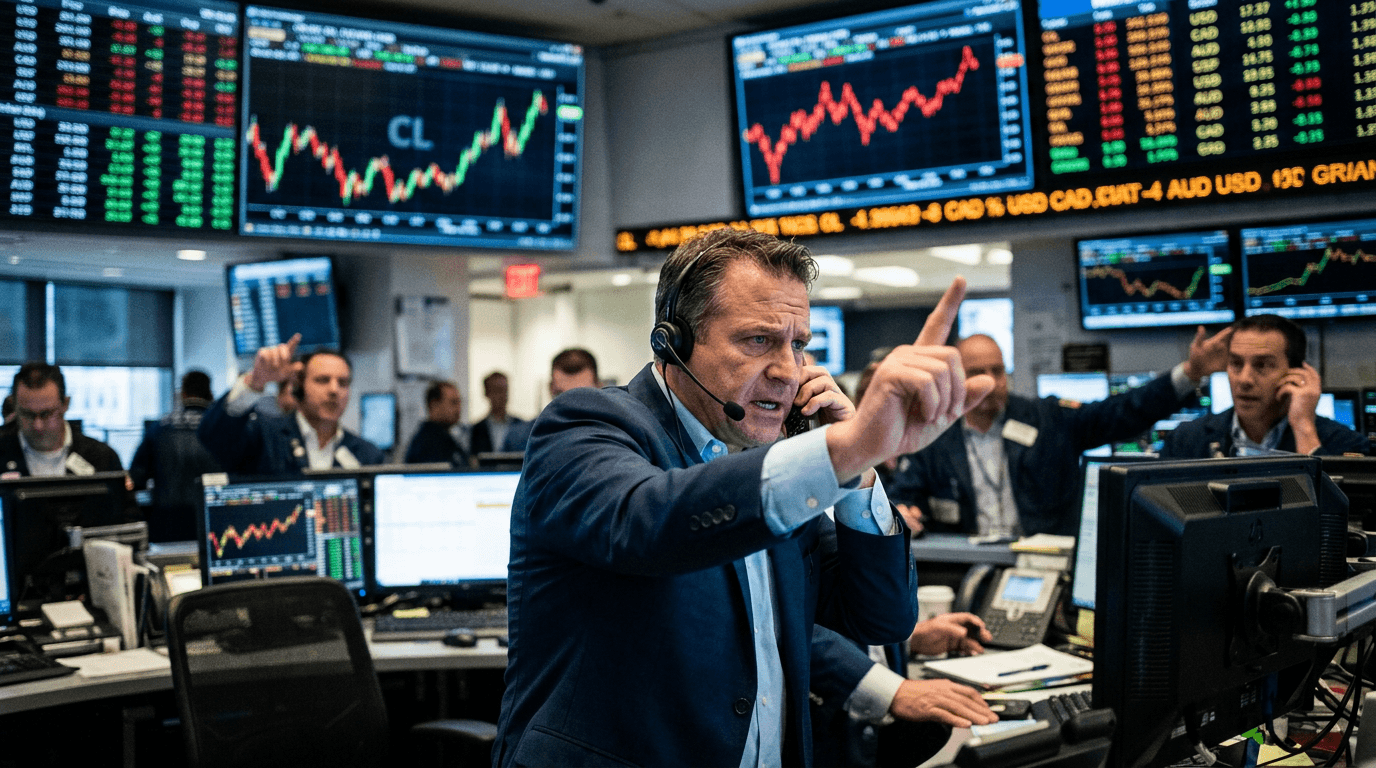
Crude oil futures are extending a powerful rally as traders price in the risk of a deeper war escalation and potential disruptions around the Strait of Hormuz, triggering violent intraday moves and a spike of roughly 9% in crude at one point.[3][7][9] The surge is not just an oil story—it is reshaping inflation expectations, lifting the U.S. dollar, and driving sharp moves across commodity-linked currencies and related futures such as grains.[1][5][9]
Oil Shock: Why War Escalation Matters So Much
In periods of geopolitical stress, oil is often the first asset to respond because it sits at the heart of global production, transport, and energy systems.[3][9] The current rally reflects fears that fighting around key Middle East chokepoints, especially the Strait of Hormuz, could impede flows of crude and refined products.[2][3]
Analysts estimate that recent hostilities have already removed millions of barrels per day from global supply, with some projections of losses around 4.5–5 million barrels daily—about 5% of world output—if disruptions deepen.[3] Even partial or temporary blockages of Hormuz can have outsized impact because roughly a fifth of globally traded oil passes through this narrow route between the Persian Gulf and the open ocean.[3]
Oil futures are reacting aggressively to this scenario risk. Brent, the global benchmark, has broken back into triple‑digit territory at times, while WTI futures have pushed well above prior ranges, underscoring that traders are pricing not only current disruptions but the possibility of prolonged instability.[2][7][8] When intraday moves are described as “violent” and include nearly double‑digit percentage spikes, that is a clear sign that optionality and hedging demand are dominating flow.[7][9]
For traders, this phase of the market is less about steady trend and more about shock risk. Headline sensitivity is extremely high, and liquidity can thin out around key news releases, amplifying price swings—conditions that simulated trading environments are designed to help participants experience and learn to navigate in a risk‑controlled way.
Inflation Expectations And Central Bank Repricing
Surging energy prices feed directly into inflation, both headline and, over time, core.[1][6][9] Higher crude raises costs for transportation, heating, and manufacturing, while also pushing up input prices for petrochemicals and fertilizer, which then affect food and broader goods inflation.[3][5][9]
Recent oil moves are already forcing markets to reassess their inflation outlook. Forward‑looking measures, such as breakeven inflation rates and inflation swaps, have ticked higher as traders consider that earlier hopes for a smooth disinflation path may have been too optimistic.[1][6][9] Commentators warn that another sustained oil shock could “bite the hands” of central banks that were preparing to slow or pause rate hikes.[6][9]
In the U.S., the rebound in energy prices has revived debate over whether the Federal Reserve will need to keep policy tighter for longer or even resume hikes if inflation proves sticky.[1][5][6] Similar conversations are emerging in other developed markets, where government bond yields have wobbled in response to rising oil and renewed price pressures.[10]
For macro‑oriented traders, this environment demands close attention to the interaction between oil futures and rate expectations. A sharp and persistent oil rally tends to:
- Lift inflation expectations and term yields
- Reinforce hawkish rhetoric from central banks
- Increase volatility in government bond and interest‑rate futures
On a simulated platform, you can test scenarios such as: “What happens to bond futures and FX when Brent holds above $110 for several weeks?”—a powerful way to build intuition about cross‑asset linkages.
Commodity-linked Fx: Who Benefits, Who Struggles
As oil surges, commodity‑linked currencies come into sharper focus. Historically, exporters like the Canadian dollar (CAD), Norwegian krone (NOK), and some emerging‑market FX have tended to benefit from higher energy prices, at least when risk appetite is stable.[9] Elevated oil improves their terms of trade, supports fiscal revenues, and can attract flows into local assets tied to resource sectors.
However, the current episode is not a simple “higher oil equals stronger commodity FX” story. Safe‑haven demand for the U.S. dollar is robust, driven by both war‑related uncertainty and the expectation that higher inflation may keep U.S. rates elevated.[1][6][9][10] This combination often leads to:
- A stronger dollar against a broad basket of currencies
- More mixed performance for commodity FX, with exporters supported fundamentally yet pressured by overall risk‑off sentiment
At the same time, higher energy and input costs weigh on import‑dependent economies and their currencies, especially those with current‑account deficits and limited policy flexibility. For such markets, an oil spike can quickly morph from an external shock into a balance‑of‑payments challenge.
Simulated trading allows you to explore these tensions in a controlled way: pairing oil futures with CAD or NOK, contrasting them with more vulnerable EM FX, and testing how different volatility regimes change correlations.
Beyond Energy: Ripple Effects In Grains And Equities
The current rally is not confined to oil. Grain markets, particularly wheat, have climbed to multi‑month highs as overlapping wars in the Middle East and Ukraine raise concerns about both energy and agricultural supply chains.[5] Higher fuel costs affect planting, harvesting, and logistics, while geopolitical disruption can interfere with Black Sea and other export routes.[3][5]
Energy‑intensive sectors and transport‑heavy industries feel the pinch fastest. Airlines, shipping companies, and some manufacturers see margins squeezed, while integrated energy producers and certain commodity‑linked equities may benefit.[7][10] Global equity indices have already shown signs of stress, with broad benchmarks under pressure even as some resource‑heavy names outperform.[7][10]
For multi‑asset traders, this is a classic environment where:
- Sector rotation becomes more important than broad index exposure
- Relative trades (e.g., energy producers vs. energy consumers) gain appeal
- Cross‑commodity strategies linking crude, refined products, and grains offer diversification but also complex risk
Using simulated portfolios, you can practice building baskets that reflect these themes—long positions in energy and select grains, hedged with short exposure to vulnerable sectors—without the emotional or capital pressure of live markets.
Conclusion And Key Takeaways For Traders
The extension of strong gains in crude oil futures on war escalation fears is more than a headline; it is a multi‑layer shock that touches inflation expectations, central bank policy, commodity‑linked FX, and broader commodity markets.[1][3][5][6][9] Violent intraday moves and double‑digit percentage spikes underscore how quickly sentiment can change when supply routes like the Strait of Hormuz are at risk.[3][7][9]
For traders and investors, three practical takeaways stand out:
1) Treat oil as a macro driver, not just a commodity. Rising crude is simultaneously an inflation story, a rates story, and a FX story. Align your analysis across these dimensions rather than viewing each in isolation.
2) Respect correlation shifts in stress regimes. Safe‑haven flows into the U.S. dollar and government bonds can offset what might otherwise be straightforward support for commodity‑linked currencies and cyclicals. Back‑testing in simulated environments can help you see when historical relationships break down.
3) Build and rehearse risk‑management plans before the next headline hits. Position sizing, use of options, and scenario analysis are critical in periods when a single geopolitical development can move major contracts by several percentage points in minutes.
Platforms like E8 Markets’ SimFi environment give traders the ability to experience these dynamics—oil shocks, inflation repricing, and FX rotation—in real time but with simulated capital, turning a turbulent market backdrop into an opportunity to learn, refine strategies, and prepare for the next phase of the cycle with greater confidence and discipline.