
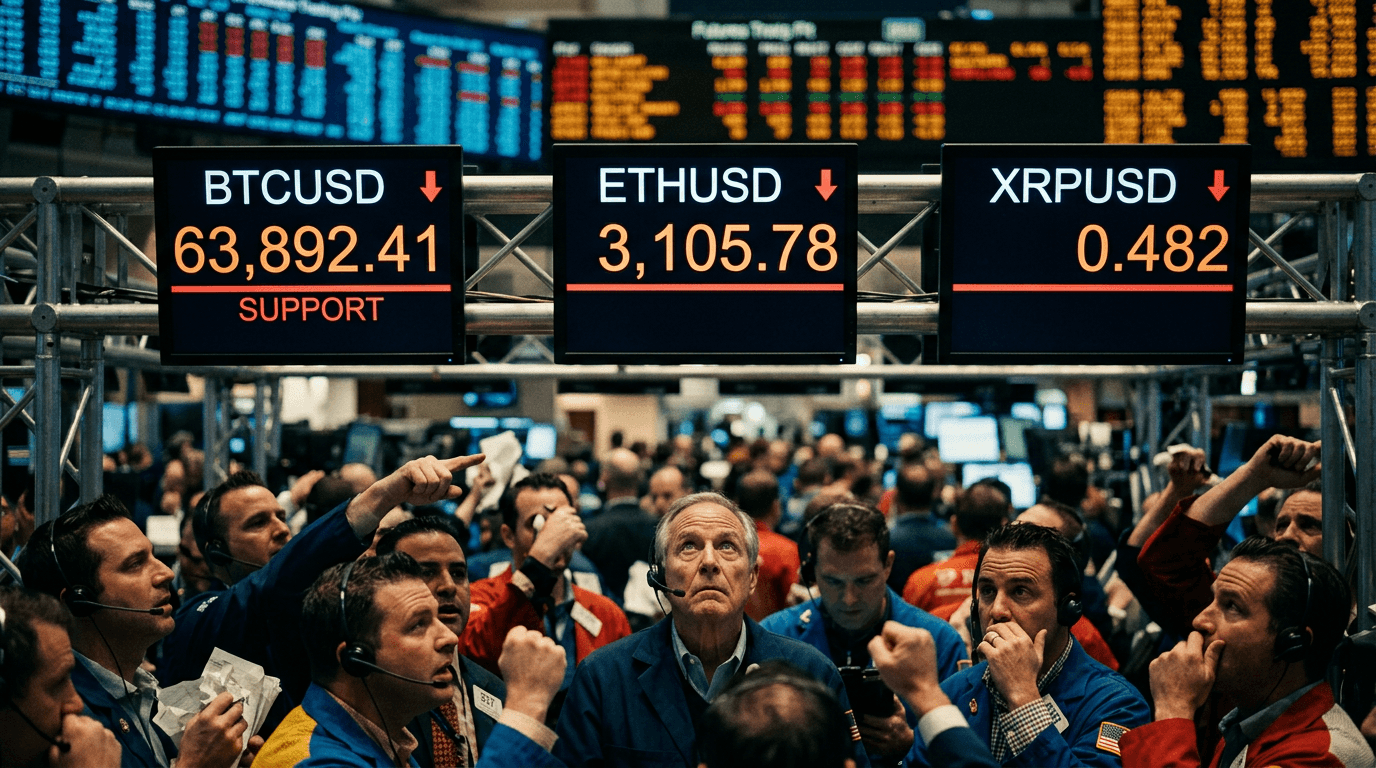
A sharp pullback has pushed Bitcoin, Ethereum and XRP back into crucial support zones, turning what was a confident grind higher into a more cautious, data-dependent market. Prices have bounced off their recent lows for now, but traders are watching these areas closely. Whether these levels hold or break will likely dictate the next phase of volatility across the crypto complex—either a constructive reset or the start of a deeper unwind.
Market Backdrop: Why This Support Test Matters
Pullbacks in strong trends are normal; what matters is how price behaves when it revisits key levels where previous buyers stepped in. Right now, Bitcoin is hovering just above a major support band that previously acted as resistance, while Ethereum and XRP are consolidating in relatively tight ranges. This clustering of assets near important levels is significant because correlations tend to rise when stress hits—if one major support fails, others often get tested in quick succession.
Support tests are also where positioning and leverage get exposed. After a rally, many traders trail stops up below obvious support. If price slices through those levels decisively, forced liquidations and algos can accelerate the move. Conversely, if buyers defend support with conviction, shorts get squeezed and the market can quickly rotate back higher. In short, these are inflection points, not verdicts.
BITCOIN: FORMER CEILING, NEW FLOOR?
Bitcoin’s current structure is a classic “role reversal” test: an area that capped price on the way up is now being challenged from above. When prior resistance turns into support, it can mark the backbone of a sustained trend higher—but only if buyers consistently step in on dips and intraday breaks are quickly reclaimed.
For traders, the focus is less on the exact level and more on behavior around the zone. Are sell-offs into support being absorbed on high volume, with strong bounces and wicks on downside probes? Or is each bounce weaker, with shallower recoveries and fading volume? The first pattern suggests healthy dip-buying; the second hints that fuel for the trend may be running low.
Another key dimension is how Bitcoin trades relative to macro sentiment. If risk assets broadly (equities, high-yield credit, tech) remain calm while BTC repeatedly struggles to hold support, that divergence can signal a crypto-specific shakeout. On the other hand, if BTC stabilizes even as broader risk wobbles, it reinforces the narrative of Bitcoin as a maturing, institutional asset.
Ethereum And Xrp: Consolidation With Hidden Information
While Bitcoin tests a clear horizontal band, Ethereum and XRP are more range-bound, grinding sideways near their own supports. This kind of price action often frustrates directional traders but contains valuable information for those willing to read it carefully.
For Ethereum, the key questions are: Is price carving out a pattern of higher lows above support, or are rallies getting sold more aggressively each time? Is ETH outperforming or underperforming BTC when the broader market attempts to stabilize? Persistent underperformance on “green days” can be an early sign that capital is rotating away from altcoins and into Bitcoin or stablecoins, signaling caution.
XRP’s range-bound structure is a classic “compression before expansion” setup. Volatility has contracted into a relatively narrow band, but that quiet condition rarely lasts. Traders should watch for a sustained break outside the range—confirmed by volume and follow-through—rather than reacting to every intraday spike. The direction of the eventual breakout, combined with how other majors are trading, can give a strong cue about the next broader move in altcoins.
How Traders Can Navigate Key Support Tests
Support tests are where trading discipline matters most. Many traders either overreact—panic-selling at the worst time—or underreact, averaging down into a breakdown with no plan. A more professional approach hinges on four pillars: levels, confirmation, sizing, and scenarios.
First, define your levels and invalidation points before you enter. Know exactly where your key supports and resistances are for each coin and at what price your thesis is wrong. For example, a trader might structure a BTC long around a support band with a stop just below the zone where prior bounces repeatedly failed. This clarity turns random volatility into planned risk.
Second, wait for confirmation instead of trying to pick the exact bottom. Evidence of confirmation might include stronger bounces from support, higher lows on shorter timeframes, volume increasing on green candles, or momentum indicators (like RSI) turning up from neutral or mildly oversold levels. You rarely buy the low; you aim to buy when the odds tilt in your favor.
Third, size positions to volatility. Elevated volatility around support tests makes tight stops and oversized positions a dangerous combination. Smaller size with enough room for noise can survive inevitable intraday whipsaws better than a large, tightly-stopped bet. In both live and simulated environments, consistent position sizing is one of the most overlooked drivers of long-run performance.
Finally, build scenarios, not certainties. Before the move happens, map out both bullish and bearish paths: If support holds and price starts to trend higher, what is your plan—add, reduce, trail stops? If support breaks and volatility spikes, do you step aside, look for short setups, or wait for the next major level? This playbook approach removes emotion and allows you to execute quickly when markets get fast.
What This Means For The Next Volatility Cycle
The current setup in Bitcoin, Ethereum, and XRP is less about predicting an immediate breakout or breakdown and more about recognizing that the market is coiling around important levels. Historically, periods of compression and back-and-forth chop around support give way to more directional, higher-volatility phases once a consensus emerges.
If buyers successfully defend these supports and push price back above recent local highs, it will reinforce the broader bullish structure and validate the idea that recent weakness was a healthy correction. In that scenario, traders who exercised patience and clear risk management around support can be rewarded with favorable trend-following opportunities.
If, instead, support gives way decisively with strong volume and little immediate recovery, the market’s character shifts. A deeper correction can flush leveraged longs, reset sentiment, and create better long-term entries—but only for traders who preserved capital by respecting their invalidation levels.
For both discretionary traders and those practicing in simulated finance environments, this is an ideal moment to refine process: test how your strategy behaves around inflection points, analyze past trades near key levels, and ensure your risk rules are robust to sudden volatility spikes.
In the end, Bitcoin, Ethereum, and XRP hovering near support after a pullback is not the answer to where crypto goes next—it is the question the market is asking. The response will show up not in a single headline or one dramatic candle, but in the interplay of price, volume, and correlations over days and weeks. Traders who focus on clear levels, disciplined risk, and scenario planning are best positioned to treat this phase as an opportunity to sharpen their edge rather than a source of anxiety.