
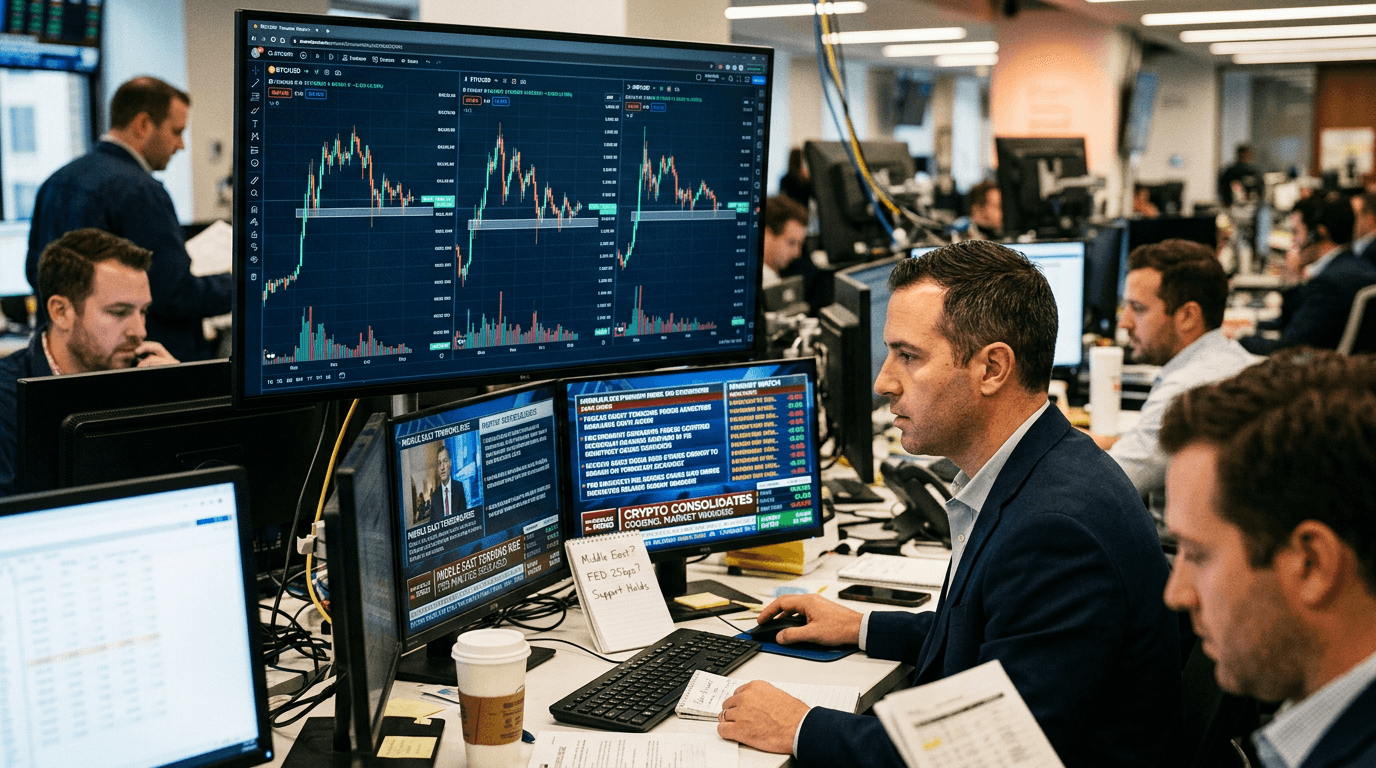
Crypto markets are pausing at a critical juncture. After a roughly 2% pullback, Bitcoin, Ethereum and XRP are trading cautiously near key support levels, with Bitcoin holding above the 71,000 area and Ethereum hovering around the 2,000 mark as traders weigh rising Middle East tensions and shifting expectations for the Federal Reserve. Rather than a full-blown risk-off capitulation, price action has settled into a consolidation phase, characterized by elevated but contained volatility and an intense focus on whether these supports will hold.
Market Snapshot: Bitcoin, Ethereum And Xrp At Key Levels
Bitcoin’s recent dip below the 71,000 threshold brought it back into a well-watched technical zone between roughly 71,300 and 73,000, identified by analysts as a “decision range” that could determine the next medium-term trend. A firm reaction higher from here would open the door to a retest of the mid-70,000s, while a breakdown could expose deeper support closer to the mid-60,000s. This is classic consolidation behavior: price oscillates within a band as market participants rebalance positions and digest new information.
Ethereum has followed a similar pattern. After rebounding from sub-1,900 levels earlier in the recent geopolitical flare-up, ETH is now pinned near the psychologically important 2,000–2,100 zone, which has acted as a key trading range for much of the past year. XRP, meanwhile, is holding around the 1.40 region, with initial support seen near 1.38–1.40 and resistance clustered around 1.49–1.54. All three majors are essentially “marking time” around technical lines in the sand.
The common thread is that buyers have not disappeared, but they have stepped back from aggressive risk-taking. The market is attempting to build or defend bases at these support levels, with each test providing information about the strength or fragility of underlying demand.
Geopolitical Risk: How Middle East Tensions Feed Into Crypto
Escalating tensions in the Middle East have shifted broader sentiment from a clean risk-on environment toward a more cautious risk-off stance. Recent headlines have included US–Iran confrontations, regional attacks affecting Gulf states, and ongoing strains involving Israel and non-state actors. Each flare-up introduces uncertainty about energy markets, global growth, and the potential for policy surprises.
For crypto, geopolitical shocks interact with several narratives:
- The “digital gold” thesis, where Bitcoin is seen as a hedge against systemic risk and currency devaluation.
- The “risk asset” reality, where crypto often trades like high-beta tech, selling off when volatility and uncertainty spike.
- The “liquidity-sensitive” dynamic, where flows depend heavily on central bank policy, funding markets, and institutional positioning.
In practice, the current episode shows a mixed response. We have seen sharp, news-driven moves lower, but not the sustained panic that would accompany a wholesale liquidation. Instead, traders appear to be selectively de-risking—reducing leverage, trimming marginal altcoin exposure, and concentrating on majors—while still willing to defend strategic support levels.
Historical behavior provides context. In previous Middle East flare-ups, Bitcoin has sometimes held or even recovered quickly after initial selloffs, suggesting that geopolitical risk alone is not decisive. It becomes more powerful when combined with macro headwinds such as tighter liquidity or negative regulatory surprises. The present consolidation near support suggests the market is trying to distinguish between temporary headline risk and more structural threats.
Technical Landscape: Support, Resistance And Volatility
Understanding the current setup requires a clear view of the technical landscape. Support and resistance levels are not magic numbers, but they do represent areas where supply and demand have historically shifted in meaningful ways.
For Bitcoin, the 71,000–73,000 band is important because it marks a cluster of recent daily closes, prior highs, and key moving averages. Above it, resistance appears near the mid-70,000s and previous local peaks. Below it, the next significant demand zones lie around the high-60,000s and then the mid-60,000s, where institutional buyers have previously stepped in.
Ethereum’s 2,000–2,100 area functions as both psychological and technical support, as much trading in 2024 has occurred in the 2,100–2,800 range. Below that, the 1,800 region has repeatedly attracted dip buyers; a break would raise the risk of a deeper move toward the 1,600–1,700 zone. XRP’s layered supports at 1.38–1.40 and then 1.34–1.30 show how liquidity tends to concentrate at round numbers and prior consolidation areas.
Crucially, volatility remains elevated but contained. Implied volatility in options markets and realized swings on spot charts are higher than during quiet, trending periods, but we are not seeing the disorderly spikes associated with extreme fear. This “contained volatility” regime is typical of consolidation: ranges widen, whipsaws increase, but the market does not yet commit to a new trend.
For traders, this has two key implications:
- Breakouts and breakdowns from these ranges are likely to be meaningful.
- Until those levels give way, fading extremes within the range (buying near support, selling near resistance) can be a viable tactic—provided risk is managed strictly.
Derivatives Positioning: What Futures And Options Are Signaling
Crypto futures and options add another layer of insight into this consolidation phase. A 2% pullback with elevated but stable volatility often reflects a rebalancing of leverage rather than a structural exit from the asset class.
In futures, open interest may decline as traders reduce high-leverage directional bets, particularly on smaller altcoins. At the same time, positioning can rotate toward majors like BTC and ETH, which offer deeper liquidity and tighter spreads. Funding rates on perpetual futures often compress toward neutral, signaling a more balanced market between longs and shorts.
Options markets, where implied volatility has remained elevated but not extreme, suggest that participants are pricing in further two-way risk without necessarily expecting a crash. Traders may be using puts to hedge downside at key supports while selling calls against spot or futures positions to generate premium in a range-bound environment.
Understanding these flows is essential for interpreting price action:
- Rising volatility with stable prices often means active hedging and gamma trading, not panic.
- A sharp drop in volatility alongside persistent consolidation can indicate growing complacency.
- A volatility spike coupled with a violent break of support is more likely to reflect genuine regime change.
Practical Takeaways For Simulated And Live Traders
For both simulated finance (SimFi) participants and live-market traders, this environment offers valuable lessons.
First, respect the levels. Support zones around 71,000 for Bitcoin, 2,000 for Ethereum, and 1.40 for XRP are not guaranteed to hold, but they are focal points for institutional and retail decision-making. Plan scenarios for both outcomes: bounces that lead to trend resumption and breaks that trigger expanded downside.
Second, size and leverage matter more when volatility is elevated. In consolidation regimes, false breakouts and sudden reversals are common. Using smaller position sizes, wider—but clearly defined—stop levels, and lower leverage helps reduce the risk of being whipsawed out of the market.
Third, separate signal from noise in geopolitical headlines. Not every development carries the same market weight. Try to distinguish between short-lived shocks and events that genuinely affect macro fundamentals, like energy prices, growth forecasts, or central bank paths.
Fourth, use SimFi environments to stress-test strategies. Practicing how you would respond if Bitcoin broke below 71,000 and accelerated toward 65,000—or, conversely, squeezed back above 75,000—helps build discipline and reduces emotional decision-making when real capital is on the line. Simulated trading allows you to refine entry and exit rules around support and resistance, experiment with hedging using options, and understand how your portfolio behaves as volatility shifts.
Finally, maintain a framework. Anchoring your decisions in a combination of technical levels, macro context, and derivatives signals is more robust than reacting to each price tick or headline. In periods like this—where major coins consolidate near key support amid geopolitical tension—the traders who thrive are those who treat uncertainty as a parameter to manage, not a reason to abandon their process.