
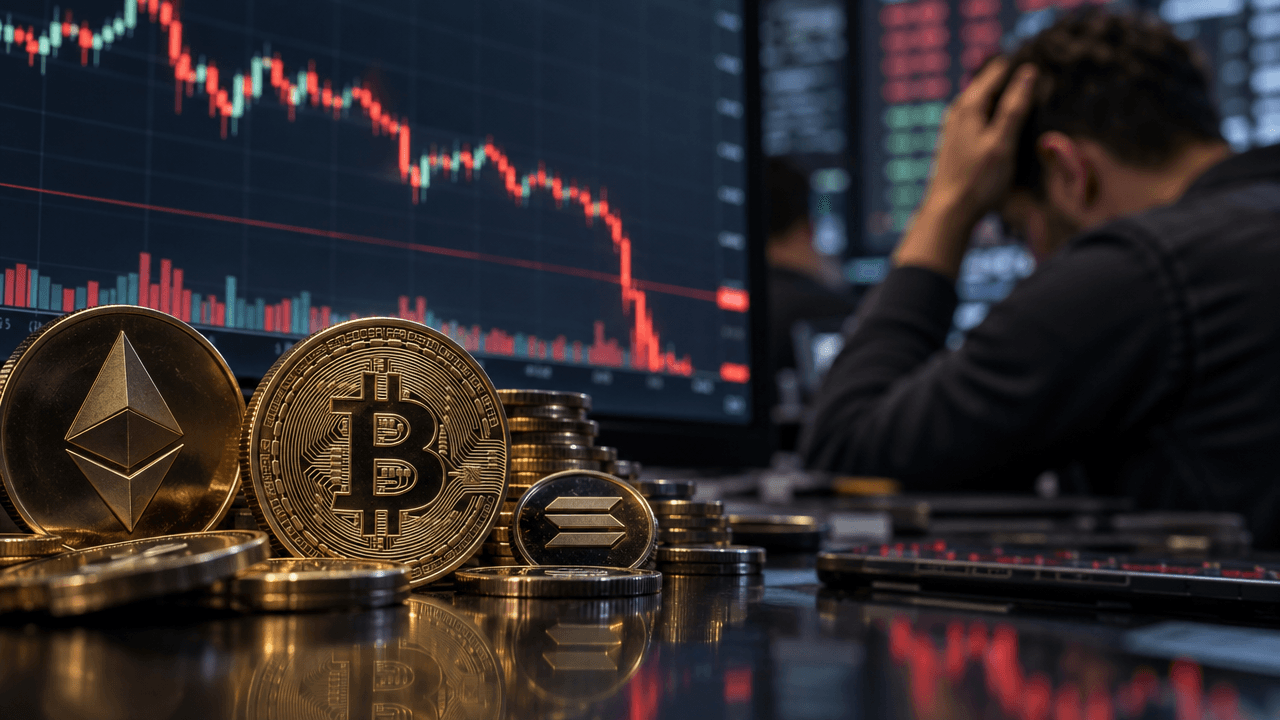
Crypto derivatives markets are once again reminding traders that leverage cuts both ways. With more than $120 million in futures positions liquidated in just 24 hours and tens of billions of dollars in open interest sitting on Bitcoin and Ethereum, the backdrop is primed for sharp, fast moves around key price levels. In a market where price can move several percent in minutes, heavily leveraged positioning can turn a routine pullback into a cascade of forced exits.
Derivatives Leverage: What The Numbers Say
To understand why these liquidations matter, start with open interest. Open interest in futures is the total notional value of outstanding contracts that haven’t been closed; it shows how much leveraged exposure is in the system at any given time.[8][12] When Bitcoin futures open interest hovers around tens of billions of dollars and Ethereum futures sit close behind, it tells you that a large share of market risk is concentrated in derivatives rather than spot.
Recent data from major venues shows aggregate crypto futures open interest frequently exceeding $100 billion across exchanges.[4][15] On some leading platforms, single-venue perpetual futures open interest has reached record highs, with one decentralised derivatives exchange alone reporting around $18 billion in open interest – nearly a tenth of the global total.[8] Against that backdrop, $124.8 million in liquidations over a single day is not an outlier; it is a reminder that these large, leveraged books are continuously being stress‑tested by price swings.
Crucially, leverage magnifies the impact of relatively small moves. At 10x leverage, a roughly 8–10% adverse move is often enough to trigger liquidation; at 20x or 50x, only a few percent against your position can wipe out the margin supporting the trade.[7][14] That dynamic means traders can be “right” on the longer‑term trend yet still get forced out by short‑term volatility if their leverage is too aggressive.
Why Liquidations Drive Volatility
Liquidation is not just a painful experience for individual traders; it is a structural feature that feeds back into price action. In crypto derivatives, a position is liquidated when the account’s equity falls below the maintenance margin requirement.[3][13] Once that threshold is breached, the exchange’s risk engine automatically closes the position—usually by executing market orders—to protect the borrowed funds and keep the account from going negative.
Those forced orders add directional pressure to the market. When leveraged long positions are liquidated, exchanges sell into the market, pushing prices lower and potentially triggering more liquidations in nearby positions.[14] When shorts are liquidated, forced buy orders push prices higher, sometimes causing short squeezes.[14] This is how an initially modest move can snowball into an outsized spike or crash.
History offers stark examples. During some of the largest liquidation events on record, total forced closures have run into the billions of dollars over 24–48 hours, transforming a routine correction into a waterfall decline or vertical squeeze.[9][11] Even in more typical trading conditions, dashboards tracking derivatives activity regularly report tens or hundreds of millions of dollars in 24‑hour liquidations, underscoring how fragile highly leveraged positioning can be when volatility picks up.[2][10]
For traders, the key point is that liquidation clusters often form around psychologically important levels—round numbers, prior highs or lows, or key moving averages—where many participants anchor their entries, stops, and risk parameters. As price approaches these zones, a sharp move through them can hit a dense band of leveraged positions and unleash a chain reaction.
What Traders Should Watch Right Now
In a landscape where crypto futures open interest remains high and liquidation totals are non‑trivial, traders should treat leverage as a risk factor, not just an opportunity. A few practical habits help:
First, monitor open interest alongside price. Rising open interest with trending prices often signals fresh leverage entering the market; if open interest builds while price stalls near major levels, it may indicate a crowded trade vulnerable to a squeeze or flush.[8][12] Sudden drops in open interest following a fast move often reflect forced deleveraging.
Second, pay attention to liquidation and funding data from derivatives analytics platforms. A spike in liquidations concentrated on one side of the market (longs or shorts) can mark exhaustion and sometimes precede local reversals.[2][10] Persistently high funding rates, meanwhile, suggest that one side is paying up to stay in a leveraged position, another sign of crowding.
Third, align leverage with your risk tolerance and time horizon. Short‑term scalpers may justify higher leverage if they have tight, disciplined exits and strong execution; swing traders and investors generally benefit from much lower leverage so that a normal pullback does not threaten their position. Always size positions so that a single liquidation event cannot materially damage your account.
Using Simulated Finance To Train Leverage Discipline
One of the challenges in learning leverage is that the lessons can be expensive. Because crypto derivatives combine high volatility with generous leverage limits, traders who experiment without a robust framework often only discover their true risk tolerance after substantial losses.[13] Simulated Finance (SimFi) offers a way to bridge that gap by letting traders practice in a realistic environment without real capital at stake.
On a SimFi platform, you can set up scenarios that mimic current market conditions: for example, trading Bitcoin and Ethereum futures with open interest near recent highs and deliberate volatility around support and resistance. You can then test how different leverage levels affect your results—running the same strategy at 3x, 5x, and 10x leverage and observing how drawdowns, liquidation risk, and psychological stress change.
This sandbox approach encourages experimentation with risk management tools that are often overlooked: partial profit‑taking before key levels, widening or tightening stop‑losses based on open interest and liquidation data, or reducing position size when funding rates and sentiment look stretched. Over time, traders build an intuitive feel for how much leverage they can responsibly deploy in a live account.
Conclusion: Navigating A Leveraged Market
The latest wave of more than $120 million in liquidations is not unprecedented, but it is a timely reminder that crypto remains a leverage‑driven market where derivatives can amplify every move. With tens of billions of dollars in open interest on Bitcoin and Ethereum futures and aggregate leverage still robust across venues, traders should expect volatility to accelerate around key price levels rather than fade.
In this environment, survival and consistency hinge on how you manage leverage. Understanding how open interest and liquidations interact, watching derivatives metrics alongside spot price, and stress‑testing your strategies in a simulated setting can turn leverage from a hidden threat into a controlled tool. For active traders and investors alike, the path forward is clear: respect leverage, design your risk rules before markets move, and treat every liquidation headline as a prompt to reassess—not to panic.