
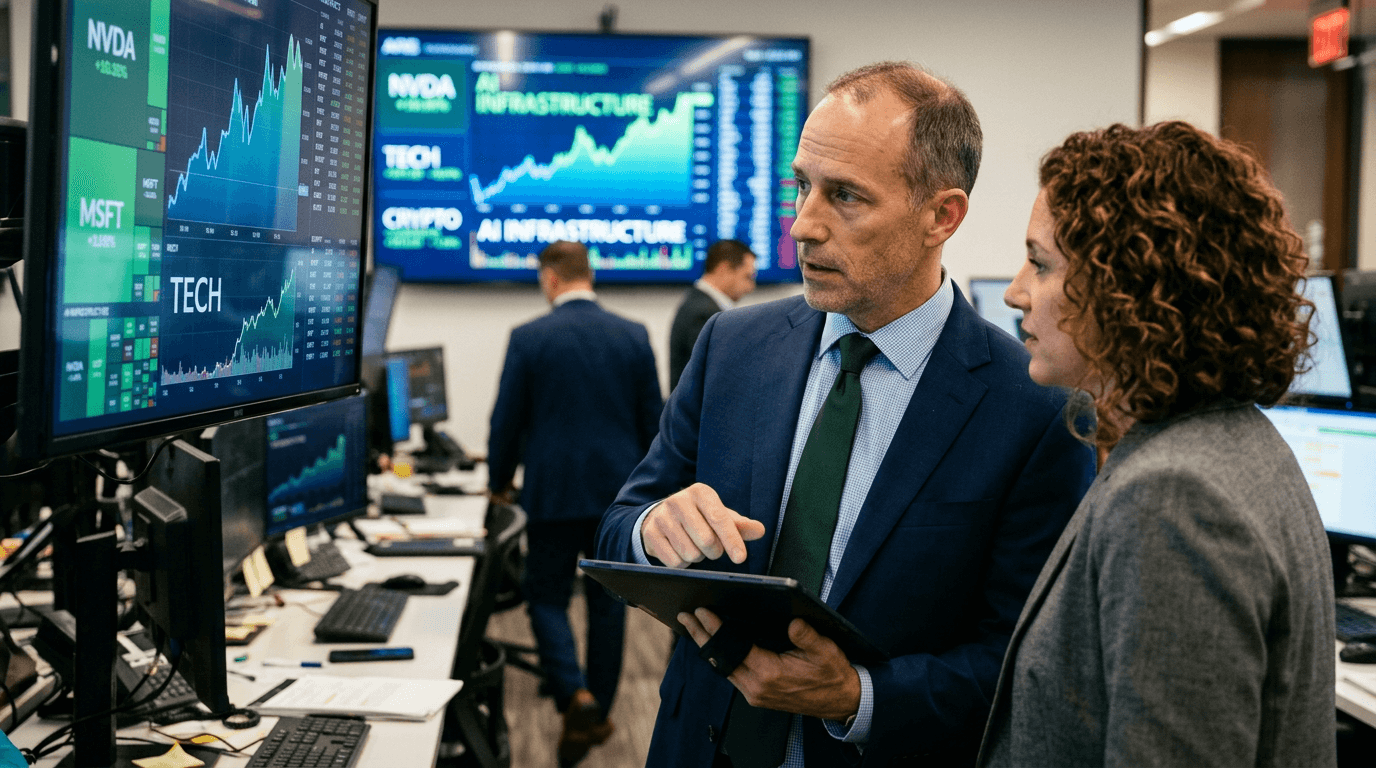
A fresh wave of AI infrastructure spending tied to NVIDIA-based hardware is rippling through markets, lifting sentiment in both mega-cap tech and crypto-equity names that lean on GPU narratives.[1][2][3] The latest multibillion-dollar cloud and AI contracts secured by Microsoft with specialist infrastructure providers reinforce the idea that hyperscalers are still in full build-out mode, even as investors debate the long-term return on this capital.[4][5][6] As headlines cross the tape, equity index futures are modestly firmer, led by AI-exposed tech, while select crypto assets linked to high-performance computing stories are catching a bid alongside them.[7] For traders, this intersection of AI, infrastructure, and crypto is less about a single deal and more about how narrative, positioning, and flows converge in one theme.
Ai Infrastructure Spending Sets The Backdrop
AI infrastructure spending is no longer a niche line item; it is a core driver of technology markets and, by extension, risk sentiment across asset classes.[8][12] Industry trackers estimate that worldwide AI infrastructure outlays reached roughly $86–90 billion per quarter in late 2025, closing the year at more than double 2024 levels.[8][15] Forecasts now see annual AI infrastructure spending pushing toward half a trillion dollars in 2026 and surpassing $1 trillion by the end of the decade, underscoring a sustained build phase rather than a short-lived bubble.[12][15] This pace of investment is being fueled by hyperscalers racing to secure capacity for large language models, generative AI workloads, and high-intensity inference at the edge.[1][9] In practice, that means capital committed years ahead of deployment, which creates a powerful signaling effect every time a new contract hits the wires.[4][6]
Recent deals highlight the scale of this commitment.[3][4][6] Microsoft has locked in multi-year access to hundreds of thousands of NVIDIA AI chips through agreements with providers such as Nscale and IREN, involving GB300-class GPUs deployed across large campuses in the U.S. and Europe.[3][4][6] Separate partnerships with Nebius, Lambda, and others add tens of thousands more GPUs and billions of dollars in contracted capacity to the pipeline.[1][2][5][14] For equity markets, each of these announcements reinforces the perception that the AI build-out is both global and durable, providing a structural tailwind to names in the GPU supply chain and their ecosystem.[3][4][6]
Gpu Narrative Bridges Tech Stocks And Crypto-equity
The immediate beneficiaries of infrastructure headlines are the obvious players: NVIDIA and other GPU manufacturers, data-center operators, and cloud platforms that monetize AI workloads.[3][4][6] However, the narrative rarely stops there. Publicly listed firms with exposure to high-performance computing, specialized cooling, power management, and AI development tools often trade in sympathy, as investors cluster anything related to “AI plumbing” into one thematic basket.[7][9] When a large contract is inked, the market effectively marks up the perceived future demand curve for these adjacent businesses, even if the revenue recognition is years away.[4][6]
On the crypto side, the linkage is more thematic and speculative but still potent.[7] Tokens associated with decentralized compute, GPU rental marketplaces, and high-performance blockchain networks often respond to AI infrastructure headlines because their core story is “access to compute at scale.”[7][9] In periods of optimism, traders extrapolate from traditional infrastructure deals to a broader thesis that demand for compute will spill into alternative networks and tokenized ecosystems. That can trigger short-covering in AI-themed crypto names, momentum chasing in smaller caps, and increased correlation between select tokens and AI equity indices.[7]
This is where “crypto-equity” comes into focus. Listed companies that pivoted from pure crypto mining toward AI-focused data centers or GPU hosting now sit at the intersection of both narratives.[3][4][6] Their share prices can react to AI headlines like a tech stock and to hash-rate or token price dynamics like a crypto asset. When a Microsoft-scale contract involving NVIDIA hardware crosses the tape, investors reassess the optionality embedded in these hybrid models, pushing them into the same momentum complex as pure-play AI infrastructure providers.[3][6]
Index Futures And Macro Tension
Despite the bullish tone in AI-related names, the macro backdrop remains complicated.[7] Rate expectations, inflation data, and growth concerns continue to inject volatility into index futures and sector rotation. What today’s price action shows is that a strong micro narrative—AI capex and infrastructure—can still drive relative strength in tech-heavy benchmarks even when the broader macro picture is unresolved.[7][10] Traders in equity index futures see this as an opportunity to lean into dispersion: the tech sleeve tied to AI performs better than defensives or cyclicals, even if the overall index move is modest.
At the same time, there is growing debate about whether AI infrastructure spending is outpacing near-term monetization.[7][15] Some investors worry that multi-billion dollar commitments to GPUs and data centers could weigh on margins if demand normalizes or if competition compresses pricing.[7] That tension creates a backdrop where positive contract headlines can rally markets in the short term but may also set up more pronounced corrections if the revenue payoff disappoints later. For futures traders, this translates into a need to distinguish between momentum trades on new headlines and longer-term views on earnings, free cash flow, and valuation.
For SimFi participants on platforms like E8 Markets, this environment is fertile ground for testing macro versus thematic strategies in a risk-controlled setting. Simulated trading allows users to explore how index futures react to AI and infrastructure news without capital at risk, building an intuitive feel for how narratives translate into price.[7][8]
Practical Takeaways For Traders
First, treat AI infrastructure headlines as catalysts, not guarantees. A new NVIDIA-based contract for a hyperscaler tends to boost sentiment in GPU suppliers, data-center partners, and AI-exposed software names, but the magnitude and duration of the move depend heavily on positioning and macro context.[3][4][6] Look at how the market was leaning beforehand—crowded long versus skeptical—before chasing the reaction.
Second, recognize the different layers of the theme. Core beneficiaries are direct contract participants and their closest suppliers; secondary beneficiaries include firms providing power, cooling, or specialized services; tertiary names are narrative-linked sectors and AI-themed crypto tokens.[3][7][9] Mapping this hierarchy helps avoid overpaying for distant plays when the move is most justified in the core.
Third, be explicit about the role of crypto-equity in your strategy. Hybrid miners-turned-AI hosts and decentralized compute projects can amplify both upside and downside when narratives shift.[3][7] Their volatility profile is closer to small-cap growth or high-beta crypto than to stable large-cap tech. Use size and risk limits that reflect that reality, especially in a simulated environment where the objective is skill-building rather than pure P&L.
Fourth, think in scenarios rather than straight-line extrapolations. One path is continued AI capex acceleration, validating current valuations and supporting multi-year uptrends.[8][12] Another is a transition from “build first” to “monetize now,” where markets scrutinize ROI and punish underperformers.[7][15] A third involves macro shocks—rates or growth—that swamp thematic tailwinds. SimFi lets traders rehearse each scenario, calibrating how their strategies might respond.
Conclusion
The latest NVIDIA-powered AI and cloud contract delivered for Microsoft is more than a single headline; it is another data point in an ongoing capital expenditure cycle reshaping both equity and crypto markets.[3][4][6] As infrastructure spending climbs toward record levels, the intersection of AI, GPU capacity, and tokenized compute is becoming a key trading theme rather than a niche curiosity.[7][8][12] For traders, the opportunity lies in understanding how these narratives propagate through tech stocks, crypto-equity, and index futures—and in using simulated environments to practice expressing those views with discipline. In a market where AI capex and macro uncertainty coexist, the edge will belong to those who can separate durable structural trends from short-lived sentiment bursts and position accordingly.