
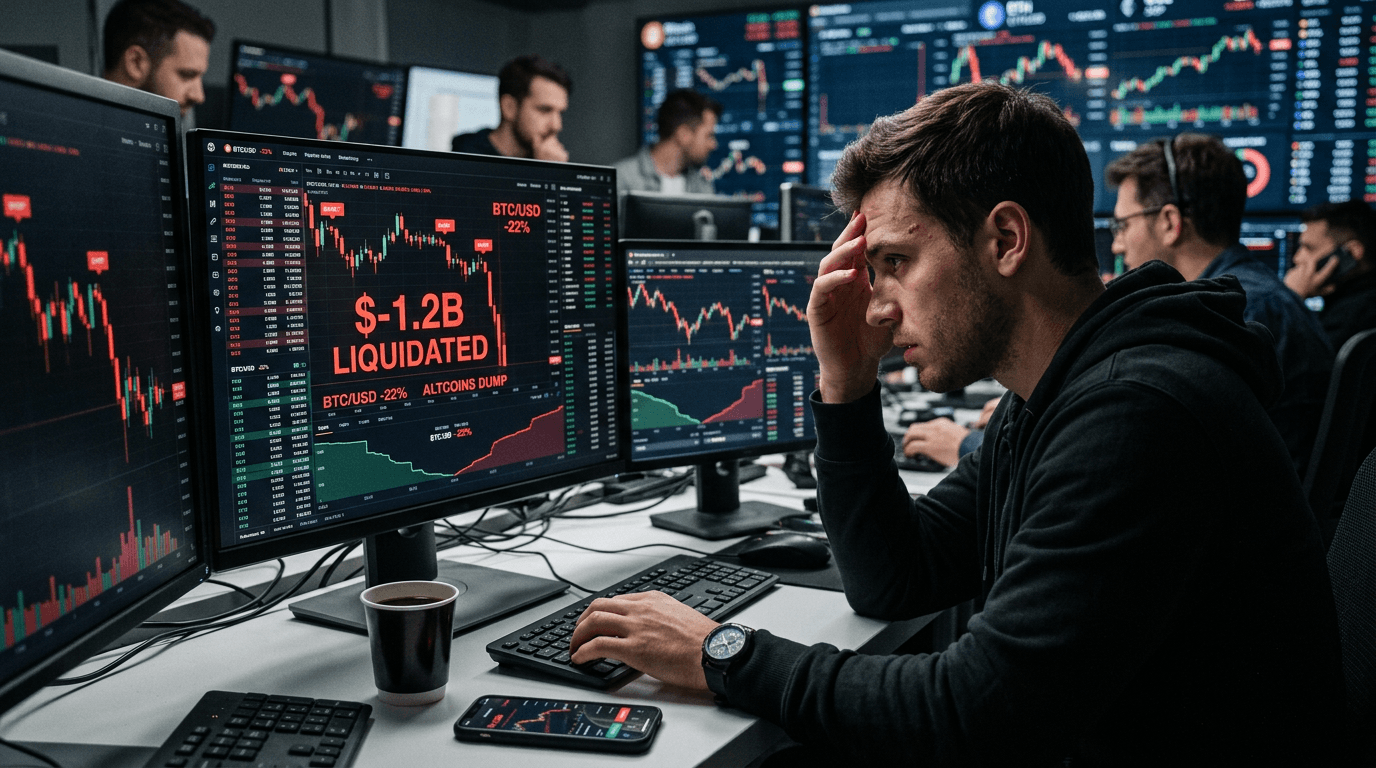
When more than $1.2 billion in crypto futures positions are liquidated in just 24 hours, the message is clear: leverage has become a key driver of market volatility rather than just a tool for amplification[4][9]. In this latest episode, rapid unwinding of leveraged trades has magnified price swings in Bitcoin and major altcoins, turning what might have been a normal pullback or rally into a sharp, emotionally charged move across the market[4][8].
Markets Just Experienced A Leverage Shock
Large-scale liquidation waves have become increasingly common in crypto, with recent episodes wiping out over $1.2 billion in leveraged futures positions and affecting hundreds of thousands of traders in a single day[4][9]. In some cases, more than $1 billion in short positions have been liquidated within roughly an hour as prices spike higher, forcing sellers to buy back at unfavorable levels[8][9]. Other periods show the opposite pattern, with long positions accounting for close to 90% of total liquidations when markets suddenly turn lower[4][10]. Even on quieter days, the derivatives market regularly posts hundreds of millions of dollars in forced closures, underscoring how embedded leverage is in crypto trading behavior[10][12][13].
This latest $1.2 billion liquidation event fits into a broader pattern: leverage builds up during periods of perceived stability, then reverses violently when new information or a technical break disrupts consensus[4][9]. A policy shift, macro surprise, or even a strong breakout in Bitcoin can quickly flip positioning and trigger a cascade of margin calls across exchanges[8][9]. For traders, the key takeaway is that “volatility events” are often leverage events in disguise, with futures markets acting as the transmission mechanism between sentiment and price action[9][14].
What Mass Liquidations Mean For Volatility
Crypto liquidations occur when a leveraged futures position is forcibly closed because the trader no longer meets margin requirements as prices move against them[14]. When this happens on a large scale, the closing of positions itself becomes additional market flow, pushing prices further in the same direction and amplifying the original move[9][14]. During recent liquidation waves, Bitcoin and Ethereum have repeatedly led the notional totals, with tens of millions of dollars in futures wiped out in 24 hours even outside the largest events[10][12]. Altcoins like XRP also show pronounced liquidation spikes, often with an overwhelming majority of positions on one side of the market being forced out[10].
This asymmetry matters for volatility. When liquidations skew heavily toward longs, it tends to coincide with sudden downside moves as bullish traders are forced to sell into falling prices[4][10][13]. Conversely, when short liquidations dominate, price action is often sharp and upward, as bears are compelled to buy back into a rising market, fueling short squeezes and intraday spikes[8][9][12]. Recent data has captured both regimes: episodes where more than 80% of liquidations come from shorts during squeezes, and periods where longs absorb the bulk of losses during abrupt pullbacks[4][10][12]. For risk management, the direction and concentration of liquidations offer clues about whether a move is primarily driven by forced flows or organic demand.
Which Traders Were Hit The Hardest
In the latest large deleveraging event, long positions appear to have accounted for the majority of the $1.2 billion-plus in liquidations, mirroring previous episodes where roughly nine out of ten dollars in losses came from bullish traders caught overextended near recent highs[4][10]. These traders often combine high leverage with tight margin buffers, leaving little room for routine intraday volatility before their positions are closed automatically[4][14]. Historically, Bitcoin and Ethereum futures have made up a significant share of total liquidation notional, reflecting their role as core collateral and primary leverage vehicles for many participants[4][9][10].
However, altcoin traders are frequently at greater relative risk because smaller tokens can exhibit larger percentage swings and thinner liquidity when volatility spikes[10][13]. In past events, liquidation totals have shown meaningful contributions from altcoins despite their lower market capitalizations, indicating that speculative leverage is widely distributed beyond just Bitcoin and Ethereum[10][13]. The profile of traders most affected tends to include short-term momentum strategies, high-frequency scalpers, and retail participants using cross-margin without fully understanding how fast requirements can change in stress scenarios[14]. Recognizing this profile can help traders identify whether their own approach resembles those most exposed during liquidation cascades.
Lessons For Leveraged Traders
The recurring pattern of billion-dollar liquidation waves offers several practical lessons for active traders using futures. First, leverage should be a variable, not a constant: it is generally safer to reduce position size and leverage when realized volatility and liquidation totals start to climb, as these conditions increase the probability of forced exits regardless of trade thesis[1][12][13]. Second, monitoring open interest and liquidation dashboards can provide early warning signals of crowded trades; surging open interest alongside extreme sentiment can precede both long squeezes and short squeezes[5][15]. Third, it is essential to stress-test positions against historical moves, including scenarios where short liquidations exceed $1 billion in an hour or total futures washouts reach $1.5–2.0 billion over a day[8][9].
Risk tools such as hard stop-loss levels, narrower leverage, and isolated margin can materially reduce the chance that a single move triggers a portfolio-wide margin call[14]. Traders can also benefit from diversifying across instruments with different volatility profiles, avoiding excessive concentration in highly speculative altcoins during unstable periods[10][13]. Most importantly, framing futures as a precision tool for hedging or tactical exposure, rather than a vehicle for constant maximum leverage, aligns trading behavior with the structural realities of liquidation-driven volatility[9][14].
How Simulated Trading Can Turn Volatility Into A Lesson
Simulated finance environments allow traders to experience billion‑dollar liquidation conditions without risking actual capital, making them valuable laboratories for learning how leverage behaves under stress. By replaying scenarios where Bitcoin short liquidations approach $2 billion in 24 hours or long liquidations dominate a $1.2 billion wipeout, traders can observe how margin levels, funding rates, and order book depth evolve through the cycle[4][8][9]. This controlled setting makes it possible to test different leverage levels, collateral allocations, and stop‑loss rules against extreme, but realistic, market paths.
Practicing in simulation also highlights the difference between volatility that is fundamentally driven and volatility that is mechanically driven by forced unwinds[9][14]. Traders can compare outcomes when they scale positions up into calm conditions versus scale down as liquidation counts rise, building intuition for how quickly paper gains can turn into realized losses in a highly leveraged system[12][13]. Over time, this helps convert the abstract concept of “risk of ruin” into a concrete understanding grounded in data and experience, improving decision‑making when similar conditions appear in live markets.
Conclusion
Crypto futures liquidations exceeding $1.2 billion in a single day are not just headline-grabbing statistics; they are reminders that leverage is now a central force shaping price behavior in digital assets[4][9]. These events show how quickly positioning can flip from calm to stressed, and how Bitcoin, Ethereum, and altcoins can all become conduits for forced flows rather than voluntary trades[4][8][10]. For traders, the path forward lies in combining robust risk management, active monitoring of derivatives metrics, and hands‑on practice in simulated environments to internalize how leverage and volatility truly interact[9][14]. Those who learn from these liquidation waves, rather than simply endure them, will be better positioned to navigate the next burst of crypto volatility with discipline and confidence.