
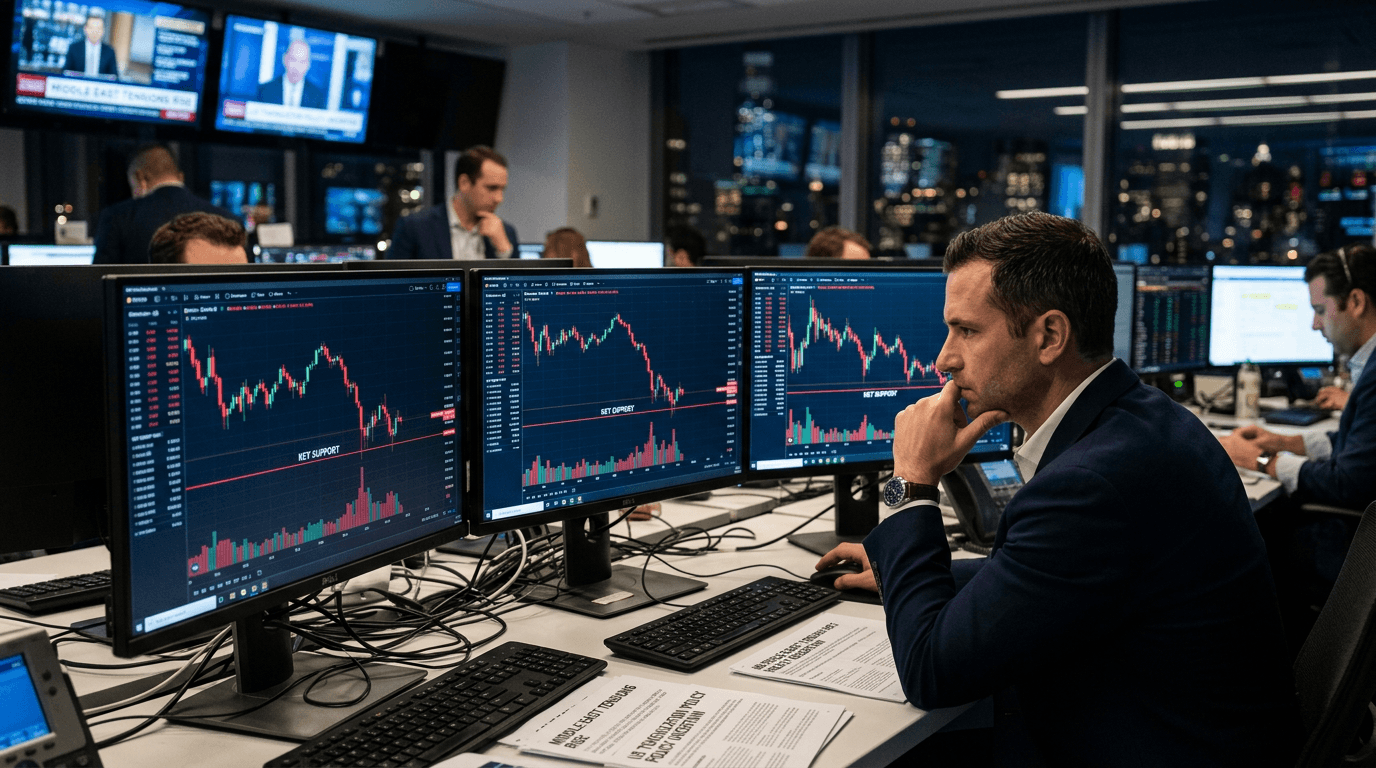
Top cryptocurrencies are catching their breath after a sharp but contained pullback, with Bitcoin holding just above the psychologically important $71,000 zone, Ethereum clinging to support near $2,000, and XRP consolidating after a roughly 2–3% drop.[12][6] This pause comes against a noisy backdrop of Middle East tensions and evolving U.S. regulatory guidance on tokenized securities and ETFs, keeping volatility elevated across both spot and derivatives markets.[12][10][11]
Market Snapshot: Cryptocurrencies Test Key Support
The latest price action is classic “pause at support” behavior after a fast move lower, rather than a full trend reversal. Bitcoin has slipped below recent highs but continues to defend the low-$70,000 range, even after a single-session decline of about 3% and a surge in trading volumes of roughly 150%.[12][6] Ethereum, meanwhile, remains locked around the $1,800–$2,000 support band that has repeatedly attracted dip buyers over recent weeks.[6] XRP has retreated as well, but price is stabilizing near $1.30 after its own 2–3% pullback, with flows into related investment products showing signs of recovery.[12][6]
From a technical perspective, these zones matter because they represent areas where buyers previously absorbed selling pressure. For Bitcoin, the $70,000–$71,000 cluster has acted as a pivot between trend continuation and deeper correction, making it a key level to watch for both short-term traders and longer-term allocators.[6] Ethereum’s $1,800–$2,000 band carries similar importance, serving as a floor during recent pullbacks while coinciding with heavy futures open interest.[6] For XRP, consolidation around the mid-$1 area is notable because it is happening alongside improving ETF and product inflows, suggesting that institutional interest has not disappeared.[6]
Geopolitical Risk: War Keeps Volatility Elevated
The near-term catalyst for the latest bout of selling pressure is the renewed uncertainty around the Middle East, where concerns about the Israel–Hezbollah front and the durability of a cease-fire with Iran are weighing on broader risk sentiment.[12][6] Each headline that questions the stability of the region tends to trigger a flurry of hedging across global markets, including crypto, as traders reassess energy prices, growth expectations, and safe-haven demand.[12]
This dynamic is visible in Bitcoin’s behavior. After briefly rallying on earlier cease-fire optimism, Bitcoin’s rejection above $72,000 and slide back toward the low-$70,000 band illustrates how sensitive the market remains to geopolitical shocks.[6] Ethereum’s struggle to decisively reclaim levels above $2,000 and XRP’s choppy consolidation tell the same story: traders are willing to hold positions but are quick to reduce risk when headlines turn negative.[12][6]
For traders, the key takeaway is that headline risk can override technical patterns in the short term. Support levels may hold, but intraday volatility can expand quickly as news flow oscillates between escalation and de-escalation. Managing position size, using defined stop levels, and avoiding excessive leverage becomes especially important when geopolitical developments, rather than clean macro data, are driving the tape.
Fed, Sec, And Tokenized Securities: Structural Shift In The Background
While geopolitical risks dominate day-to-day price swings, regulatory developments around tokenized securities and ETFs are quietly reshaping the structural backdrop for digital assets. U.S. regulators have clarified that tokenized versions of traditional securities—equities, Treasuries, and index-tracking ETFs—remain subject to the same federal securities laws as their non-tokenized counterparts.[11] That means registration, disclosure, and investor protection requirements apply regardless of whether ownership is recorded on-chain or in legacy databases.[11]
At the same time, the SEC has approved Nasdaq’s proposal to allow trading of certain tokenized securities and ETFs on the same order book and with the same execution priority as traditional shares, provided the tokenized instruments are fully fungible and carry identical rights.[10] Eligible assets include highly liquid stocks in the Russell 1000 index, U.S. Treasuries, and major index ETFs such as those tracking the S&P 500 and Nasdaq-100.[10]
For crypto traders, this matters in several ways. First, it signals growing institutional comfort with blockchain-based market infrastructure, even if the assets themselves are traditional securities rather than native crypto tokens.[10][11] Second, it strengthens the bridge between on-chain markets and mainstream financial products, potentially increasing the role of stablecoins, tokenized treasuries, and cross-market arbitrage strategies in overall portfolio construction.[10] Third, it reinforces the message that regulation will follow assets into the digital realm, reducing the likelihood that tokenization alone can sidestep legal obligations.[11]
How Derivatives Are Framing Risk
Derivatives markets provide a useful window into how sophisticated participants are reading the current mix of war risk and regulatory change. Recent analytics show at-the-money implied volatility in major crypto options trading close to year-to-date lows, even as Middle East tensions remain elevated.[1] This suggests that, while spot prices have moved sharply on headlines, options traders are not yet pricing in an extended period of extreme turbulence.[1]
One interpretation is that the market sees the current pullback as a relatively contained shakeout within a broader bullish structure, rather than the start of a prolonged bear phase. Another is that traders prefer to express caution by reducing directional exposure in futures and spot, rather than paying up for options protection.[1] In either case, the combination of subdued implied volatility and higher realized swings underscores the importance of monitoring both markets, not just price levels.
For active traders, this environment creates opportunities and risks. Short-dated options may appear cheap relative to the headline noise, but their value depends on whether volatility persists or fades. Futures positioning can reveal where large players are leaning—toward hedging, carry trades, or outright speculation—helping simulated traders on platforms like E8 Markets test strategies that respond dynamically to changing volatility regimes.
Practical Takeaways For Simulated Traders
For traders using SimFi environments to refine their approach, this kind of market backdrop is an ideal live-fire laboratory without real capital at risk. Several practical lessons stand out.
First, learn to map key support and resistance zones and track how price reacts around them. Watching Bitcoin around $70,000–$71,000, Ethereum around $1,800–$2,000, and XRP near the mid-$1 range helps train the eye to distinguish between healthy pullbacks and more serious breakdowns.[12][6]
Second, integrate geopolitical and policy narratives into your trading plan without overreacting to every headline. Simulated trading is a powerful way to test rules such as “reduce leverage when war-related news intensifies” or “avoid opening new positions immediately before major regulatory announcements.”
Third, pay attention to the growing intersection between crypto and tokenized traditional assets. As regulated exchanges list tokenized versions of stocks, treasuries, and ETFs, strategies that span both worlds—like basis trading between tokenized and traditional ETFs or yield management across stablecoins and tokenized treasuries—will become more relevant for advanced traders.[10][11]
Finally, use derivatives data as a risk compass. Comparing implied and realized volatility, studying options skews, and monitoring futures open interest can help you understand when the market is complacent, fearful, or opportunistic.[1] Practicing this analysis in a simulated setting builds the discipline needed to navigate real capital markets when conditions turn volatile.
Conclusion
Top cryptocurrencies are clustering near key support after a brisk pullback, caught between the push and pull of war-related headline risk and a slow-moving but meaningful evolution in U.S. regulatory and market structure around tokenized securities and ETFs.[12][6][10] For traders, the message is clear: price levels matter, but they exist within a broader ecosystem shaped by geopolitics, policy, and derivatives behavior. Using simulated environments to stress-test strategies across these dimensions—technical, macro, and structural—can turn short-term turbulence into long-term learning, positioning traders to act with greater confidence when the next wave of volatility arrives.