
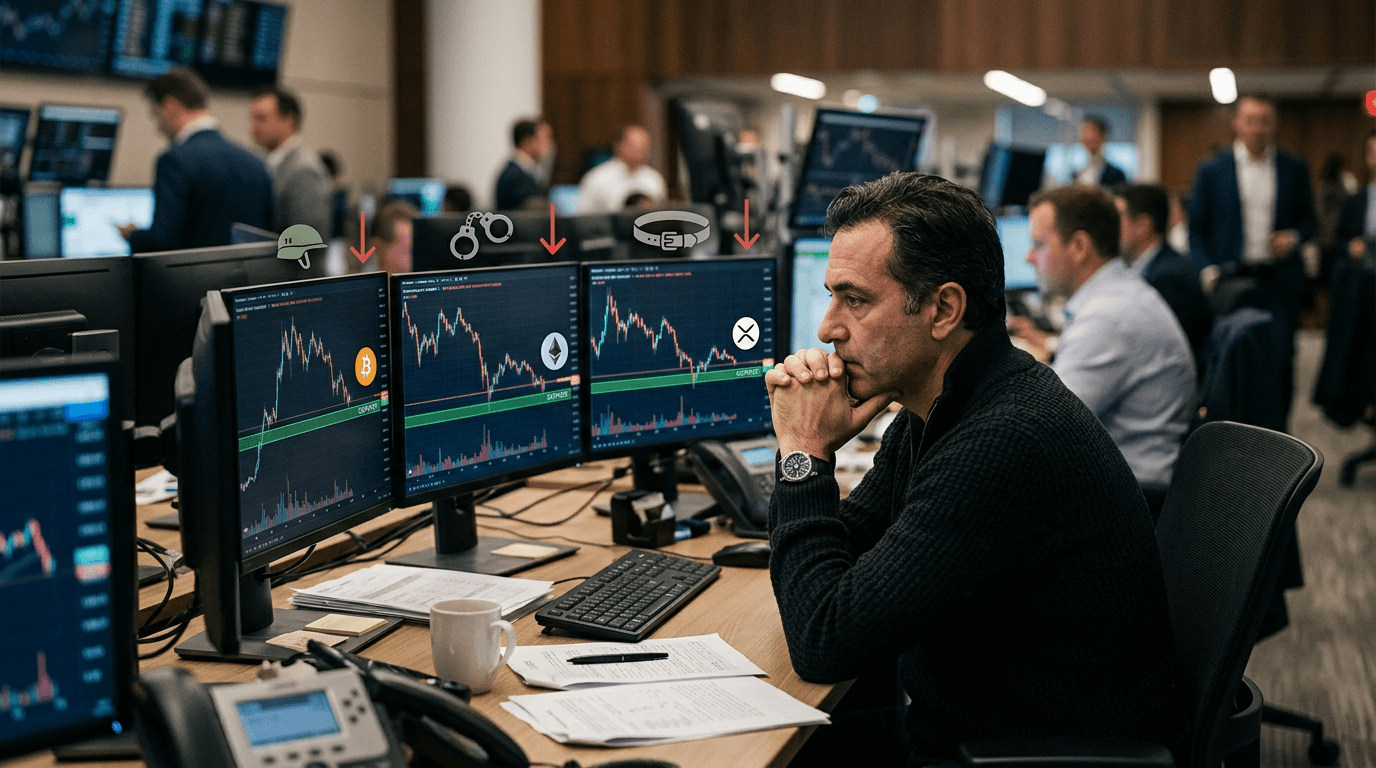
Major cryptocurrencies are pausing at crucial levels. Bitcoin, Ethereum, and XRP are holding just above key technical support after a sharp pullback, but the tone has shifted from aggressive dip-buying to cautious observation. Traders are weighing war-related headlines, tighter financial conditions, and regulatory uncertainty, and the result is a slower, more defensive market—even while prices remain relatively elevated versus their longer-term lows.
Market Snapshot: Cautiously Above Support
The current structure is classic “late-stage uptrend under stress.” Prices are closer to recent highs than to the last major swing lows, yet momentum has cooled. Breakouts are failing faster, and instead of chasing new highs, traders are focused on whether support holds.
For Bitcoin, the market is watching clearly defined zones on the daily chart where previous breakouts started and where moving averages cluster. Ethereum and XRP show similar patterns: consolidation bands where prior resistance turned into support. As long as these areas hold on a closing basis, the broader uptrend technically remains intact.
However, the behavior around these levels has changed. Instead of sharp V-shaped bounces, the market is seeing slower, overlapping price action. That usually signals two things: dip buyers are more selective, and sellers are more willing to lean into rallies.
What Funding Rates And Volumes Are Telling Us
Derivatives markets are providing important clues about positioning beneath the surface. Funding rates on perpetual futures have eased from previously elevated levels, and trading volumes have softened across major exchanges.
Funding rates matter because they reflect the imbalance between longs and shorts. When funding is strongly positive, longs are paying shorts, signaling bullish crowding. The recent moderation in funding suggests three shifts:
1) Fewer traders are willing to pay up for leveraged bullish exposure. 2) Some prior longs have been flushed out or scaled back. 3) The market is moving from “fear of missing out” to “wait and see.”
Lower volumes reinforce this defensive stance. In periods of strong conviction—either bullish or bearish—volume tends to expand as new capital enters or exits aggressively. Right now, reduced turnover implies that many participants are sitting on their hands, unwilling to commit until the macro and regulatory picture becomes clearer.
For active traders, this environment has two implications. First, breakouts and breakdowns can be less reliable, with thinner liquidity increasing the risk of false moves. Second, it becomes more important to track derivatives metrics—funding, open interest, and options skew—to spot when conviction starts to rebuild in either direction.
War Risk, Macro, And The Safe-haven Narrative
Geopolitical risk is once again on the front page. Tensions and conflict—whether in the Middle East, Eastern Europe, or elsewhere—have historically triggered bouts of risk aversion across global markets. Traditional safe havens like the US dollar and gold often see inflows, but the role of crypto is more nuanced.
Bitcoin’s “digital gold” narrative means some investors treat it as a long-term hedge against monetary and political instability. However, in the short term, crypto still behaves largely as a high-beta risk asset: during acute stress, it often sells off alongside equities as investors de-lever and rush into cash.
This dual identity helps explain the current cautious mood. On one hand, longer-horizon holders may see geopolitical turmoil as validation of crypto’s long-term value proposition. On the other, leveraged traders recognize that sudden headlines can trigger rapid liquidations, margin calls, and forced selling.
Tighter financial conditions add another layer. Rising yields, stickier inflation, or a more hawkish central bank stance increase the cost of leverage and reduce appetite for speculative assets. When war risk and tighter policy collide, traders tend to prioritize capital preservation over aggressive risk-taking, which is exactly what current positioning suggests.
Regulation Overhang: Why It Matters For Pricing
Regulatory uncertainty is the second major lid on enthusiasm. While the details vary by jurisdiction, the broad themes are similar: governments and regulators are moving toward stricter oversight of exchanges, stablecoins, DeFi, and crypto tokens more broadly.
In the US and other major markets, ongoing enforcement actions and evolving classification debates (security vs. commodity vs. something else) create a persistent “policy overhang.” Traders are not just worried about today’s rules; they’re worried about what could change next—on issues like:
- Exchange licensing and operational requirements
- KYC/AML standards and enforcement
- Stablecoin backing and disclosure rules
- Tax treatment and reporting obligations
For prices, this uncertainty shows up as a valuation discount and a higher risk premium. Projects and tokens that lack regulatory clarity often see suppressed valuations and more violent reactions to headlines. Even for majors like BTC and ETH, regulatory noise can dampen upside momentum by discouraging institutional participation or triggering de-risking from more cautious funds.
From a trader’s standpoint, regulation-related risk behaves a lot like event risk around central bank decisions or major economic data: it’s lumpy, asymmetric, and hard to time. That makes scenario planning essential.
Trading Playbook: How To Navigate This Phase
A cautious market sitting on support requires a different playbook than a roaring bull or a full-blown crash. A few practical principles stand out:
1) Respect key levels—but don’t over-leverage around them. Support zones on BTC, ETH, and XRP are obvious to everyone, including large players. They can hold multiple times, then fail abruptly. Use them as reference points, not guarantees. Lean toward smaller position sizes and modest leverage when trading near these lines in the sand.
2) Size for headline risk. In an environment where a single war-related update or regulatory announcement can move Bitcoin by thousands of dollars in minutes, position sizing becomes risk management priority number one. Many traders adapt by: - Reducing leverage and overall exposure - Widening stop-loss levels but lowering position size - Avoiding concentrated bets into known event windows
3) Use scenarios instead of predictions. Rather than asking, “Will conflict escalate?” or “Will regulators crack down?” build conditional plans: - If tensions ease and macro data stabilizes, which levels could trigger a trend resumption higher? - If conflict escalates or a harsh regulatory action hits, where would your invalidation levels be? How quickly could liquidity dry up?
Writing these scenarios down in advance reduces emotional decision-making when volatility spikes.
4) Watch derivatives for shifts in conviction. Keep a regular eye on: - Funding rates: Are they flipping negative (signaling aggressive shorting) or spiking positive again? - Open interest: Is leverage returning to the system after a period of de-risking? - Options skew: Are traders paying up for downside protection or upside calls?
Trend reversals often start in positioning data before they are obvious on the price chart.
5) Practice in low-risk environments. Because war risk and regulatory headlines can create unusual, gap-prone price behavior, it’s wise to test strategies in simulated environments before committing real capital. Simulated finance platforms like E8 Markets allow traders to:
- Stress-test strategies against sudden shocks
- Refine entry, stop, and take-profit logic around support and resistance
- Practice reacting to news-driven volatility without financial consequences
This kind of rehearsal helps you build muscle memory for when real-money decisions matter most.
Key Takeaways For Traders
The crypto market is in a delicate balance: prices are still relatively high, but positioning has turned defensive. War risk, tighter financial conditions, and regulatory uncertainty are capping euphoria and pushing traders toward caution.
In such phases, survival and consistency matter more than hero trades. Focus on sound risk management, scenario-based planning, and disciplined execution around key levels. Use derivatives data as an early-warning system for shifts in sentiment, and consider simulated environments to develop and refine your approach.
Crypto’s long-term story may remain compelling, but the path is unlikely to be smooth. The traders who endure are those who learn to navigate these cautious, headline-driven stretches with patience, preparation, and respect for risk.