
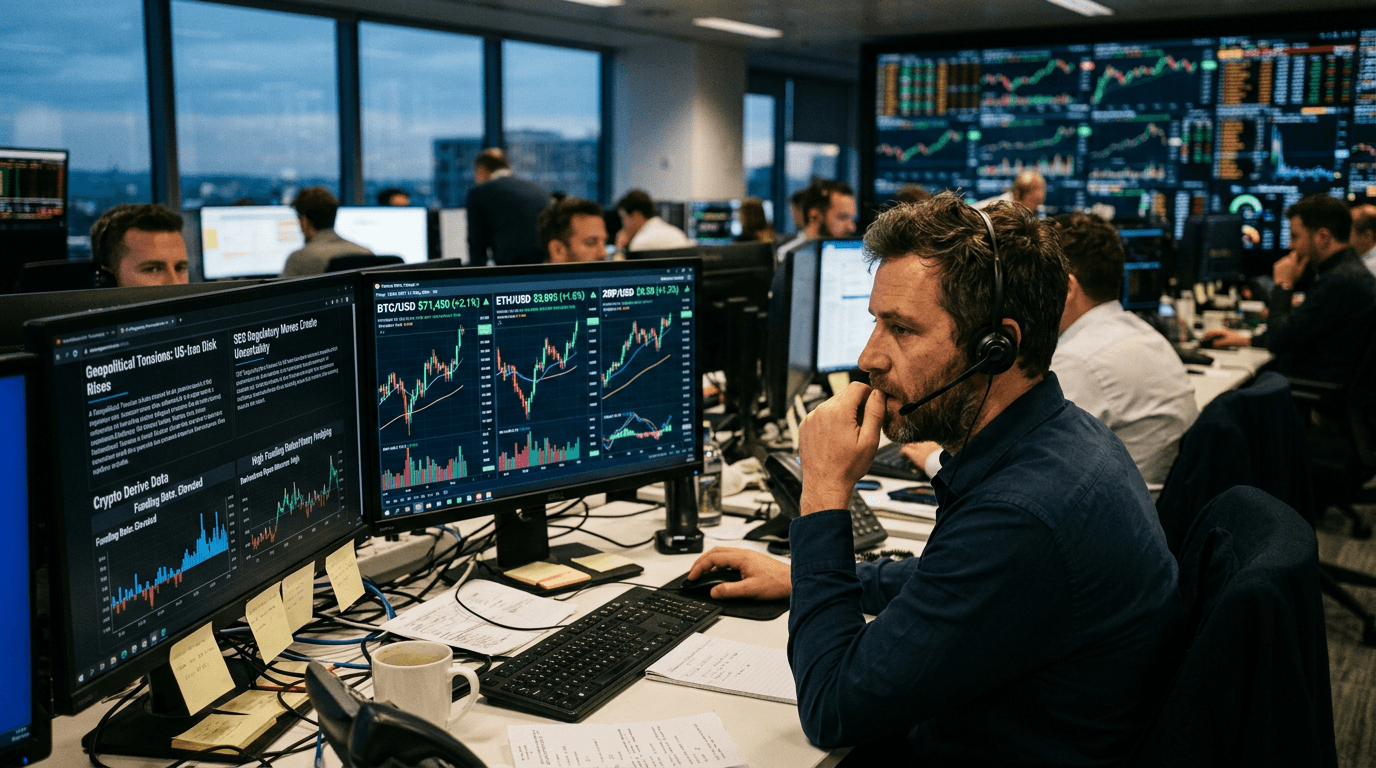
Bitcoin, Ethereum, and XRP are treading water just below their recent peaks, with spot prices holding above key support but struggling to break convincingly higher. Under the surface, the tone is noticeably cautious: derivatives funding remains elevated, implied volatility is firm, and futures leverage has been dialed back as traders hedge both geopolitical shocks and regulatory surprises. The market is still bullish—but it is a nervous kind of bullish, capped by US–Iran war risk and a lingering US regulatory overhang.
MACRO BACKDROP: NEAR HIGHS, BUT NOT “RISK-ON”
Crypto’s current positioning is a classic late-stage uptrend profile. Prices are closer to recent highs than to the last meaningful lows, yet momentum has cooled and breakouts are failing more quickly. Rather than the “fear of missing out” that defined prior legs higher, traders are now managing “fear of giving back” profits.
This transition reflects broader macro conditions. Equities are healthy but choppy, US yields are still sensitive to inflation data, and risk assets have already priced in a lot of good news. In this environment, it takes less negative news to trigger risk-off moves—and crypto, despite its long-term narrative as “uncorrelated,” tends to trade as a high-beta macro asset in the short run.
That makes the combination of war risk and policy uncertainty particularly important. Markets can handle bad news or good news; what they dislike most is not knowing which one is coming next.
GEOPOLITICS: HOW US–IRAN HEADLINES MOVE BITCOIN
The US–Iran conflict has become a repeat driver of crypto volatility. When fighting escalated earlier in the year, Bitcoin dropped several thousand dollars in hours as traders rushed to reduce risk. Later, ceasefire headlines and talk of reopening the Strait of Hormuz helped push BTC back toward the high‑$70,000s, marking some of its strongest sessions in weeks.
More recently, reports of a potential one‑page memorandum of understanding—designed to end the current war and set the stage for nuclear talks—have supported a rebound across risk assets. Each sign of de-escalation has been mirrored by a bounce in Bitcoin, gold cooling from panic highs, and a relief rally in equities. Conversely, renewed strikes or stalled negotiations have quickly knocked BTC lower by 3–5% in single sessions.
For traders, the key takeaway is that geopolitics is not just background noise; it is a direct input into crypto pricing. An actual agreement that meaningfully reduces the odds of a wider regional war could unlock another leg higher, especially if it coincides with softer oil prices and improved expectations for rate cuts. On the other hand, any breakdown in talks or shock escalation could flip the script quickly, sending leveraged positions scrambling for the exit.
In other words, war risk is acting like an invisible volatility switch above the market: as long as it remains unresolved, rallies are vulnerable to sudden headlines.
Regulation: The Other Ceiling Over The Market
If geopolitics is the short-term wild card, US regulation is the slow‑burn overhang. The core issues are now well-known to most crypto traders: how tokens are classified (security vs. commodity), how exchanges should be regulated, and what rules will govern stablecoins, DeFi, and staking. Progress has been uneven—some positive steps like spot Bitcoin ETFs, but also ongoing enforcement actions and legal uncertainty.
Recent political developments have occasionally boosted sentiment. For instance, supportive comments from key US policymakers and proposals for clearer market structure legislation have helped lift crypto-exposed equities and spur short-term rallies in Bitcoin. Still, none of this has translated into a durable, comprehensive framework yet.
That uncertainty matters for positioning
- Institutional allocators remain cautious. Many are comfortable with Bitcoin (and increasingly Ethereum), but slower to touch altcoins until there is more clarity.
- Altcoins face a “regulatory discount.” Tokens perceived as higher risk from a securities-law perspective tend to underperform on bad regulatory headlines and recover more slowly.
- Liquidity is fragmented. Different jurisdictions are moving at different speeds, which complicates cross-border trading and product development.
Until there is a clearer US regulatory regime, crypto will likely carry a structural risk premium. That can cap upside during otherwise bullish periods, as investors demand higher expected returns to compensate for the policy unknowns.
Derivatives Signals: What Funding And Volatility Are Saying
The derivatives market is often more honest than spot because traders there are forced to continually mark risk to market. Right now, it is sending a subtle but important message: optimism is still present, but it is being hedged aggressively.
A few key dynamics stand out
- Elevated funding rates: Positive funding on perpetual futures suggests that the market remains net long; traders are willing to pay to hold bullish exposure. However, when funding stays high while price struggles to push higher, it often signals a crowded long trade with limited immediate upside.
- Firm implied volatility: Options prices reflect higher expected volatility, consistent with geopolitical risk and event uncertainty. Traders are paying up for downside protection and tail hedges, even while spot consolidates.
- Reduced leverage: Some exchanges report lower aggregate leverage and smaller average position sizes compared with earlier in the rally. This “de‑risking without capitulation” posture is typical when traders respect the upside trend but are uncomfortable going all‑in.
For active traders, these signals are useful context. High funding and high implied volatility in a rangebound market tilt the risk‑reward away from aggressive directional bets and toward strategies that either harvest premium cautiously or focus on relative value rather than outright exposure.
How Traders Can Navigate A Cautious Market
A cautious market near highs calls for a different playbook than a momentum-driven breakout. A few practical principles stand out:
1. Respect support and resistance. With Bitcoin, Ethereum, and XRP holding just above key levels, those supports matter. A clean break and close below them—especially on high volume—can signal that risk-off forces (geopolitical or regulatory) are finally overpowering the uptrend.
2. Size for headline risk. When single headlines can move BTC by thousands of dollars, leverage becomes more dangerous. Consider running lower leverage, wider but clearly defined stops, and smaller position sizes relative to account equity.
3. Use scenarios, not predictions. Instead of trying to guess whether the US–Iran talks will succeed, map out “what if” scenarios. For example: “If a ceasefire and memorandum are announced, what levels do I expect for BTC, ETH, and key altcoins? If talks collapse, where are my invalidation points?” Preparing both scenarios reduces emotional decision-making when news actually hits.
4. Pay attention to derivatives cues. Track funding rates, open interest, and options skew. If funding spikes but price doesn’t follow, consider whether the long trade is overcrowded. If downside options become unusually expensive, that may signal heightened fear—or offer opportunities for those who can manage complex strategies.
5. Practice and stress-test in low-risk environments. Simulated finance platforms like E8 Markets allow traders to test strategies under volatile conditions—such as sudden gaps from war headlines or sharp moves on regulatory news—without risking real capital. Using these tools to rehearse your response to extreme events can materially improve execution when the stakes are real.
Conclusion: Bullish, But Braced
The crypto market today is neither euphoric nor panicked. Prices are still relatively close to their highs, but traders are clearly braced for impact—from the next US–Iran headline or the next regulatory twist out of Washington. Elevated funding, firm implied volatility, and reduced leverage all point to a market that believes in the long-term story but is acutely aware of the near-term landmines.
For traders and investors, the challenge is to stay constructive without becoming complacent. That means respecting macro and geopolitical risk, acknowledging the drag from incomplete regulation, and adapting tactics to a regime where caution—rather than blind conviction—dominates behavior. In such an environment, disciplined risk management and thoughtful scenario planning are not just good habits; they are the real edge.