
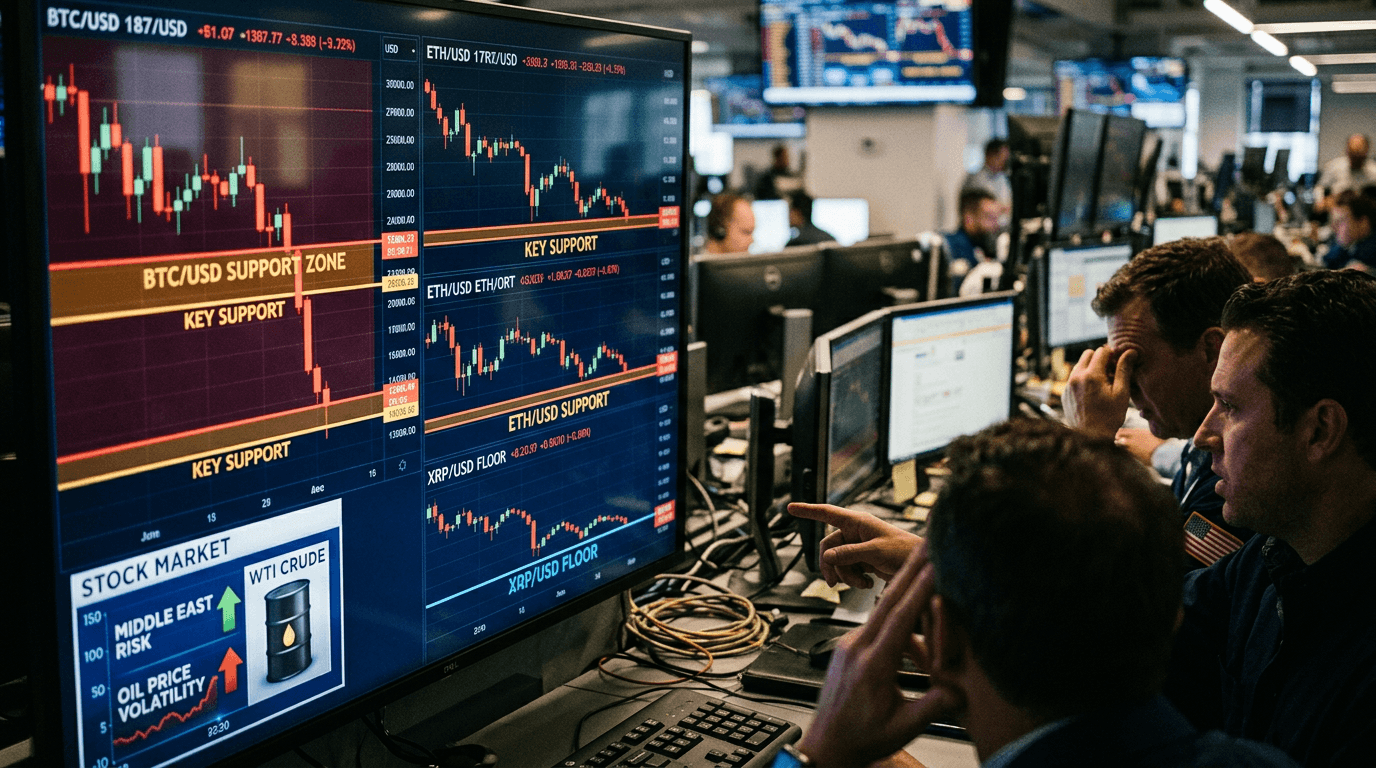
Crypto’s bellwethers are catching their breath after a brisk pullback, with Bitcoin, Ethereum and XRP all hovering just above key support zones as markets grapple with escalating Middle East tensions and a sharp rise in oil prices.[1][2] Higher energy costs and geopolitical uncertainty are feeding inflation worries, cooling appetite for high‑beta assets like crypto while simultaneously boosting safe‑haven demand in gold and select FX pairs.[2] For traders, the current backdrop is less about panic and more about a live stress test of the broader uptrend and risk‑management discipline.[1]
Markets Pause As Macro Risks Intensify
The latest move in crypto has been modest in percentage terms, roughly in the low single digits, but important in context.[1] After strong gains earlier in the year, spot prices have slipped back toward areas where buyers previously stepped in, effectively turning the current consolidation into a check on whether dip‑buying remains the dominant strategy.[1] Cautious price action reflects investors weighing two opposing forces: structural optimism around digital assets on one side, and growing macro headwinds on the other.
Oil’s surge following heightened Middle East tensions has brought inflation back into focus, especially for central banks still wary of declaring victory over price pressures.[2] Persistent or renewed inflation could keep interest rates higher for longer, which tends to weigh on speculative assets and tighten financial conditions.[2] Against this backdrop, crypto is trading with a more defensive tone, but without clear evidence yet of a full‑blown trend reversal.
Key takeaway: Markets are not collapsing, but they are clearly in a phase of reassessment as macro risks rise and prior gains are tested.
Key Support Zones For Btc, Eth And Xrp
Bitcoin remains the primary reference point for the crypto complex, and its current technical posture is central to the broader narrative.[6] Recent price action has seen BTC hovering above a support band in the mid‑60,000s, with options positioning clustered around the 60,000–64,000 USD area providing an additional layer of interest for institutional traders.[1][5] This zone has repeatedly attracted buyers during previous dips, making it a pivotal region for gauging whether the prevailing uptrend can absorb another bout of macro‑driven volatility.[1]
Ethereum is trading near a key psychological pivot, with short‑term support identified around the 2,250 USD region and a broader structural level closer to 2,000 USD.[1][10] The 2,000 area has acted as a recurring inflection point where sentiment tends to shift from cautious to constructive when held, and from neutral to bearish when broken.[1] With ETH often seen as both a “beta play” on BTC and a fundamental bet on the smart‑contract economy, how it behaves around these levels can offer clues about risk appetite beyond Bitcoin itself.[10]
XRP’s technical picture is somewhat different, reflecting its unique regulatory and narrative backdrop. Price action has been consolidative near the 1.00 USD psychological mark, a level that traders often watch as a dividing line between optimism and concern.[1][6] Beneath that, a wider macro support band between roughly 1.11 and 1.20 USD has served as a longer‑term structural floor in past cycles, while shorter‑term analyses highlight additional support zones slightly below current levels based on pivot and volatility measures.[1][2][3][8][9] So far, XRP appears to be digesting volatility rather than breaking decisively in either direction, which keeps both bullish breakout and deeper correction scenarios on the table.[1][4]
Key takeaway: BTC, ETH and XRP are all near well‑defined support zones; how price reacts here will likely set the tone for the next phase of the market, from renewed uptrend to broader consolidation or deeper correction.
Geopolitics, Oil And Risk Sentiment: Why Crypto Cares
The link between Middle East tensions, oil prices and crypto is not always intuitive, but it runs through global macro channels that affect all risk assets.[2] A sustained rise in crude raises input costs across the economy, threatening to reignite or prolong inflation at a time when central banks are trying to normalize policy.[2] If inflation expectations creep higher, bond yields may rise, tightening financial conditions and making future cash flows from speculative assets less attractive.
In such environments, investors often rotate from high‑beta exposures like growth stocks and crypto into perceived safe havens such as gold and certain currencies.[2] This does not necessarily mean a linear sell‑off in digital assets; instead, it can manifest as choppy trading, shallower rallies, and more sensitivity to macro headlines. For crypto traders, the practical implication is that technical levels are more likely to react to cross‑asset flows and event risk than purely crypto‑native news during these phases.[1][2]
Key takeaway: In times of geopolitical stress and rising oil, macro drivers can overshadow on‑chain or sector‑specific narratives, making cross‑asset awareness critical for crypto traders.
Practical Takeaways For Traders
In a market defined by elevated macro uncertainty and key supports in play, risk management becomes as important as directional calls. One of the most useful exercises is mapping out the critical levels in advance: for BTC, the mid‑60,000s zone and the 60,000–64,000 USD band; for ETH, the 2,250 and 2,000 USD regions; and for XRP, the 1.00 USD psychological line and the broader 1.11–1.20 USD support corridor.[1][4][5][10] Knowing where price has previously absorbed selling pressure helps traders size positions, set stop‑losses more intelligently, and avoid emotional decision‑making during intraday swings.
Scenario planning adds another layer of discipline. Traders can build playbooks around three broad outcomes: supports hold and the uptrend resumes; supports hold but price chops sideways in a range; or supports break, triggering a deeper corrective phase. Each scenario implies different tactics for entry, exit, and leverage. For example, aggressive dip‑buying near support with tight stops may make sense if you see strong order‑book interest and improving macro headlines, whereas a more conservative approach—reducing exposure or using simulated environments—may be prudent if geopolitical risk escalates or key levels start to give way.[1][6]
For newer traders and even experienced participants refining their edge, Simulated Finance (SimFi) platforms offer a way to test strategies under realistic market conditions without capital at risk. Practicing how to react when BTC touches a major support, ETH wicks below a pivot, or XRP spikes on news—but in a simulated environment—can help build the muscle memory needed to avoid costly mistakes when volatility rises in live markets.
Key takeaway: Map your levels, plan your scenarios, and consider using simulation to rehearse responses to support tests before committing real capital in a headline‑driven tape.
What To Watch Next
Looking ahead, three elements stand out as key drivers: the durability of current support zones in BTC, ETH and XRP; the evolution of Middle East tensions and their impact on oil prices; and central‑bank communication around inflation and future policy. A clean bounce from support, accompanied by improving macro headlines, could re‑energize the uptrend and invite renewed risk‑taking. Conversely, a decisive break of these levels on heavy volume, especially if paired with worsening geopolitical news or hawkish policy signals, would argue for a more defensive posture and a reassessment of positioning across the crypto spectrum.[1][2][10]
Key takeaway: The next meaningful move in crypto is likely to be catalyzed by a combination of technical breaks or bounces at key supports and shifts in the macro narrative, making both the charts and the news flow equally important to watch.