
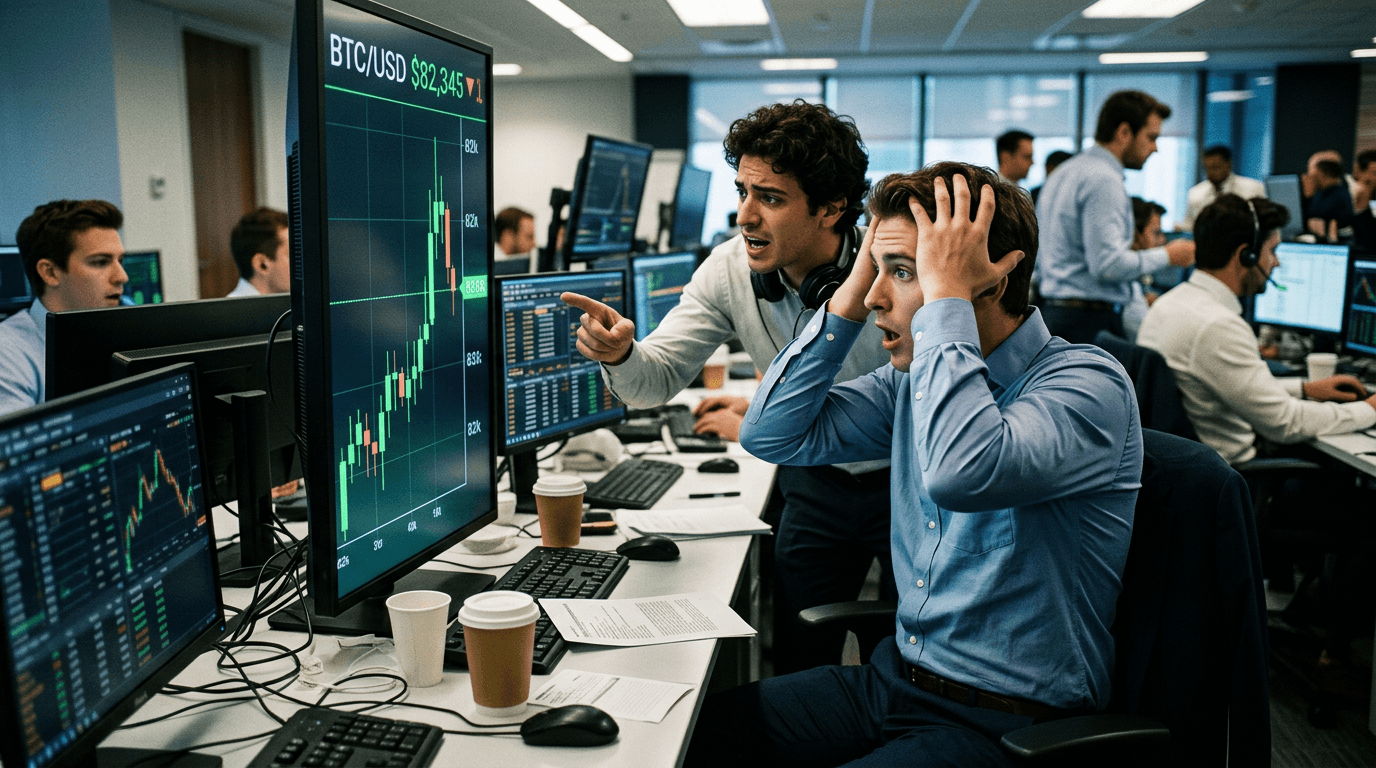
Bitcoin’s latest surge above $82,000 put leverage and risk management back in the spotlight, as a broad crypto rally wiped out hundreds of millions of dollars in short positions before macro data triggered a sharp intraday retrace.[6][9] For simulated traders, this kind of move is a live case study in how positioning, liquidity, and sentiment can combine to amplify both gains and losses in a matter of hours.[7][9]
Market Snapshot
Earlier in the session, Bitcoin broke above $82,000 for the first time since May, extending a multi-day advance and briefly pushing the market to new three‑month highs.[6][9][12] After the breakout, BTC eased back toward the $80,000–$81,000 zone, leaving $82,000 as a key resistance level that bulls will need to reclaim.[5][9]
The rally was not limited to Bitcoin. Major altcoins such as Ethereum, XRP, and BNB each gained more than 4% over 24 hours, reinforcing the impression of a broad, risk‑on move across the crypto complex rather than a single‑asset spike.[6] This breadth matters because cross‑asset participation often signals that flows are coming from a mix of derivatives, spot, and institutional products rather than just retail momentum in one coin.[6][13]
Behind the price action was a significant wave of liquidations in the derivatives market. Approximately $500–$510 million of crypto short positions were wiped out over 24 hours, with the majority concentrated in Bitcoin as price pushed through the $79,000, $80,000, and ultimately $82,000 thresholds.[6][9] Data suggests more than 119,000 traders saw positions liquidated during the move, underscoring how crowded the bearish side of the trade had become going into the breakout.[9]
What Short Liquidations Reveal About Market Structure
Short liquidations occur when leveraged traders betting on price declines see their margin fall below exchange requirements, forcing automated closures of their positions.[7][14] In practice, this means the exchange buys back the short exposure in the market, converting forced sellers into buyers at increasingly higher prices.[7]
When many traders are short at similar levels, a swift move up can trigger a cascade of margin calls, producing the classic “short squeeze” dynamic where price accelerates sharply as liquidations feed further buying.[13] Recent data shows that, in the days leading up to Bitcoin’s latest push toward $80,000 and beyond, billions of dollars in bearish bets had already been unwound as the asset rallied from the mid‑$60,000s to the high‑$70,000s.[13] That backdrop made the market particularly vulnerable to another squeeze once key resistance zones gave way.
For simulated traders, this episode illustrates several important concepts:
1. Position crowding: When too many market participants are leaning in the same direction with leverage, reversals can be violent and self‑reinforcing.[11][13] 2. Liquidity pockets: Levels like $80,000 and $82,000 become focal points where large clusters of stop orders and liquidation thresholds sit, turning them into catalysts for rapid volatility once breached.[5][9][15] 3. Asymmetry of risk: Shorting with leverage exposes traders to theoretically unlimited upside moves, and liquidation risk rises more quickly when volatility spikes.[7]
Macro Data And The Retrace
The story did not end with the initial breakout. After the rally pushed Bitcoin above $82,000, subsequent macro data releases and position rebalancing prompted a partial pullback, with BTC slipping modestly from its highs while still defending the psychologically important $80,000 handle.[4][5][9] Earlier, easing concerns over an imminent Federal Reserve rate hike and a decline in Treasury yields had provided a supportive backdrop for the risk‑on move, helping crypto to trade higher alongside other speculative assets.[4]
Once fresh data hit the tape, traders reassessed the trajectory of monetary policy and growth, leading to profit‑taking near resistance and a cooling of intraday momentum.[5] This kind of sequence—macro release, rapid repricing of rate expectations, then a knock‑on effect in crypto—is a reminder that digital assets do not trade in isolation. At current market capitalizations, Bitcoin and major altcoins are increasingly integrated into broader cross‑asset risk frameworks, making them sensitive to the same macro shocks that move equities, bonds, and FX.[4][12]
For anyone using simulated environments, this offers a practical lesson in building playbooks around the macro calendar. Moves like this tend to cluster around key events such as inflation reports, jobs data, or central bank commentary, where implied volatility is elevated and positioning can flip quickly.
Lessons For Simulated Traders And Risk Practice
Simulated finance platforms like E8 Markets give traders the ability to rehearse exactly these kinds of scenarios without capital at risk, which is ideal for stress‑testing strategies that rely on leverage, tight stops, or intraday momentum. While the prices and order flow may mirror live markets, the objective in simulation is skill development: understanding how a thesis can fail and how risk tools respond when it does.
Several actionable takeaways emerge from the latest short‑squeeze‑and‑retrace pattern:
1. Define risk in volatility units, not just price levels. A move from $80,000 to $82,000 may be only 2.5% on paper, but in a crowded, leveraged market it can be enough to trigger hundreds of millions in liquidations.[6][9][15] 2. Stress‑test short strategies against upside shocks. Build simulated scenarios where price gaps above a key level and continues to run without a convenient pullback, forcing you to rely on pre‑defined exits rather than hope.[7][13] 3. Incorporate macro triggers into your plan. Map out how you would adjust exposure around major data releases and central bank events, and practice reducing leverage ahead of high‑impact catalysts.[4][11] 4. Track positioning indicators. Data on futures funding, open interest, and estimated long/short ratios can help identify when one side of the market is stretched, increasing the odds of a squeeze.[10][13]
In a SimFi environment, you can deliberately set up trades that are “wrong‑footed” by design—heavy shorts into support or aggressive longs into resistance—to see how your risk rules behave under pressure. That kind of deliberate practice builds the muscle memory needed to respond quickly in live conditions.
Looking Ahead
Bitcoin’s brief push above $82,000, the broad participation from major altcoins, and the liquidation of roughly half a billion dollars in shorts collectively point to a market that is both structurally leveraged and highly sensitive to shifts in sentiment and macro data.[6][9][12] For directional bulls, the ability of price to hold above $80,000 after the retrace is constructive, but the rejection at $82,000 reinforces that key resistance remains overhead and that volatility around these levels is likely to persist.[5][9]
For traders operating in simulated markets, this episode is a timely reminder that the path of price is rarely smooth, even during strong uptrends. Short squeezes can create sharp, fleeting opportunities, but they also expose weaknesses in risk frameworks that rely too heavily on static levels or assumptions about mean reversion. Using SimFi tools to rehearse responses to squeezes, macro‑driven reversals, and liquidity shocks can turn headlines like “broad crypto rally liquidates shorts” into practical training drills rather than painful learning experiences.
Ultimately, the current phase of the cycle appears driven as much by the unwinding of bearish leverage and the rebuilding of bullish positioning as by any single fundamental narrative.[10][13] In that environment, disciplined risk management and scenario planning matter just as much as directional calls—and simulated trading is one of the safest ways to refine both before the next major move.