
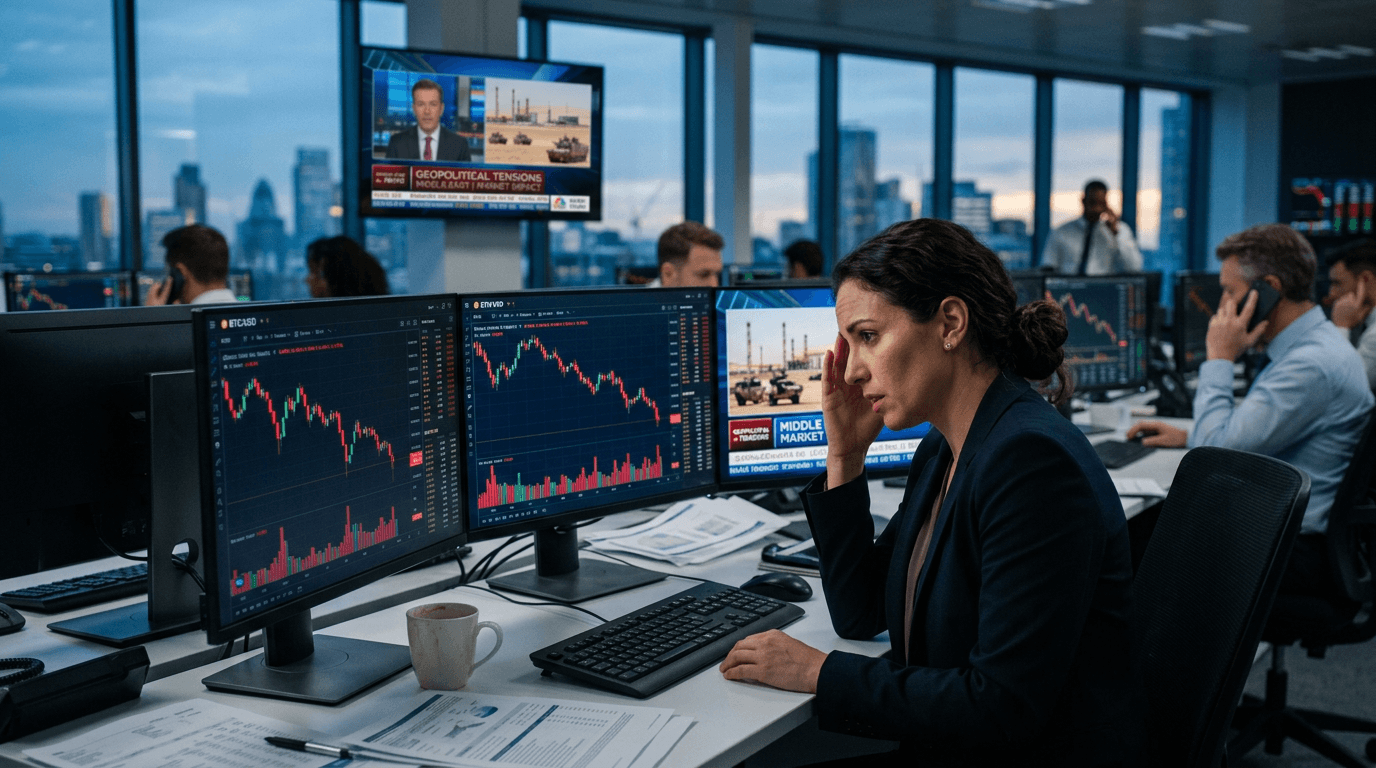
Crypto markets entered a cautious retreat as renewed Middle East tensions and a broader risk‑off mood pushed Bitcoin, Ethereum and major altcoins lower. A roughly 2–3% pullback in leading tokens may look modest on the surface, but it highlights how quickly sentiment can shift when geopolitical risk collides with already fragile risk appetite[2][5].
Markets Pull Back As Geopolitical Risk Rises
As reports of escalating conflict involving the U.S. and Iran filtered through global markets, investors moved to de‑risk across asset classes, from equities to crypto[2][3][6]. Bitcoin slid around 2–3% over 24 hours, marking its lowest levels in several weeks, while Ether followed with a smaller but still notable decline[2][5]. XRP and other major altcoins also traded defensively near key support zones, underperforming the larger tokens as traders trimmed exposure to high‑beta assets[2][3].
This type of move is consistent with recent episodes where Middle East headlines sparked rapid risk‑off positioning. Earlier flare‑ups saw Bitcoin drop between 3% and 6% in a single session, with Ether and popular altcoins often posting deeper drawdowns and leading a temporary contraction in total crypto market capitalization[1][3][4]. In the latest pullback, the reaction has been more measured but still reveals nervousness around geopolitical and macro uncertainty.
Importantly, crypto‑related equities and ETF products have mirrored the weakness. Shares of major exchanges, mining firms, and Bitcoin‑focused public companies have tended to fall 3–6% on days when geopolitical tensions weigh on Bitcoin, underscoring how listed crypto proxies amplify underlying spot market moves[4][5].
Why Crypto Still Trades Like A Risk Asset
A key takeaway from this episode is that, despite frequent narratives around “digital gold,” crypto still behaves primarily as a risk asset in moments of acute stress. During recent Middle East escalations, global stock indices fell alongside Bitcoin and Ethereum, indicating that investors were broadly reducing exposure to growth and speculative assets rather than flocking to crypto as a safe haven[2][3][6].
In fact, analysis of prior conflict‑driven sell‑offs shows:
- Bitcoin’s intraday drops have often been comparable to or larger than major equity indices, especially when volatility spikes[2][3].
- Ether and leading altcoins such as Solana, Cardano, and Dogecoin have typically shown even higher sensitivity, with single‑day drawdowns in the 6–10% range during sharp risk‑off moves[3].
- Total crypto market cap has repeatedly contracted by 4–5% or more when geopolitical headlines coincide with macro concerns such as inflation or changing rate expectations[3][4].
Middle East tensions also feed into inflation expectations via oil and energy markets. Rising crude prices can complicate central bank policy, re‑ignite fears of sticky inflation, and raise the odds of tighter financial conditions. In previous episodes, traders have linked conflict‑driven energy shocks to concerns about future interest rates, which further reduces appetite for volatile, long‑duration assets like crypto[3][4][6].
The net effect: when geopolitical risk rises, crypto tends to get treated more like high‑beta tech or growth stocks than like gold or Treasuries. Understanding this behavioral pattern is crucial for portfolio construction and risk management.
Key Levels And The Technical Landscape
From a technical perspective, the latest pullback brought major coins back toward widely watched support areas. In prior Middle East‑driven dips, Bitcoin’s decline has often stalled near structurally important levels around psychologically significant round numbers, where dip buyers have tended to emerge[3][4][7]. Similar behavior is visible now, with traders watching whether current support holds or gives way to a deeper test lower.
For Bitcoin, several recent corrections have triggered large clusters of liquidations, particularly in leveraged long positions, once price broke below short‑term support[4]. One notable episode saw more than $1.8 billion in liquidations in a single day, with long accounts bearing the majority of the losses[4]. That history makes current levels critical: another decisive break could accelerate forced selling, while a successful defense may reinforce the view that pullbacks during geopolitical scares are often temporary within larger cycles.
Ethereum tends to exhibit higher beta to Bitcoin in risk‑off phases, with prior conflict‑related moves showing declines of 6% or more versus mid‑single‑digit losses for BTC[1][3][4]. Traders are therefore paying close attention to Ether’s relative performance. If ETH stabilizes more quickly than smaller altcoins, it can signal a rotation back toward higher‑quality crypto assets even while overall risk appetite remains muted.
For altcoins, the picture is more fragile. Historical data shows that sectors like DeFi, gaming, and meme tokens often experience outsized swings when macro and geopolitical stress spike, reflecting their greater reliance on speculative capital[3][8]. In the current environment, many traders are avoiding aggressive altcoin accumulation until volatility normalizes and headlines become less uncertain.
LESSONS FOR TRADERS: NAVIGATING RISK‑OFF MOODS
Episodes like this offer several practical lessons
1. Treat geopolitics as a volatility catalyst, not a one‑directional price driver. The initial reaction is often a sharp drop, but prior Middle East flare‑ups have also seen partial rebounds as markets reassess actual economic impact[2][3][6].
2. Respect leverage. Large liquidation events have frequently followed conflict‑driven drawdowns, especially when investors enter headlines with high leverage and tight margin buffers[4]. Managing position size and avoiding excessive leverage into known risk events can materially reduce stress.
3. Differentiate between assets. Bitcoin’s drops around 2–5% in these episodes, while Ether and altcoins frequently exhibit more pronounced swings[1][3][5]. Positioning across the crypto stack—BTC, large‑cap altcoins, smaller tokens—should reflect each asset’s volatility profile.
4. Focus on scenarios, not predictions. Rather than trying to forecast specific geopolitical outcomes, traders can pre‑define scenarios (contained conflict, escalation, de‑escalation) and build playbooks for each, including levels where they would add, trim, or hedge.
USING SIMULATED TRADING TO STRESS‑TEST YOUR STRATEGY
Simulated finance environments are particularly useful during periods of geopolitical uncertainty. By running strategy backtests and paper trades through historical episodes of conflict‑driven sell‑offs, traders can see how their approaches would have handled:
- Sudden 5–10% intraday moves in major coins.
- Chains of liquidations triggered by support breaks.
- Rapid rotations from altcoins back into Bitcoin and stablecoins.
Using a simulated account to practice execution during fast markets—setting conditional orders, adjusting stops, and managing margin—helps build muscle memory without capital at risk. It also forces traders to think through how they would respond if support fails, if volatility spikes beyond expectations, or if headlines shift from escalation to de‑escalation faster than anticipated.
Ultimately, this latest pullback underscores a recurring theme: crypto exists within a broader macro and geopolitical ecosystem, not outside of it. For traders and investors, the goal is less about predicting every headline and more about designing robust strategies that can withstand sudden risk‑off episodes, exploit mispricings when fear overshoots fundamentals, and adapt as the narrative evolves.