
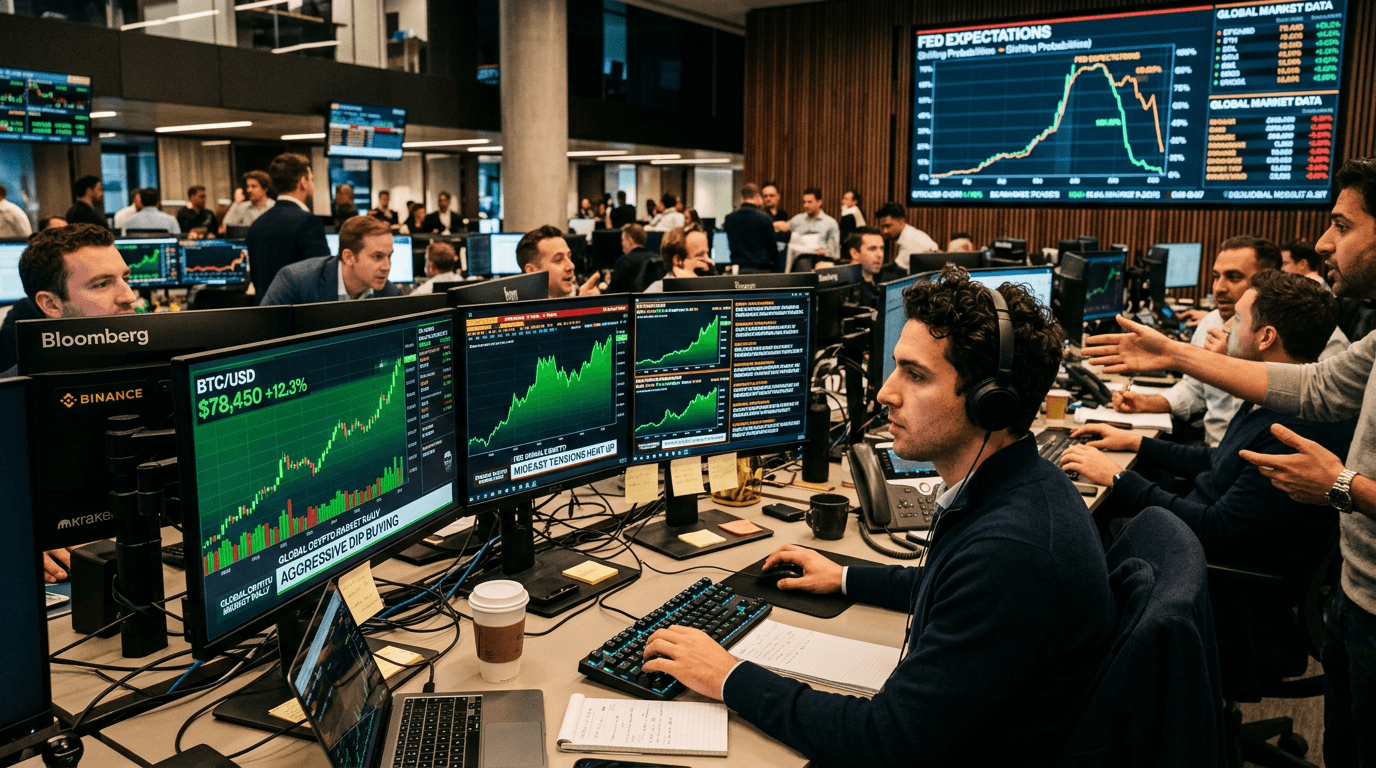
Crypto markets have surged globally in recent sessions, with traders increasingly tying the rally to shifting expectations around the Federal Reserve’s next moves and a steady stream of geopolitical headlines.[9][10][15] The combination of war-related news, evolving rate-cut probabilities, and aggressive dip-buying has reinforced a growing narrative that the recent bear phase in digital assets may be drawing to a close.[9][15] For both spot and derivatives traders, the key question is whether this improved sentiment can withstand the next wave of U.S. economic data and policy signals.[9][10][12]
Macro Backdrop: Fed Expectations Drive Risk Sentiment
Crypto’s latest upswing is closely aligned with a broader improvement in global risk appetite as markets price in a higher likelihood of Fed easing.[9][10] In one recent episode, expectations for rate cuts later in the year helped push Bitcoin to fresh highs and lifted total crypto market capitalization toward the multi-trillion dollar mark.[9][10] When traders anticipate lower policy rates, they tend to re-risk portfolios, benefiting high-beta assets such as cryptocurrencies alongside equities and high-yield credit.[10][15]
Fed communication has become a direct catalyst for crypto volatility, amplifying intraday moves around speeches and press conferences.[12][15] Hawkish commentary from policymakers can quickly trigger algorithmic de-risking and ETF outflows, while more measured or dovish language often supports renewed inflows and spot buying.[10][12] This communication channel matters because it shapes the perceived path of real rates and liquidity conditions, which are core drivers of both digital asset valuations and volatility regimes.[10][12][15]
For traders operating in a SimFi environment, this macro backdrop is an opportunity to practice translating central bank narratives into trading scenarios: tightening cycles that compress valuations, pauses that stabilize risk assets, and potential pivot points that fuel trend reversals and momentum strategies.
Geopolitical Headlines And Crypto As A Macro Asset
Geopolitical risk has moved from a peripheral consideration to a central driver of crypto price action, particularly around conflict-related news and peace negotiations.[3][9][15] Recent reports illustrating progress on peace frameworks have coincided with rallies in Bitcoin and improved sentiment across risk assets, underscoring how quickly markets reprice when war outcomes appear less adverse for growth and inflation.[3][9][15] Crypto’s response to these headlines reflects its integration into broader macro portfolios that react to the same shocks as equities, bonds, and commodities.[1][15]
Research shows that geopolitical risk typically impacts crypto through macro transmission channels rather than headlines alone.[1][8][15] Rising geopolitical risk tends to increase uncertainty, tighten financial conditions, and alter inflation expectations, which then feed into risk appetite across assets.[1][8][15] During extreme events, volatility in major cryptocurrencies spikes and trading activity rises as investors rebalance between Bitcoin, altcoins, stablecoins, and traditional safe havens like gold and Treasuries.[3][5][6]
Empirical studies highlight that the impact of geopolitical risk on crypto is non-linear and regime-dependent.[2][6][8] In some bearish phases, heightened geopolitical stress can coincide with positive returns as investors seek alternative stores of value, while in strong bull markets similar shocks often dampen performance and increase drawdown risk.[2][6][8] For practitioners, the takeaway is clear: geopolitics should be treated as a variable in macro scenario analysis, with attention to how energy prices, inflation, and central bank responses propagate through digital assets.[1][15]
Derivatives, Leverage, And Aggressive Dip-buying
The current rally is not purely a spot market phenomenon; derivatives positioning and leverage dynamics are playing a significant role in amplifying moves.[1][5][15] Periods of elevated geopolitical risk and macro uncertainty often coincide with thin liquidity, higher leverage, and more pronounced liquidation cascades, creating sharp intraday swings in both directions.[1][5][15] When sentiment shifts from fear to cautiously optimistic, short-covering and the unwinding of defensive hedges can drive outsized upside moves relative to fundamental news.[4][6][8]
Aggressive dip-buying has been a notable feature of the recent upswing, with traders seeking to front-run a potential transition from bear phase to early bull cycle.[9][15] In practice, this means layering bids around key technical levels, using options structures to express directional views with defined risk, and rotating from defensive stablecoin allocations back into higher-beta tokens.[5][6][9] Historical episodes show that after initial selloffs on conflict or policy shocks, Bitcoin and major altcoins often recover as the macro narrative stabilizes and liquidity returns.[3][15]
For SimFi traders, this environment is ideal for stress-testing risk management frameworks: controlling leverage, modeling forced-liquidation risk, and understanding how funding rates and volatility skew change as markets transition from panic to relief. Building and backtesting strategies that adapt to changing volatility regimes can be more valuable than attempting to predict every headline.
What Traders Should Watch Next
The durability of the current crypto rally will depend on whether Fed expectations and geopolitical narratives continue to move in a supportive direction.[9][10][15] Upcoming U.S. inflation prints, labor market data, and Fed speeches will shape how quickly markets price in rate cuts and whether real yields start to trend lower.[10][12][15] A sustained easing narrative tends to support risk assets, while any hawkish surprises or upside inflation shocks could reintroduce downside pressure and volatility.[10][12][15]
On the geopolitical front, traders should focus less on day-to-day headlines and more on how conflicts affect energy prices, inflation expectations, and global growth assumptions.[1][8][15] Studies emphasize that extreme spikes in geopolitical risk indices are strongly associated with crypto volatility, particularly when they coincide with sharp moves in oil and policy-rate expectations.[5][8][15] Monitoring these macro variables alongside on-chain data, liquidity metrics, and derivatives positioning can provide a more complete view of market vulnerability and opportunity.[1][5][6]
From a practical standpoint, this means building playbooks for different combinations of Fed paths and geopolitical scenarios: rapid easing with de-escalation (typically bullish), delayed cuts with persistent tension (more mixed or bearish), and shock events that force emergency policy responses (high-volatility, regime-shift environments).[2][6][8] Simulated trading environments are well-suited to testing these frameworks without capital at risk.
Conclusion: Navigating A Macro-driven Crypto Market
The latest global crypto rally underscores a structural shift: digital assets are now tightly linked to the same macro forces that drive traditional markets, particularly Fed policy expectations and geopolitical risk.[1][9][10][15] War-related news, central bank communication, and institutional positioning are no longer background noise—they are core inputs into price discovery, volatility, and trend formation.[1][12][15] For traders, the edge lies not in predicting every headline, but in understanding the transmission channels from geopolitics and monetary policy into liquidity, risk appetite, and market structure.[1][5][15]
In this environment, both discretionary and systematic strategies benefit from integrating macro scenario analysis, robust risk controls, and clear rules for responding to regime changes. Using simulation to rehearse playbooks for different combinations of Fed signals and geopolitical outcomes can turn complex news flow into structured decision-making. As the market tests whether this rally marks the end of the bear phase or just another relief bounce, disciplined, macro-aware trading will matter more than ever.