
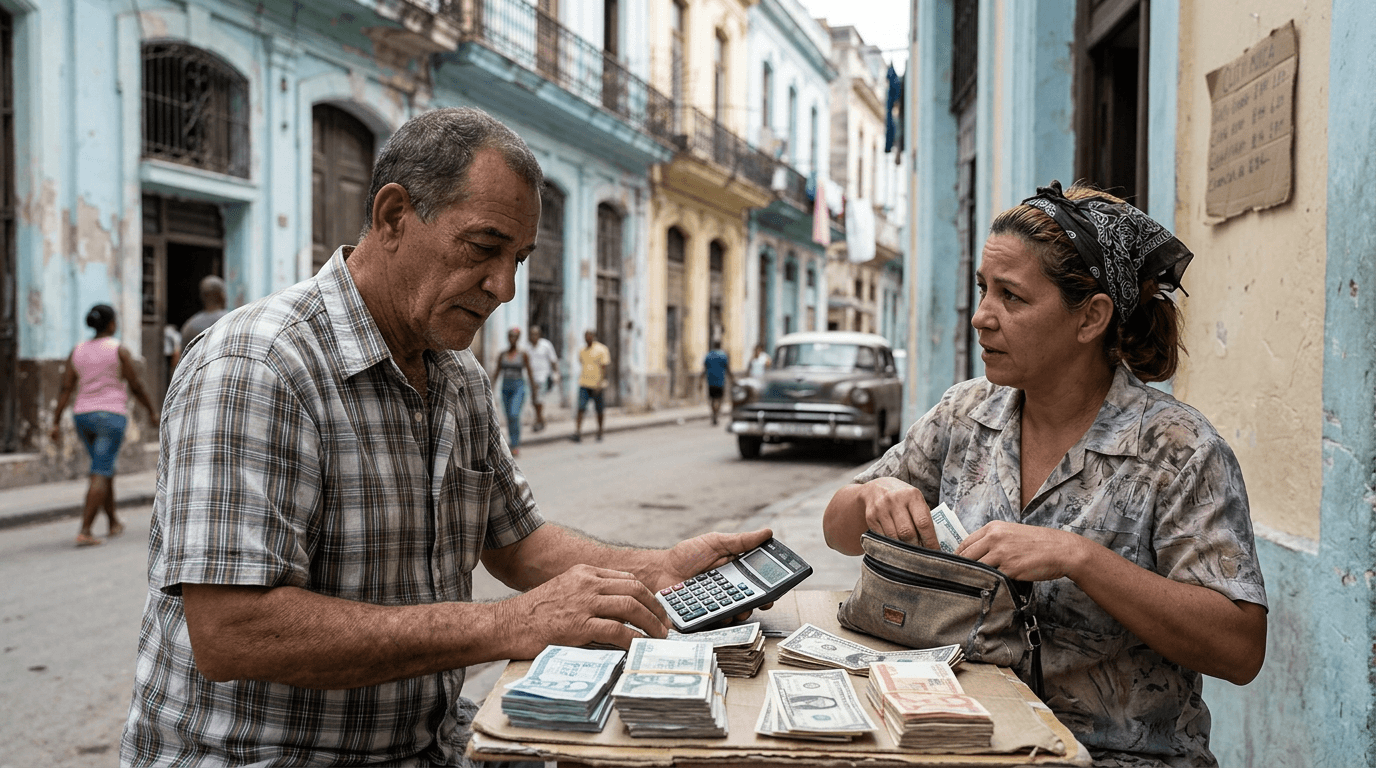
The Cuban peso’s slide to a record low on the informal market is more than a local currency story; it is a visible stress signal from an economy under extreme pressure and a textbook example of how de facto dollarization reshapes incentives, prices, and ultimately risk premia across emerging and frontier markets.[1][2][5] For traders and investors, it is a case study in how informal FX markets and policy distortions can feed into credit risk and broader EM sentiment.[2]
Peso Collapse Signals Deepening Stress
In recent trading, the Cuban peso has plunged to around 400 CUP per U.S. dollar on the informal market, its weakest level on record.[1][2][5] That implies a devaluation of more than 90% versus the official rate, and an extraordinary loss of confidence in the local currency as a store of value.[2]
The contrast with the official framework is stark. For state companies selling goods to tourists, the fixed official rate of roughly 24 CUP per dollar is still in place, even as the market-clearing rate has blown out to more than 16 times weaker in the street market.[2] The euro shows a similar pattern, with the informal rate reportedly around 445 CUP per EUR, also a record low.[2]
Such a wide gap between official and informal rates is a hallmark of severe macroeconomic imbalance. It reflects chronic foreign exchange shortages, a large fiscal hole financed by money creation, and a policy framework that delays adjustment instead of absorbing shocks. The result is a dual (or multi-tier) FX regime where access, not fundamentals, determines who benefits from the cheap official rate—and everyone else is pushed into the informal market at steep discounts.[2]
DOLLARIZATION 2.0: HOW CUBA’S PARALLEL MONEY SYSTEM WORKS
As the peso weakens, Cuba is experiencing accelerated de facto dollarization: a growing share of prices, savings, and contracts are being set in U.S. dollars or other hard currencies instead of the local unit.[1][4][5] Restaurants, private shops and services increasingly quote prices in both pesos and dollars, but often give clear preference to foreign currency.[4] In many cases, you can pay in CUP, but the effective price in pesos is adjusted frequently to track the street rate.
Beyond retail, entire segments of the economy now operate on a dollar-only basis. Stores that stock imported or higher-quality goods often require payment in foreign currency, while very limited access to hard currency leaves most peso earners effectively locked out of these markets.[1][5] This creates what local observers have dubbed a “monetary apartheid,” in which a dollar-earning minority has access to goods and services that are increasingly out of reach for the peso-earning majority.[2]
Partial dollarization of this kind is self-reinforcing. As more prices are dollarized, households and firms try to hold fewer pesos and more USD or euros, further depressing the local currency and pushing more activity into the informal sphere.[1][4][5] The central bank’s ability to anchor expectations erodes, informal FX trackers become the de facto reference rate, and inflation becomes harder to measure and control. Over time, the local currency risks becoming a mere transactional unit for low-value, state-controlled activities, while real economic decisions are made in dollars.
Why A Small, Closed Economy Still Matters To Global Markets
On paper, direct exposure to the Cuban peso for global investors is limited. The currency is not freely traded on major FX platforms, there is no liquid onshore derivatives market, and sovereign instruments are not widely held in mainstream benchmarks. But the signal value of this episode for EM and frontier risk is meaningful.[2]
First, the peso’s collapse underscores the vulnerability of heavily managed regimes in low-income, FX-constrained economies. When policy keeps official exchange rates and domestic prices out of line with fundamentals, pressure builds up in parallel markets, often culminating in sharp step devaluations or stealth dollarization. For EM credit investors, that translates into rising default risk, higher risk premia, and greater dispersion across frontier names with similar policy profiles. The Cuban case reinforces the broader narrative of elevated sovereign risk and fragile policy credibility across parts of the frontier universe.[2]
Lessons For Em And Frontier Market Traders
For traders focused on emerging and frontier markets, the peso story highlights practical signals to monitor—especially in economies with capital controls and tight official FX regimes. Large and persistent gaps between official and informal FX rates are an early warning of unsustainable policy and future restructuring risk. Informal trackers, remittance channels, and grey-market pricing often move well before official devaluations or rating actions.
Second, dollarization dynamics matter as much as headline FX moves. When everyday transactions and corporate balance sheets gradually shift into dollars, the domestic banking system becomes more vulnerable to FX mismatches and deposit flight. That, in turn, can amplify sovereign risk and feed into wider EM credit spreads and indices, even where direct trade or financial links are small. In periods of risk-off, investors tend to sell first and ask questions later in illiquid frontier names that “look like” the country under stress.
Finally, Cuba’s case shows how social and political dimensions of currency crises—such as inequality between dollar- and local-currency earners—can influence policy responses. Governments may resist official devaluation for longer to avoid visible shocks to real incomes, only to face worse outcomes later. For macro-focused traders, understanding these constraints helps in timing: pressure can build quietly in informal markets before exploding into a policy reset that moves sovereign spreads or regional ETFs in a single session.
How Simulated Traders Can Use This Scenario
For SimFi and practice-focused traders, the Cuban peso’s record low is a rich scenario for building and testing macro strategies without real-money risk. One approach is to design a simulated portfolio that tracks a basket of frontier sovereign bonds, EM high-yield credits, and relevant equity indices, and then model how they might react to incremental news about a country’s FX regime, dollarization, or informal market blowouts.
Another angle is to construct “stress ladders”: map hypothetical widening in unofficial FX spreads or dollarization measures to step changes in sovereign spreads and risk premia. That forces you to translate qualitative macro stories—like Cuba’s accelerating dollarization—into quantitative trading rules and risk limits. Over time, you refine which indicators (FX gaps, parallel-market volumes, policy announcements, rating outlooks) tend to lead meaningful market moves.
By treating Cuba’s currency crisis as a live case study rather than an isolated headline, traders can sharpen their ability to read early warning signs in other EM and frontier economies, design more robust stress tests, and better understand how local currency dysfunction feeds into global risk pricing.