
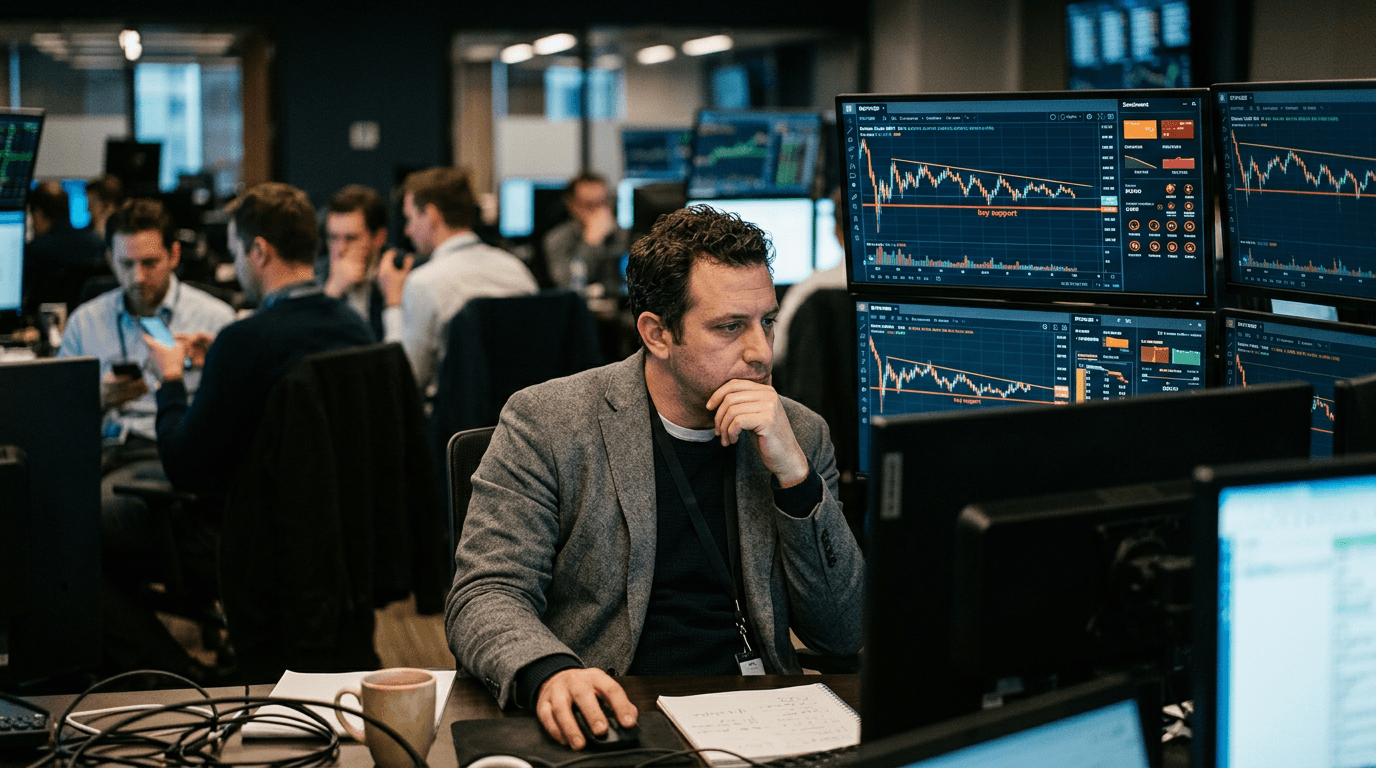
Crypto markets are leaning into a defensive posture, with Bitcoin Cash and other majors grinding sideways rather than breaking into new trends. Bitcoin Cash is trading close to 204 USD, only modestly higher on the day and clustered around the psychologically important 200 USD area, highlighting a range‑bound environment where traders remain cautious and selective rather than aggressively risk‑on[8][9][11].
Market Snapshot
Bitcoin Cash sits near 204–205 USD, with recent data placing its market capitalization around 4.1 billion USD and showing only fractional gains over the last 24 hours[8][9][11]. This kind of small daily move is consistent with consolidation rather than directional conviction. Over August, BCH has repeatedly oscillated between the low 200s and the mid‑210s, reflecting a gradual drift lower rather than a sharp breakdown, and reinforcing the idea that 200 USD is acting as a key support area[1][2][4][6][9].
Beyond BCH, the broader market tone is similarly reserved. Bitcoin recently traded around 62,900 USD, below major daily moving averages and in the context of a slow, methodical downtrend rather than a crash[7]. Sentiment gauges such as the Fear & Greed Index sit in the high‑20s, clearly in “fear” territory, indicating reduced risk appetite and a preference for defensive positioning[7]. Total crypto market capitalization has softened, while Bitcoin dominance around the mid‑50% range signals a flight to higher‑quality assets within the space[7].
Understanding A Defensive Tone
A defensive tone in crypto does not necessarily mean outright panic. Instead, it describes an environment where traders prioritize capital preservation, limit leverage, and favor strategies that perform better in ranges or slow trends. Current conditions fit this profile: prices are drifting rather than surging, volatility is relatively muted, and large‑cap assets are holding key supports but failing to attract strong follow‑through buying[7][9].
Sentiment indicators reinforce this picture. A Fear & Greed reading near 29 suggests investors are wary of adding risk and more likely to sell rallies than chase upside breakouts[7]. In such phases, order flows often shift toward hedging, shorter‑timeframe trades, and systematic position management. Instead of momentum chasing, many participants watch levels like 200 USD in BCH or recent swing lows in BTC and ETH, reacting to those inflection points cautiously rather than pre‑empting big moves[7][9].
For both spot and futures markets, a defensive tone typically coincides with reduced net long exposure, slower growth in open interest, and a higher share of capital sitting in stablecoins or fiat. That backdrop helps explain why range trading and mean‑reversion strategies often outperform trend‑following systems when the market feels more like a grind than a sprint[7][10].
Consolidation Near Key Support
Consolidation near support means price is repeatedly testing and bouncing off a level that buyers have historically defended, without yet triggering a decisive reversal or breakdown. Bitcoin Cash’s behavior around 200 USD is a textbook example of this dynamic. Over recent sessions in August, BCH has swung between roughly 203–215 USD, with pullbacks toward the 200–203 USD zone attracting enough demand to stabilize price but not enough momentum to resume a convincing uptrend[1][2][4][6][9].
From a technical perspective, key supports like 200 USD often correspond to prior accumulation zones, round psychological figures, or areas where volume has historically spiked. The repeated defense of such levels suggests that long‑term holders are still willing to maintain positions, even if short‑term traders are reluctant to add aggressively. For BCH, the modest month‑to‑date decline in August and the tendency to hold the low‑200s underscores this balance between cautious buyers and hesitant sellers[4][6][9].
For traders, consolidation near support presents both opportunity and risk. On one hand, buying near well‑defined support with tight risk limits can be attractive, especially if the broader structure remains intact. On the other hand, failed supports often lead to accelerated moves lower, as stop orders cluster just beneath these levels. In a defensive market, participants are acutely aware of this asymmetry and tend to keep position sizes calibrated accordingly[7][9][10].
Derivatives Positioning And Leverage
Derivatives data adds another layer to the defensive story. Recent positioning in regulated Bitcoin futures shows asset managers reducing both longs and shorts, a form of position unwinding rather than new accumulation, which keeps net exposure relatively low by historical standards[10]. Leveraged funds, by contrast, remain meaningfully net short and their positioning sits in elevated bearish percentiles over six‑ and twelve‑month windows, signaling persistent skepticism about near‑term upside[10].
At the same time, overall open interest in major futures contracts has barely budged, with changes measured in dozens rather than thousands of contracts, indicating limited fresh capital entering directional trades[10]. Liquidation statistics for perpetual futures reveal that recent activity has skewed toward long liquidations in Bitcoin, consistent with traders repeatedly attempting to buy dips only to be forced out by continued grinding weakness[15]. This pattern fits well with a defensive environment: leverage is used, but more cautiously, and the market punishes premature attempts to call a bottom[7][10][15].
In altcoin derivatives, including Bitcoin Cash, exposure has grown but without clear, strong bullish catalysts, suggesting that many traders are using instruments like perpetual swaps primarily for hedging and range‑trading rather than for high‑conviction directional bets[9][10][15]. The combination of subdued open interest growth, cautious net positions, and a bias toward unwinding rather than building suggests that speculative energy remains constrained.
Practical Takeaways For Simulated Traders
For traders using SimFi platforms such as E8 Markets, a defensive, consolidating market offers valuable conditions to refine risk management and range‑trading playbooks without real capital at risk. First, it is an ideal environment to practice trading around support and resistance: identifying levels like 200 USD in BCH, planning entries near support, and defining precise stop‑loss placements just below key zones[4][6][9].
Second, it encourages disciplined position sizing. Simulated portfolios can be structured to test how small, incremental positions perform compared with aggressive leverage when volatility is modest and trends are unclear. This helps traders internalize the impact of different leverage levels on drawdowns and psychological stress, which is critical before applying similar strategies to live capital[7][10].
Third, defensive markets reward patience and clear scenario planning. For example, traders can design and backtest two concurrent strategies: a range‑bound mean reversion approach active as long as BCH holds above 200 USD, and a breakout‑continuation strategy triggered if that level fails and price accelerates lower. Running these playbooks side by side in simulation clarifies how structural regime shifts affect performance and risk metrics[4][7][9][10].
Finally, SimFi environments are well‑suited for experimenting with hedging across spot and derivatives. Traders can simulate holding spot BCH while using futures or swaps to partially hedge downside, evaluating how different hedge ratios and tenors alter portfolio volatility and maximum drawdown in a defensive market backdrop[9][10][15].
Looking Ahead
Until a new macro or sector‑specific catalyst arrives, the most probable path for Bitcoin Cash and other large‑cap crypto assets is continued range‑bound trading around key supports, with occasional tests of both downside and upside boundaries. The persistence of cautious sentiment, modest open interest changes, and bearish professional positioning suggests that any rallies may encounter profit‑taking rather than strong trend reinforcement[7][9][10].
For traders, the message is clear: this is a market to respect levels, manage risk tightly, and avoid over‑leveraging into unclear narratives. SimFi platforms provide a safe arena to refine these skills, allowing market participants to turn a defensive phase into an educational opportunity that builds readiness for the next truly directional move. When volatility eventually returns and genuine catalysts emerge, those who have honed disciplined strategies during this quieter, more guarded period will be better positioned to navigate the shift with confidence and control[7][9][10].