
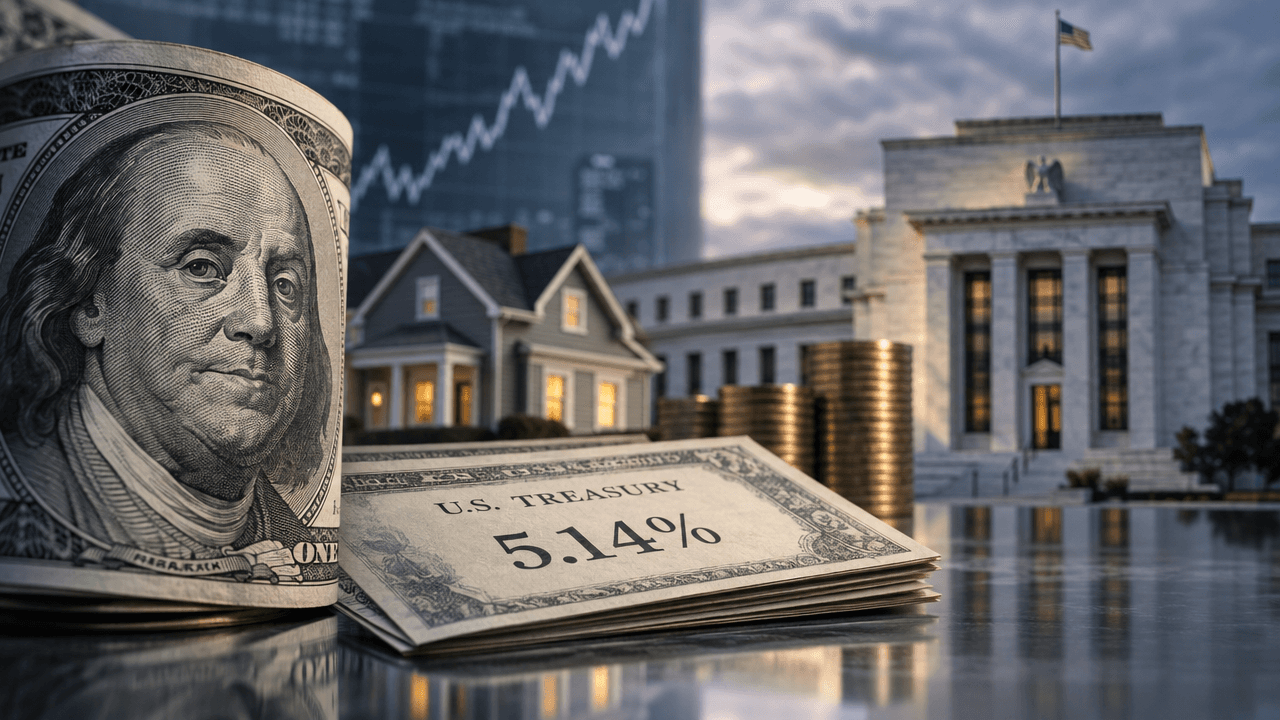
The U.S. dollar and Treasury yields are moving higher as investors prepare for a crowded stretch of corporate earnings, economic data, and fresh signals from the Federal Reserve. The dollar index rose to 101.97, while the benchmark 10-year Treasury yield climbed 6.7 basis points to 5.14%. Together, those moves point to a market increasingly focused on interest rates, inflation risks, and the possibility that borrowing costs may remain elevated for longer.
This combination matters far beyond the foreign-exchange and bond markets. Higher Treasury yields influence mortgage rates, corporate financing costs, equity valuations, and consumer credit. A stronger dollar also affects multinational companies by reducing the value of overseas revenue when it is converted back into U.S. currency.
Why The Dollar And Yields Are Rising
Treasury yields typically rise when investors expect stronger economic growth, persistent inflation, increased government borrowing, or a Federal Reserve that will keep monetary policy restrictive. The latest move toward 5.14% reflects a repricing of those risks ahead of important market signals.
The dollar benefits when U.S. interest rates appear more attractive than rates available in other major economies. Higher yields can encourage global investors to hold U.S. government debt and dollar-denominated assets. Expectations of additional Federal Reserve tightening, or simply fewer anticipated rate cuts, can provide another source of support for the currency.
However, a stronger dollar is not automatically a sign of improving market conditions. It can also reflect defensive positioning. When investors become concerned about geopolitical uncertainty, inflation, or slowing global growth, they often seek the liquidity of U.S. dollars and Treasuries. The result can be a firm dollar alongside pressure on risk-sensitive assets.
The Housing Market Feels The Pressure
Housing is one of the clearest examples of how bond-market moves affect the real economy. The National Association of Home Builders/Wells Fargo Housing Market Index fell three points to 29 in October, its lowest reading since June 2012. Any reading below 50 indicates that more builders view market conditions negatively than positively. [2]
Mortgage rates have moved above 7%, increasing monthly payments and making it harder for prospective buyers to qualify for loans. Higher financing costs can cause buyers to delay purchases, reduce the price of homes they can afford, or leave the market altogether.
Builders are also facing higher energy and material expenses, as well as deteriorating labor and lot conditions. The combination creates a difficult operating environment: demand weakens just as the cost of developing new homes increases. Some builders may respond with price reductions, incentives, or smaller projects, but those measures can compress profit margins.
For traders, housing data is an important interest-rate indicator. Weak builder confidence can signal that monetary policy is slowing activity in rate-sensitive sectors. At the same time, persistent inflation in construction costs may make it more difficult for the Federal Reserve to quickly ease policy.
Earnings Will Test Corporate Resilience
Major earnings reports will provide the next test of whether companies can absorb higher rates and a stronger dollar. Financial firms may benefit from certain interest-income trends, but they must also manage credit quality and potential loan losses. Technology companies and other growth stocks face greater valuation pressure because their future cash flows are discounted at higher rates.
The stronger dollar creates another challenge for multinational companies. When overseas sales are translated into dollars, exchange-rate changes can reduce reported revenue and earnings even if local-currency demand remains steady. Management teams may respond by adjusting forecasts, reducing costs, or emphasizing domestic growth.
Investors should listen closely for comments about pricing power, customer demand, refinancing plans, capital expenditure, and currency effects. A company that maintains its outlook despite higher borrowing costs may attract attention, while a business that cuts guidance because of weak demand could reinforce concerns about an economic slowdown.
What Fed Signals Could Mean
The Federal Reserve’s communication will be central to the next market move. Investors will assess whether policymakers remain primarily concerned about inflation or are becoming more worried about the effects of restrictive policy on employment, housing, and consumer spending.
A hawkish message could push Treasury yields and the dollar higher, particularly if officials suggest that rates may stay elevated or that another increase remains possible. A more dovish tone could ease pressure on bonds and rate-sensitive equities, although a sharp decline in yields might also signal rising recession concerns.
Markets can react more to changes in expectations than to the policy decision itself. Traders should therefore compare new guidance with the rate path already priced into futures markets. A statement that sounds modest in isolation can still produce a large move if it differs from investor positioning.
Practical Takeaways For Traders
First, monitor the 10-year yield as a broad financial-conditions gauge. A sustained move above 5% can pressure growth-stock valuations and increase financing costs across the economy.
Second, watch the dollar index alongside Treasury yields. A rising dollar and rising yields often indicate stronger expectations for U.S. rates, while a rising dollar with falling yields may point more toward defensive demand.
Third, treat housing data as an early warning signal rather than a complete economic verdict. Builder confidence is weak, but the broader economy depends on employment, consumer spending, business investment, and financial stability as well.
Finally, avoid reacting to one headline in isolation. Earnings guidance, inflation data, labor-market reports, and Federal Reserve commentary can quickly change the market’s interpretation of rates and growth.
The current rise in the dollar and Treasury yields highlights a market at an important crossroads. Investors are balancing inflation risks against evidence that high borrowing costs are beginning to damage interest-sensitive industries. The coming earnings reports and Federal Reserve signals should help determine whether the latest moves represent a temporary adjustment or the beginning of a broader repricing across financial markets.