
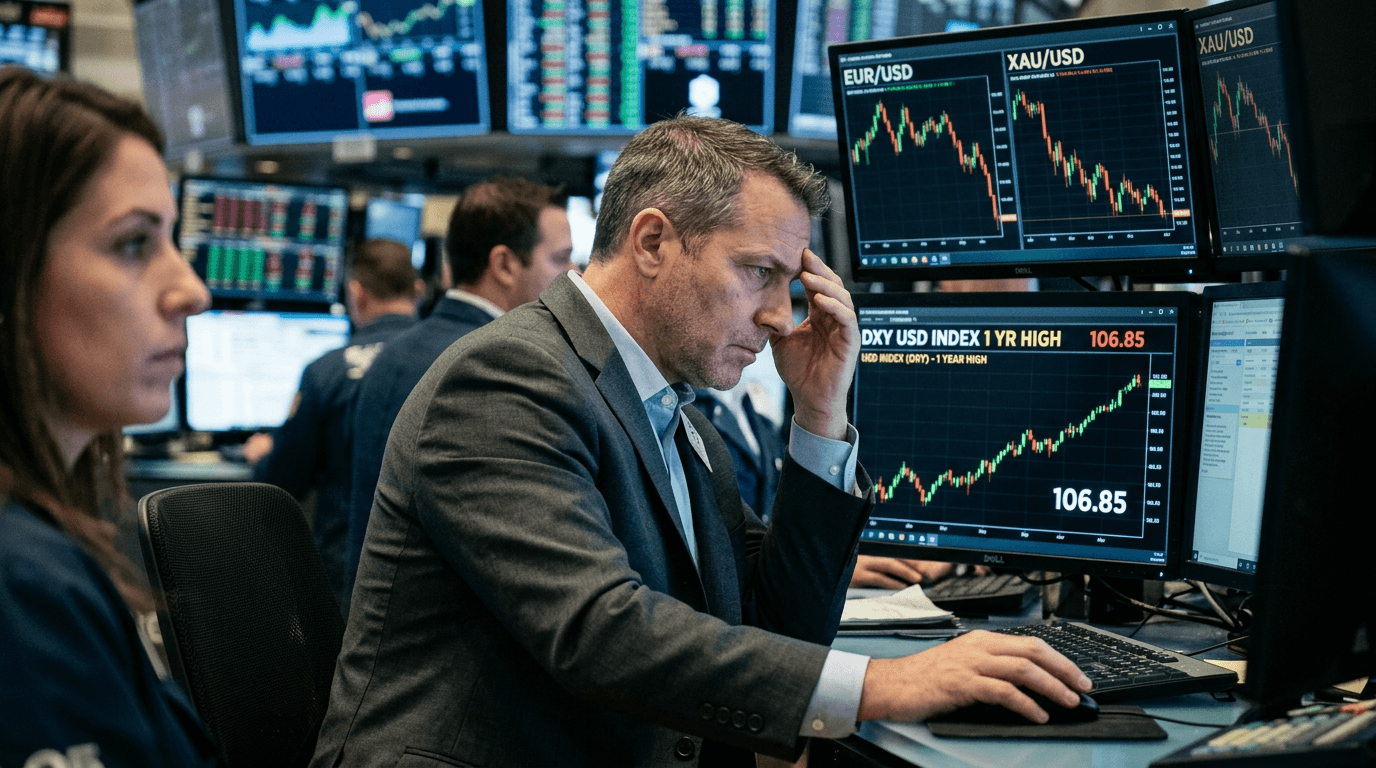
The US Dollar Index has surged to a one‑year high, underscoring a powerful rotation into safe‑haven assets as investors reassess global growth, inflation, and policy risks.[6][12] At the same time, precious metals are sliding toward six‑month lows, highlighting a clear risk‑off tone that is rippling through FX, commodities, and rates markets. This move is not just a headline; it is reshaping major currency pairs, derivatives positioning, and the way traders think about portfolio defense.
Safe Haven Rotation: Why The Dollar Is Surging
The U.S. Dollar Index (DXY) measures the dollar against a basket of major currencies, with the euro, yen, and pound making up the largest weights.[11] In recent sessions, DXY has pushed into the 101–102 region, printing fresh 52‑week highs in the 101.6–101.8 zone.[6][12] This advance comes after a period of consolidation and reflects renewed demand for the dollar as a store of value amid global uncertainty.
Several forces are driving this safe‑haven rotation. First, U.S. yields remain elevated relative to most developed markets, making dollar‑denominated assets more attractive on a carry basis.[5][8] Second, risk assets from European equities to global indices have come under pressure, reinforcing the appeal of cash and highly liquid instruments.[1] Third, lingering questions around global growth, geopolitical tensions, and the timing of future central bank easing keep investors biased toward defensive positioning.
The simultaneous weakness in precious metals adds an important nuance. Typically seen as alternative safe havens, gold and silver drifting toward six‑month lows suggests that, at present, liquidity and yield are trumping the traditional “store of value” trade. In other words, when volatility picks up, investors are prioritizing the currency they can easily use and the assets that still offer a positive real return.
Impact On Major Fx Pairs
Dollar strength is most visible in the major FX pairs that anchor global trading: EUR/USD, GBP/USD, and USD/JPY. Because the euro and pound carry the largest negative weights in the DXY calculation, their weakness directly amplifies the index’s climb.[11] As the dollar rallies, EUR/USD and GBP/USD are grinding lower, reflecting both relative rate differentials and shifting risk sentiment.
For EUR/USD, the story is partly about growth divergence. Concerns about the euro area’s economic momentum and the pace of any European Central Bank easing make the euro less compelling when the U.S. still offers higher yields and resilient data. Meanwhile, GBP/USD faces its own mix of political and macro uncertainty, from fiscal questions to the Bank of England’s delicate balance between inflation control and growth support.
USD/JPY often behaves differently, acting as a barometer of yield spreads and risk sentiment. Elevated U.S. Treasury yields versus Japanese government bond yields continue to support the dollar against the yen, even as authorities in Tokyo watch for excessive currency weakness. In a risk‑off environment, some investors do rotate into the yen, but the structural rate gap and the dollar’s global funding role frequently keep USD/JPY supported.
For traders, these dynamics matter in practical terms. Dollar rallies tend to compress volatility in some pairs while expanding it in others, and the correlation structure between FX, equities, and rates can shift quickly. Simulated trading environments are particularly useful in this phase, allowing market participants to stress‑test strategies against scenarios where the dollar continues to climb or suddenly mean‑reverts.
PRESSURE ON EMERGING‑MARKET CURRENCIES
The sharp move higher in the dollar index is especially challenging for emerging‑market (EM) currencies. When the dollar strengthens, funding costs rise, external debt burdens feel heavier in local terms, and capital flows often turn more cautious. The result can be a feedback loop: weaker EM FX can tighten financial conditions, which then weighs on growth expectations and risk appetite.
In EM FX, the combination of a strong dollar and softer commodity prices is particularly problematic. Many emerging economies rely on commodity exports for growth and foreign exchange earnings; falling precious metals and broader resource prices can compress revenues just as dollar‑denominated liabilities become more expensive. That is a textbook recipe for wider risk premia and heightened volatility in EM currency pairs.
From a trading perspective, this environment increases the importance of understanding carry, correlation, and liquidity risk. Strategies that were profitable in a low‑volatility, weaker‑dollar regime may behave very differently when the greenback is at a one‑year high and global investors are retrenching. Using simulated portfolios to explore hedging with options, reducing unhedged EM exposure, or shifting into more liquid pairs can be a valuable exercise.
CROSS‑ASSET POSITIONING AND DERIVATIVES FLOWS
The move in DXY is not occurring in isolation; it is driving meaningful repositioning across futures and options markets. US Dollar Index futures are actively traded, providing a direct way for institutional players to express views on broad dollar strength or weakness.[5][10] As the index pushes higher, flows into FX futures and options on major pairs like EUR/USD and GBP/USD tend to increase, with traders pricing in a longer period of elevated U.S. yields and tighter global financial conditions.
Options markets can reveal how traders are positioning for tail risks. In a risk‑off rotation, demand often rises for dollar calls (or put options on dollar‑quoted pairs like EUR/USD), reflecting a desire to hedge against further dollar appreciation. Skew in implied volatility—the relative cost of upside versus downside protection—can offer clues about whether the market fears a continued dollar surge or is more worried about a sudden reversal.
Beyond FX, the dollar’s strength influences equities, credit, and commodities. Dollar‑denominated assets become more expensive for non‑U.S. investors, potentially weighing on global equity flows, while companies with significant foreign earnings may face translation headwinds. In commodities, a stronger dollar typically exerts downside pressure on prices, since many global contracts are priced in USD; that reinforces the recent weakness in precious metals and can reshape the relative attractiveness of inflation hedges.
For traders and investors building multi‑asset strategies—whether in live or simulated environments—this is a prime moment to revisit correlation assumptions. Historical patterns can break down when policy, growth, and liquidity regimes shift, so relying solely on past relationships between the dollar, metals, and risk assets can be dangerous.
What Traders Can Do Now
With the dollar at a one‑year high and safe‑haven demand in focus, traders need a clear framework rather than reactive decision‑making. A few practical steps stand out:
First, reassess currency exposure. Map out how much of your portfolio is implicitly long or short the dollar through equities, bonds, and commodities, not just FX positions. This holistic view helps avoid unintended concentration risk.
Second, stress‑test strategies under different dollar scenarios. Consider what happens if DXY extends further above its recent highs, versus a pullback toward prior ranges.[6][12] Simulated trading and scenario analysis can reveal where stops, position sizing, and hedges may be inadequate.
Third, revisit hedging tools. FX options, index futures, and cross‑currency hedges can all play a role in managing dollar risk. Understanding how option pricing responds to volatility spikes in risk‑off regimes is crucial for selecting cost‑effective protection.
Finally, maintain flexibility. Safe‑haven rotations can be sharp but short‑lived, or they can evolve into longer trends driven by macro fundamentals. Keeping a rules‑based approach—anchored in clear risk limits and tested strategies—helps traders navigate both outcomes with discipline.
As the US Dollar Index holds near its one‑year highs and precious metals struggle, the message from markets is clear: capital is seeking safety, liquidity, and yield. For market participants, the challenge is not just to recognize this regime, but to adapt their trading, risk management, and portfolio construction to turn a complex macro shift into informed, controlled decision‑making.