
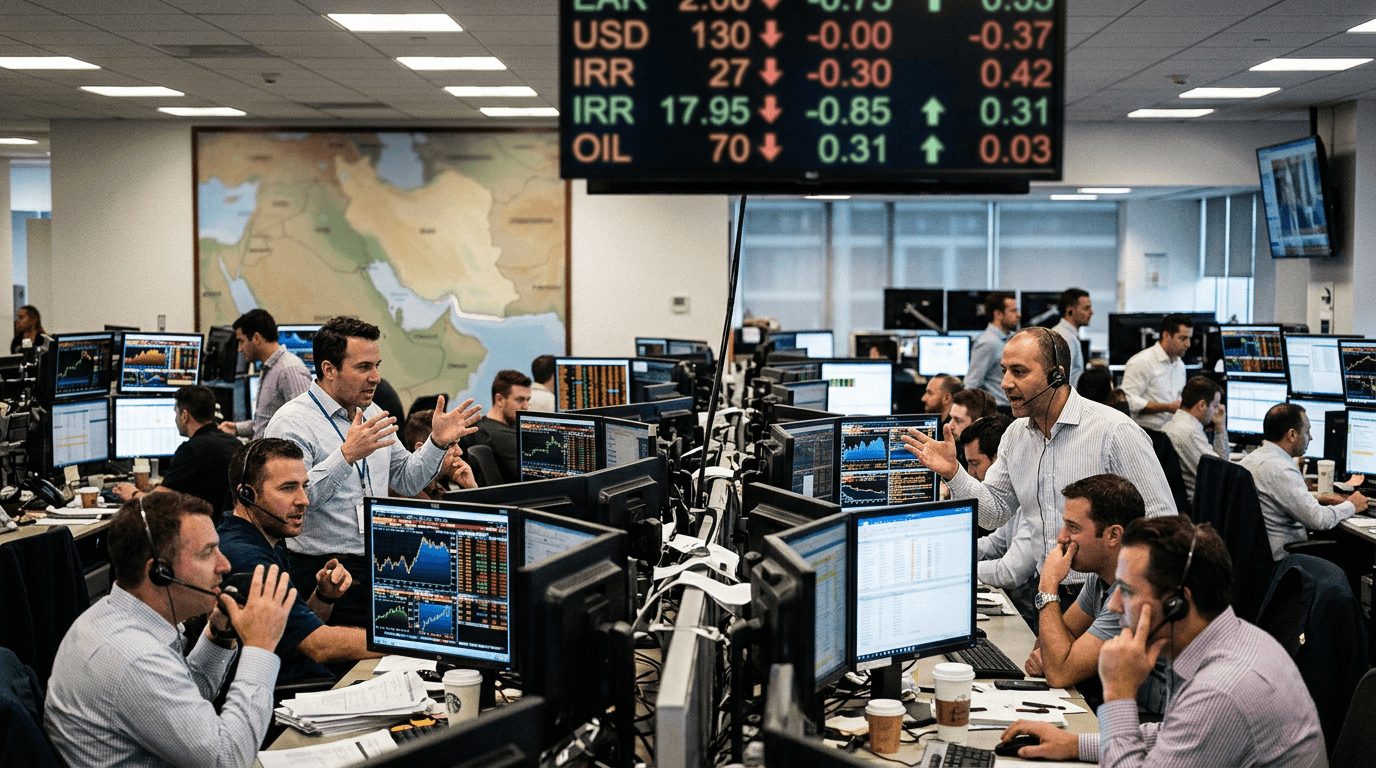
The U.S. dollar slipped against major peers after reports that Washington and Tehran had reached a ceasefire-style peace arrangement that would reopen the Strait of Hormuz, easing immediate geopolitical fears and reducing demand for traditional safe-haven assets.[1][6] With the war-risk premium fading, forex markets quickly pivoted back to the familiar drivers of central bank expectations, interest rate differentials, and upcoming inflation data.[1][2]
Market Reaction: Dollar Softens As Risk Premium Fades
The initial market response followed a classic “risk-on” pattern. The dollar weakened broadly, with traders unwinding some of the safe-haven flows that had previously supported the currency during heightened tensions in the Gulf.[1][6] At the same time, Asian equities rallied and oil prices fell sharply as the prospect of a reopened Strait of Hormuz reduced fears of supply disruption and stagflationary pressure.[2][6]
This shift reflects how quickly FX markets reprice geopolitical risk once a credible path to de-escalation appears. Previously, fears of an extended conflict and disrupted shipping lanes through the Strait had boosted demand for the dollar and U.S. Treasuries as global investors sought liquidity and safety.[1] With a 60‑day ceasefire framework and commitments tied to reopening the Strait now on the table, that premium has started to unwind.[1][3][4][6]
Importantly, the move in the dollar has not been a collapse but a recalibration. The underlying macro backdrop—U.S. growth, relative yields, and the Federal Reserve’s policy path—has not changed overnight. What has changed is the market’s need to pay up for protection against an extreme tail risk in the Middle East.
Safe-haven Demand: Why It Matters For Currencies
To understand this move, it helps to clarify what “safe-haven demand” means in FX. In periods of acute uncertainty—wars, financial crises, sudden sanctions—investors tend to rotate into assets perceived as stable, liquid, and resilient. The U.S. dollar, U.S. Treasuries, the Japanese yen, and the Swiss franc often benefit from these flows.
When tensions around the Strait of Hormuz were elevated, the dollar’s role as the world’s primary reserve currency, combined with deep U.S. financial markets, made it a natural beneficiary of defensive positioning.[1] Energy importers hedging oil risks, institutions reducing emerging-market exposure, and macro funds trimming risk often do so by raising dollar cash balances or dollar-denominated assets.
Once a credible peace or ceasefire framework emerges, some of those flows reverse. Traders no longer need as much dollar “insurance,” and capital starts moving back into risk-sensitive assets and currencies with higher yields or growth potential. That is the dynamic now playing out: lower geopolitical risk has translated into lower safe-haven demand for the dollar and a softer USD profile on the screens.[1][2][6]
For traders, this episode reinforces a key lesson: geopolitical risk tends to support the dollar on the way up but can lead to abrupt reversals when the news flow turns. Position sizing and stop-loss discipline are critical when trading around such binary catalysts.
Strait Of Hormuz, Oil Prices, And Inflation Expectations
The Strait of Hormuz is one of the world’s most important energy chokepoints, with a large share of global seaborne oil and LNG passing through this narrow passage. Any threat to its stability typically pushes oil prices higher, stokes inflation fears, and prompts markets to reassess interest rate paths and growth risks.
The reported U.S.-Iran deal, which includes provisions to reopen or keep open the Strait of Hormuz under a 60‑day ceasefire window, has dramatically reduced the perceived probability of a sustained supply disruption.[1][3][4][6] In response, oil prices tumbled, easing concerns about another leg higher in global inflation.[2][6]
Lower energy prices filter through to markets in several ways:
First, they reduce headline inflation readings with a lag, especially in economies heavily exposed to energy imports.
Second, they can soften inflation expectations, making central banks slightly less inclined to hike or more comfortable discussing future easing.
Third, they provide some relief to corporate margins and household budgets, supporting risk appetite for equities and higher-beta currencies.
That interaction between geopolitics, oil, inflation, and central bank policy is exactly why FX markets care so much about the Strait of Hormuz. The latest peace deal has effectively removed, at least temporarily, one of the biggest upside risks to global energy prices.
Central Banks Back In Focus
With the immediate geopolitical shock fading, traders are quickly refocusing on central bank paths and upcoming inflation data as the primary drivers of currency moves.[1] In the U.S., markets are watching key releases like the Fed’s preferred PCE inflation gauge and CPI reports to judge whether the Federal Reserve can consider rate cuts or must stay higher for longer.[1]
If lower oil prices feed into softer inflation prints, that could marginally increase the probability of earlier or deeper easing from the Fed compared with previous expectations.[2][6] That scenario would typically weigh on the dollar, particularly against currencies where central banks remain relatively more hawkish. Conversely, if core inflation remains sticky despite cheaper energy, the Fed may keep its restrictive stance longer, potentially limiting the dollar’s downside.
Outside the U.S., other major central banks will also be reassessed in this new environment. A calmer Middle East and lower energy prices reduce pressure on the European Central Bank and Bank of England, whose economies are more sensitive to imported energy costs. That can narrow the perceived policy gap with the Fed and further shape major FX pairs.
For FX traders, the message is straightforward: the geopolitical premium may be fading, but the macro and policy story is far from settled. Data surprises will likely reclaim center stage as the main source of volatility.
Practical Takeaways For Traders And Simulated Strategists
Several practical lessons emerge from this episode that apply to both live and simulated trading environments:
First, distinguish between temporary risk premiums and structural shifts. The dollar’s earlier strength was partially driven by a war-risk premium tied to the Strait of Hormuz. Once that risk was reduced by the tentative U.S.-Iran peace deal, part of that premium naturally evaporated.[1][6] Building scenarios in advance for “peace” and “escalation” cases can help avoid emotional trading when headlines hit.
Second, understand cross‑asset linkages. The move in FX is tightly linked to oil, rates, and equities. Lower oil prices reduce inflation risk and rate expectations, which in turn pressure the dollar while supporting stocks and higher‑beta currencies.[2][6] Tracking these relationships—rather than looking at FX in isolation—can improve timing and risk management.
Third, respect the speed of repricing. Geopolitical narratives can change abruptly. Traders who chased the dollar purely on conflict headlines may have been caught offside by the rapid pivot to a ceasefire narrative. Using appropriate leverage, well-placed stop losses, and defined risk per trade is essential in such environments.
Finally, keep your focus on data and central banks once the dust settles. With the immediate shock fading, markets will likely trade more on incoming economic numbers, policy guidance, and relative growth stories than on geopolitics—at least until the next unexpected headline.
For those practicing in a simulated setting, this is an ideal case study: build and test strategies that respond to both “event risk” (like peace deals) and “macro drift” (like gradual changes in inflation and rate expectations). Over time, the goal is to develop a playbook that can adapt quickly, manage risk under uncertainty, and avoid overreacting to any single news item.