
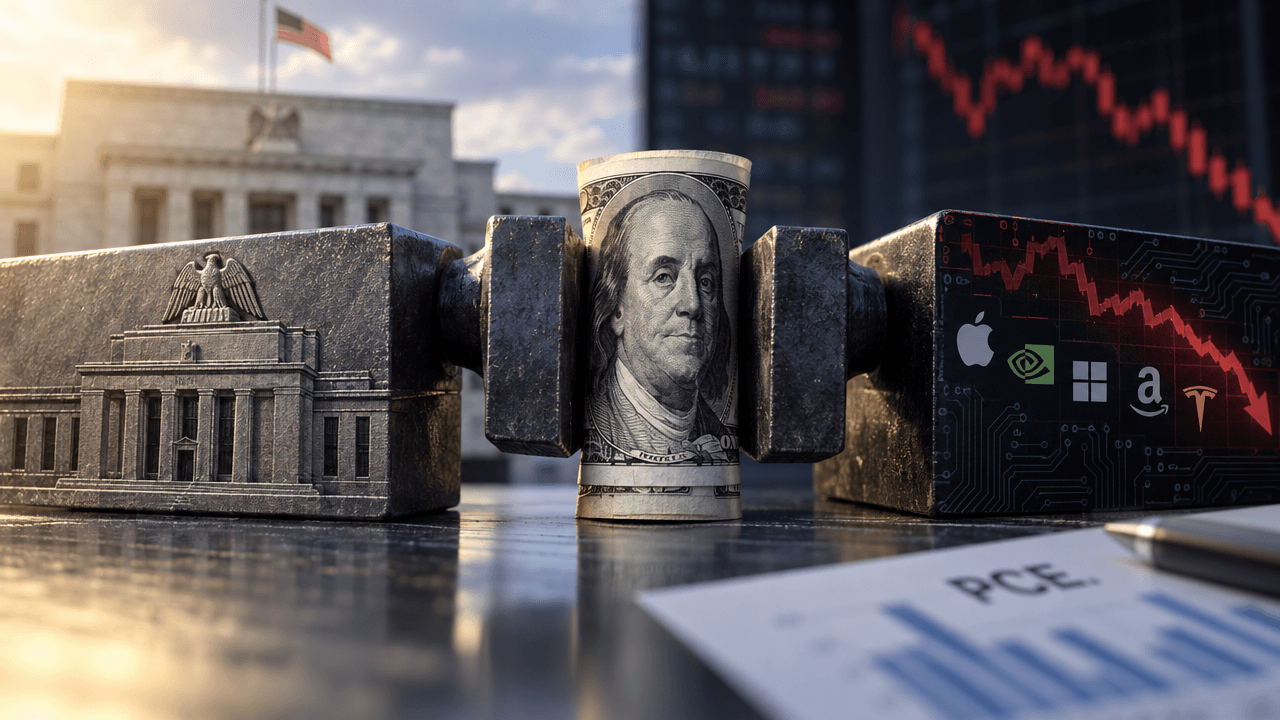
The U.S. dollar is being pulled in two directions. On one side, renewed expectations for Federal Reserve interest-rate increases are supporting the currency. On the other, fading enthusiasm for technology stocks is changing risk appetite and encouraging investors to reassess whether the dollar’s recent rally can continue. With the dollar index easing toward 103.8, the next major move may depend less on consumer confidence and more on the inflation data shaping interest-rate pricing. [1]
INFLATION IS THE MARKET’S MAIN SIGNAL
The Federal Reserve’s preferred inflation measure, the Personal Consumption Expenditures price index, is at the center of the market’s attention. Traders are watching both headline PCE inflation and the core measure, which excludes food and energy prices and is often viewed as a better guide to underlying price pressures.
A hotter-than-expected report would suggest that inflation is proving difficult to control. That could encourage traders to price additional rate increases, not only at the Fed’s upcoming meeting but potentially into 2027. Higher expected interest rates generally make dollar-denominated assets more attractive because they offer the prospect of greater returns compared with assets in economies where rates are expected to remain lower.
Recent market previews suggest that a core PCE reading of 0.4% month over month or higher could lift short-term Treasury yields and strengthen the dollar. A reading closer to 0.2% or lower could produce the opposite reaction by reducing expectations for further tightening. [5]
The key lesson is that markets respond to the difference between the result and expectations. Even a relatively high inflation reading may have a limited effect if traders have already anticipated it. Conversely, a modest number can weaken the dollar if investors were positioned for something significantly hotter.
Rate Pricing Can Override Other Data
Consumer confidence has recently improved, reaching its highest level in nearly two years, according to reports on the latest survey. Stronger confidence can support the dollar because it suggests that households remain willing to spend and that economic activity may be resilient. [1]
However, confidence data is not the same as inflation data. For currency traders, the more important question is whether economic strength will keep prices elevated and prevent the Federal Reserve from easing policy. If confidence improves while inflation remains firm, markets may view the combination as especially supportive for the dollar.
Interest-rate expectations are already playing a major role. Market pricing has pointed to a high probability of a quarter-point Fed increase at the December 8–9 meeting. [4] A strong PCE report could increase expectations for follow-up increases, pushing front-end bond yields higher and giving the dollar another potential boost.
A softer PCE report would challenge that outlook. Traders could reduce rate-hike bets, Treasury yields could fall, and the dollar could lose one of its most important sources of support. This is why a single inflation release can affect currencies, bonds, equities, and commodities at the same time.
Technology Risk Appetite Adds A Second Layer
The dollar’s direction is not determined by interest rates alone. Investor sentiment is also important, particularly when technology stocks are experiencing sharp moves.
Concerns about elevated artificial-intelligence valuations, corporate financing needs, and the future returns on massive technology investments have recently weighed on equity markets. Those concerns have encouraged some investors to seek traditional safe-haven assets, including the dollar and U.S. government bonds. [11]
At the same time, a recovery in technology shares can reduce demand for defensive currencies. When investors become more comfortable taking risk, they may move money into equities, emerging markets, and higher-yielding currencies. That can limit the dollar’s gains even if U.S. interest rates remain relatively attractive.
This creates a complicated market backdrop. A decline in technology stocks may support the dollar through safe-haven demand, but it could also lead traders to expect weaker economic growth and fewer future rate increases. The short-term reaction may therefore depend on whether investors interpret the technology selloff as a temporary correction or as a broader threat to economic activity.
What Traders Should Watch
The first priority is the core PCE monthly change. Traders should compare the actual number with both the consensus forecast and the previous reading. A small surprise can have a large effect when positioning is concentrated ahead of a major central-bank event.
The second priority is Treasury yields, especially two-year yields. These yields are highly sensitive to expectations for Federal Reserve policy. If inflation rises and two-year yields climb alongside the dollar, that would confirm that rate pricing is driving the move.
The third signal is the response of equity markets. A stronger dollar combined with falling technology stocks would suggest that both higher-rate expectations and defensive demand are working in favor of the currency. By contrast, a softer dollar alongside rising equities would point to easing rate expectations and improving risk appetite.
Traders should also avoid treating the first price reaction as the final outcome. Currency markets can reverse quickly when investors reassess the details of an inflation report or focus on forward-looking comments from Federal Reserve officials.
The Broader Outlook
The dollar’s recent strength reflects a market that is increasingly focused on the possibility of tighter U.S. monetary policy. Yet that support remains conditional. It depends on inflation staying high enough to justify further rate increases without damaging confidence in economic growth.
A hotter PCE report would likely reinforce the dollar’s rate advantage and could push the index back toward recent highs. A softer report would weaken the case for additional tightening and may send the dollar lower, particularly if technology stocks stabilize and investors return to riskier assets.
For SimFi traders, the most useful approach is to build scenarios rather than predict a single outcome. Define what would happen if inflation exceeds expectations, meets forecasts, or falls short. Then monitor the dollar, Treasury yields, and equities together. The strongest trade signals often emerge when all three markets confirm the same economic message.
The dollar’s next major move will ultimately depend on whether inflation or risk appetite takes control. For now, every meaningful data surprise has the potential to change both the Fed outlook and the balance between safety and growth in global markets.