
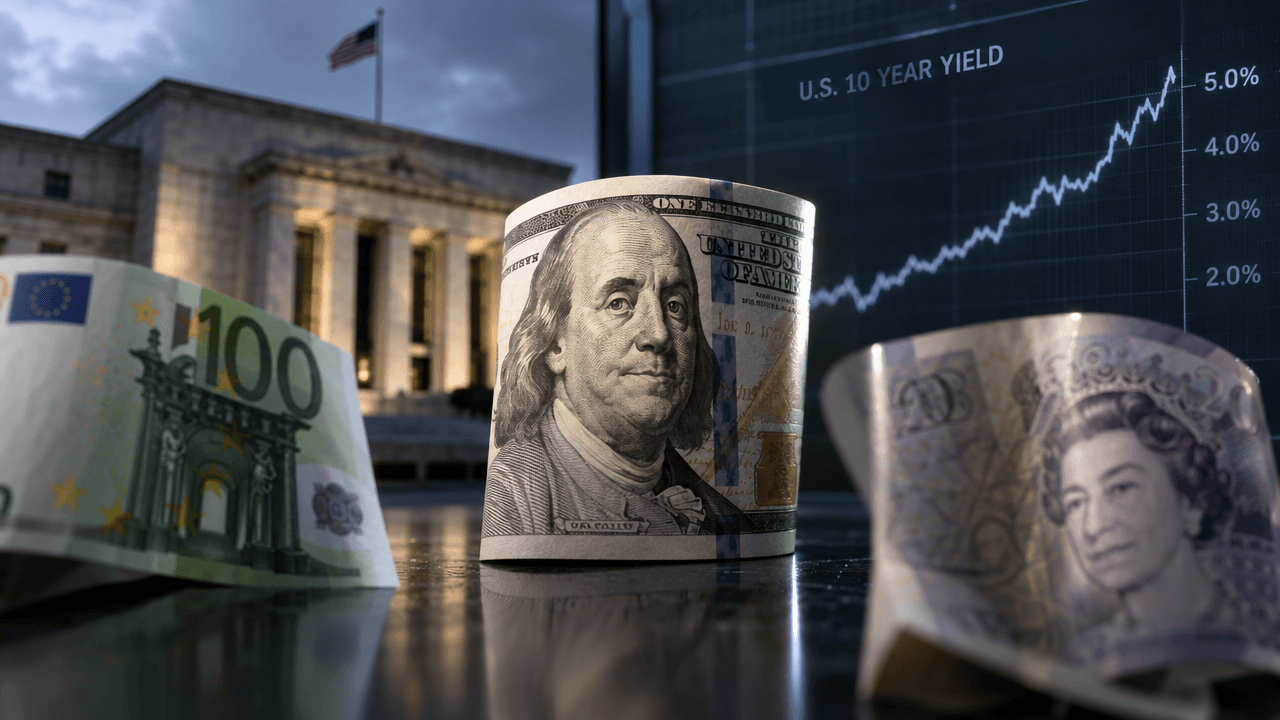
The U.S. dollar is holding firm as long-term Treasury yields climb to fresh multi-decade highs, reshaping the risk–reward landscape across global markets[1][8][9]. With the Dollar Index trading just above 101 and major pairs like EUR/USD near 1.1380 and GBP/USD around 1.3230, rate expectations and bond market dynamics are once again at the center of FX price action[1][4][15]. For traders, this environment demands close attention to yield curves, central bank narratives, and cross-asset correlations.
Market Snapshot: Stronger Dollar, Softer Majors
The Dollar Index has firmed, sitting just above the 101 level after posting gains over the past month and year, confirming a resilient underlying bid for the greenback[1]. At the same time, the euro is trading close to the 1.14 threshold versus the dollar, near its weakest levels in roughly two months as U.S. rate expectations weigh on the single currency[10][12]. Sterling is in a similar position, with GBP/USD hovering in the 1.32 area and struggling to extend recent gains against the dollar[4][14][15].
This combination of a steady Dollar Index and pressured major currencies reflects a familiar macro backdrop: higher U.S. yields, relatively stronger nominal growth, and persistent uncertainty about inflation and fiscal sustainability[8][9][13]. For FX traders, it reinforces the idea that the dollar still serves as the global “high-yield safe haven” when U.S. rates rise and risk sentiment turns cautious[8][9].
Why Higher Treasury Yields Support The Dollar
Long-term Treasury yields have surged in 2026, with the benchmark 10-year note trading around the 5.2% area, near its highest levels since the mid-2000s[2][3][13]. The 30-year yield has climbed even more aggressively, recently touching levels around 5.45–5.48%, the highest since 2004, as investors demand greater compensation to hold long-duration U.S. debt[3][8][13]. These moves represent a broad, sustained repricing of interest rate risk rather than a short-lived spike.
Several forces are driving yields higher: a more hawkish Federal Reserve stance, still-elevated inflation, resilient economic growth, and mounting concerns about long-run government spending and deficits[3][8][9]. As markets price in a “higher for longer” rate path, U.S. fixed income increasingly offers attractive real and nominal returns compared with other developed markets[6][9][13]. International investors reallocating towards U.S. assets must buy dollars, which directly supports the currency and contributes to the firmness of the Dollar Index[1][8][9].
In FX terms, the yield advantage boosts the carry appeal of holding dollar positions against lower-yielding currencies such as the euro, yen, or Swiss franc[9][10]. Even for higher-yielders like sterling, the relative gap versus U.S. long-term rates has widened, limiting the upside potential of GBP/USD despite domestic rate levels[4][13][15].
PRESSURE ON EUR/USD AND GBP/USD
Against this yield backdrop, EUR/USD has been consolidating just below and around 1.14, reflecting the euro’s struggle to gain traction as investors weigh softer regional growth against the stronger U.S. rate profile[10][12][15]. Recent data and central bank commentary in the euro area have reinforced expectations that policy is likely at or near its peak, leaving the European Central Bank less able to compete with the Fed in terms of rate differentials[9][10]. That disparity keeps the euro on the defensive when Treasury yields push higher.
GBP/USD is experiencing similar pressures, with spot levels near 1.3230 and intraday moves closely tracking shifts in U.S. yields and dollar sentiment[4][14][15]. While the Bank of England has delivered substantial tightening, markets are increasingly focused on the relative outlook: slowing domestic growth, limited scope for significantly higher rates, and the global attraction of U.S. long-term bonds[4][13]. As a result, rallies in sterling against the dollar have been shallow, and traders are quick to fade strength when yields in the U.S. move up again[4][8][15].
For both EUR/USD and GBP/USD, the key technical challenge is sustaining moves higher while the underlying fundamental driver—U.S. yield dominance—remains firmly in place. Until Treasury yields stabilize or begin to decline, major currencies face an uphill battle against the dollar[8][9][13].
What This Means For Active And Simulated Traders
For active traders and those using simulated finance platforms, the current environment is an ideal case study in how macro drivers translate into FX price action. Elevated Treasury yields tend to reinforce dollar strength, particularly against currencies whose central banks are closer to pausing or cutting rates[8][9][10]. This can create directional opportunities in pairs such as EUR/USD and GBP/USD, but also increases volatility as markets react to every new data point related to growth, inflation, and fiscal policy[3][8][9].
In a simulated environment, traders can model several scenarios: a continued rise in yields and stronger dollar, a stabilization phase where yields plateau and FX ranges form, or a reversal where softer data triggers expectations of easier Fed policy and a weaker dollar[6][9][13]. Testing strategies such as trend-following on DXY, carry trades in dollar crosses, or mean reversion around key technical levels on EUR/USD and GBP/USD can help build a deeper understanding of how macro themes drive intraday and swing moves[1][10][15].
Practical Takeaways For Traders
1. Track U.S. yield curves daily, especially the 10-year and 30-year, as they remain primary drivers of dollar sentiment[2][3][8].
2. Monitor central bank communications from the Fed, ECB, and Bank of England to gauge shifts in relative rate expectations and policy paths[3][9][10].
3. Use EUR/USD and GBP/USD as “benchmark” pairs for expressing views on U.S. yield moves, but manage risk carefully given heightened volatility around data releases[4][10][15].
4. In simulated trading, stress-test strategies under different yield regimes—rising, stable, and falling—to see how performance changes across macro environments[6][9][13].
5. Incorporate cross-asset signals from equities and credit spreads, as risk sentiment can amplify or dampen the impact of higher yields on the dollar[8][9].
Conclusion
The firm U.S. dollar and surging long-term Treasury yields underscore how closely FX markets are tied to the global interest rate cycle[1][8][9]. With the Dollar Index above 101 and major currencies like the euro and sterling under pressure, traders are being reminded that yield differentials and policy expectations remain core drivers of currency trends[1][4][10]. Whether trading live or in a simulated environment, understanding this relationship is essential for building robust strategies, managing risk, and navigating an increasingly complex macro landscape.