
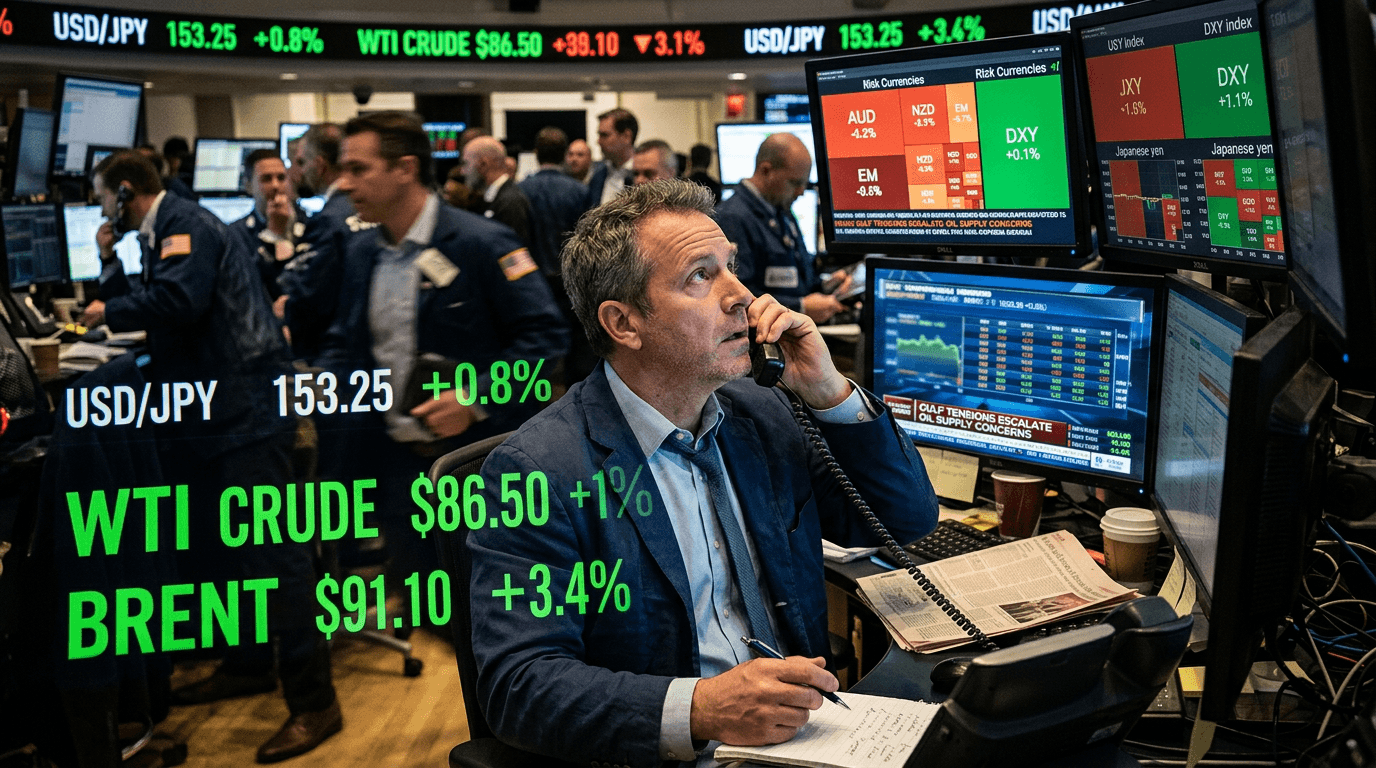
Renewed tensions in the Gulf have quickly rippled through global markets, and the U.S. dollar is once again at the center of the reaction. As headlines highlight rising hostilities and the prospect of supply disruptions, investors have moved to reduce risk, rotating into assets perceived as safer. The dollar, backed by deep liquidity and the world’s largest economy, has firmed against most major currencies, while oil prices spike and rate expectations stay elevated—creating a powerful mix for traders to navigate.
SAFE-HAVEN DEMAND AND THE DOLLAR’S ROLE
When geopolitical risks flare, especially in strategically critical regions like the Gulf, market behavior tends to follow a familiar pattern. Risk assets such as equities and higher-yielding currencies often come under pressure, while investors seek shelter in safe-haven instruments. Traditionally, that list has included U.S. Treasuries, the dollar, gold, and to some extent the Swiss franc and Japanese yen.
In the latest episode, the dollar is drawing more of that flow than its peers. Traders are not just responding to the headlines themselves, but to what they imply: potential disruptions in energy supply, higher input costs, and knock-on effects for global growth. This combination has pushed the dollar index higher, with the greenback holding firm against the euro, the pound, and a range of Asian currencies as risk sentiment softens. For many institutions, allocating to dollar-denominated assets is both a defensive move and a way to maintain flexibility until the geopolitical picture clears.
The dollar’s safe-haven appeal is reinforced by its unique status in global finance. It is the dominant invoicing currency for trade, the primary reserve currency for central banks, and the backbone of international funding markets. In times of stress, the ability to transact quickly and at scale in dollars becomes a key advantage, which is exactly what we see when Gulf tensions escalate.
Oil Price Shocks, Inflation Fears, And Rate Expectations
Rising Gulf tensions rarely stay confined to the security domain; they almost immediately filter into energy markets. With a significant portion of global oil supply linked to the region, any indication of heightened risk to shipping routes or production can push crude prices higher. That is happening again—oil has jumped, reviving concerns about energy-driven inflation at a time when many central banks are still trying to keep price pressures under control.
Higher oil prices tend to be inflationary: they raise transportation costs, feed into manufacturing and food prices, and ultimately hit consumers. For the U.S., that means traders reassessing the Federal Reserve’s path. Even if the Fed is close to a plateau on rates, any renewed upside surprise in inflation data can delay the timing of cuts or even bring the possibility of additional hikes back onto the table.
This is a critical link for forex markets. A firm dollar is not only about safe-haven buying—it is also about relative interest-rate expectations. If traders believe the Fed will keep rates higher for longer than other major central banks, the yield advantage of dollar assets increases. That pull becomes stronger when risk sentiment is weak, reinforcing demand for the greenback and helping it hold gains even against other defensive currencies.
Yen Under Pressure And Fx As The Main Theme
One of the clearest expressions of this dynamic is visible in USD/JPY. Despite the yen’s reputation as a safe-haven currency, it has struggled when U.S. yields remain elevated and the dollar is in demand. Gulf tensions have revived risk-off flows, but instead of boosting the yen, the move has highlighted the divergence between the Federal Reserve’s relatively firm stance and the Bank of Japan’s still-accommodative framework.
With U.S. yields staying high and oil-driven inflation risks in focus, traders have favored the dollar over the yen, pushing USD/JPY higher and keeping the Japanese currency under pressure. This is a reminder that “safe haven” is not a static label; yield differentials and policy expectations can outweigh tradition. In the current environment, FX markets are capturing this tension more directly than equities or bonds, making currency pairs one of the clearest expressions of shifting sentiment.
For traders, this setup turns FX into the primary market-moving theme. Moves in EUR/USD, GBP/USD, USD/JPY, and commodity-linked currencies like AUD and CAD are closely tracking changes in risk appetite, oil prices, and rate expectations. Volatility can rise quickly when new Gulf headlines hit the tape, with intraday swings often amplified by thin liquidity during off-peak trading hours.
How Simulated Traders Can Navigate Gulf-driven Volatility
On a SimFi platform, these developments create a valuable environment to practice navigating complex macro scenarios without capital at risk. Gulf tensions, higher oil prices, and shifting rate expectations form a rich backdrop for testing strategies, building playbooks, and sharpening execution.
First, focus on key indicators: the dollar index (DXY), benchmark U.S. yields (particularly the 2-year and 10-year), and front-month crude oil prices. Tracking how these move together around Gulf-related news provides a practical map of the macro linkages between energy markets, inflation fears, and FX performance.
Second, monitor headline risk. Geopolitical stories can evolve unpredictably—talks break down, ceasefire rumors surface, or unexpected escalations occur. Using a simulated environment, traders can build scenario trees: What happens to USD/JPY if tensions escalate further and oil spikes another 5–10%? How might EUR/USD respond if energy prices rise but the European Central Bank adopts a more cautious stance than the Fed? Running these scenarios through simulated trades helps translate macro views into concrete positions.
Third, pay attention to correlations. During stress episodes, correlations can tighten: risk assets tend to fall together, safe havens tend to rise together, and currency pairs linked to energy exporters can move more aggressively. Observing when correlations strengthen or break down is valuable for refining portfolio construction and understanding when diversification is truly working.
Risk Management Lessons From Safe-haven Rallies
Safe-haven rallies are emotionally charged and often fast-moving, but they rarely last indefinitely. As tensions eventually stabilize, markets re-price risk, and some of the defensive flows unwind. For traders, the most important lesson is to treat these episodes as part of a cycle, rather than a permanent state.
In practice, that means planning not only for the continuation of the risk-off environment, but also for its reversal. Simulated traders can experiment with staggered entry and exit strategies, tighter stop-loss levels during high-volatility periods, and hedging approaches that account for both geopolitical surprise and policy shifts. For example, if Gulf tensions ease sooner than expected while the Fed signals more confidence about inflation, the dollar could give back some gains, and risk currencies might stage a sharp rebound.
Using simulation, traders can also examine how position sizing affects outcomes in volatile conditions. A safe-haven bid for the dollar might be fundamentally justified, but oversized positions can still lead to drawdowns if timing is off or if markets overreact and then mean-revert. Practicing disciplined sizing, clear risk limits, and pre-defined exit rules in a SimFi environment builds habits that are transferable to live trading.
Ultimately, Gulf tensions, a firm dollar, and rising oil prices offer more than just headline drama—they provide a real-time case study in how geopolitics, macroeconomics, and market psychology intersect. For traders, the opportunity lies in understanding those connections, testing strategies when volatility is elevated, and being prepared for both the risk-off phase and the eventual rotation back into risk assets.