
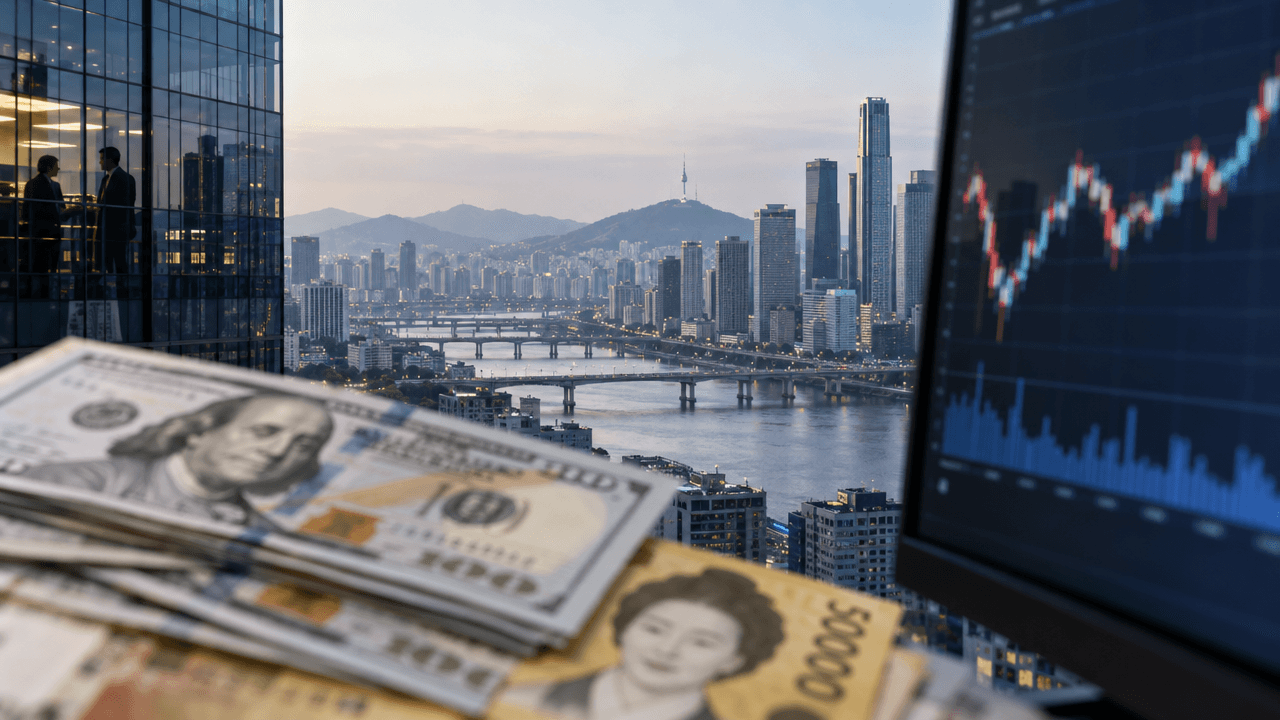
Global foreign exchange markets are reminding traders that in Asia, currencies still dance to the twin rhythms of capital flows and yield differentials. Moves like the latest uptick in USD/KRW, driven by futures and equity-related flows, underline how quickly regional FX can react when dollar demand and US rates shift[2][4].
Flow-driven Moves In Asian Fx
On September 30, USD/KRW traded higher as foreign-currency futures buying and equity-linked custody flows pushed the pair up intraday versus both the prior Seoul and New York closes[2]. This was not a macro headline day; it was a flow-driven move that revealed where sensitivity currently lies.
Foreign investors were net buyers of Korean assets, generating demand for dollar-hedging and pushing USD/KRW higher even as the won has been one of the more resilient Asian currencies this month[2][4]. The contrast is important: a currency can be fundamentally supported, yet still move sharply when concentrated flows hit the market in a short window.
Across Asia, currencies are broadly heading for monthly losses as high US yields and a firm dollar reduce the relative appeal of regional assets[4]. Rising Treasury yields narrow the yield advantage that many Asian markets traditionally offer, making them more vulnerable to periods of outflows or reduced inflows as global portfolios rebalance[4][3].
Why Yield Differentials Still Rule
Yield differentials—how much more or less a country pays relative to US rates—remain a core driver of FX valuation. When US yields are elevated and expected to stay higher for longer, the search-for-yield premium in many Asian markets compresses, weakening the case for unhedged local currency exposure[3][4].
Asian economies have benefited in recent years when lower US yields encouraged investors to seek higher returns in regional bonds and equities, supporting inflows and local currency strength[3]. As the dollar strengthens and US yields rise, part of that dynamic reverses, and those same currencies become more sensitive to risk-off shifts and portfolio exits[3][4].
In a world of around 5% US Treasury yields, investors are more discriminating across Asia, focusing on external balances, energy dependence, and specific capital flow patterns instead of treating the region as a single macro trade[4]. That means yield differentials interact with country-level fundamentals: a credible policy framework and solid external position can cushion against higher US rates, while weaker balance sheets see amplified FX pressure[4][3].
Cross-border Flows And A Changing Asian Map
The flow picture is also changing inside Asia itself. Cross-border investment increasingly moves not just between Asia and the US or Europe, but within the region, across multiple financial centers and instruments[12]. Capital raised in one market may be deployed in another, with FX hedging and rate management executed elsewhere in the region[12].
Asia’s intraregional share of cross-border assets and liabilities has been climbing, reflecting deeper financial integration and more complex portfolio architectures[3][12]. That integration amplifies FX sensitivity: when one market experiences outflows or sector rotation, spillovers can ripple through local currencies via hedging flows, derivative unwinds, and rebalancing trades[3][12].
For FX traders, this means that watching only headline data is no longer enough. Custody flows tied to equity indices, futures positioning, and cross-currency hedges can all drive short-term moves, even if macro data looks benign on the surface[2][12]. The USD/KRW move on September 30 is a textbook case of flows overpowering the broader narrative of the won’s relative resilience this month[2][4].
Practical Takeaways For Active Traders
For those trading major Asian FX pairs—whether in live markets or through a simulated environment—this flow-and-yield backdrop offers several concrete lessons.
1) Track yield spreads, not just levels. Comparing local 2-year and 10-year yields to US Treasuries helps gauge whether a currency is offering enough compensation to attract foreign capital or if the differential has eroded to the point where outflows are more likely[3][4].
2) Watch portfolio and futures flows. Daily data on foreign equity and bond flows, as well as positioning in currency and stock index futures, can explain intraday spikes that fundamental models might miss[2][12]. Moves like the recent USD/KRW jump often originate in these micro-structures.
3) Distinguish structural from tactical moves. A month-long trend of Asian FX softness amid high US yields is a structural theme, but individual sessions driven by custody or futures flows may be tactical opportunities to fade or follow, depending on broader positioning and risk appetite[4][3].
4) Integrate macro, flows, and sentiment. Combining rate expectations, cross-border flow data, and risk sentiment gives a more realistic picture of what is driving FX pairs on any given day, particularly in integrated markets like Asia where intraregional flows matter as much as US-centric dynamics[3][12].
How Simulated Finance Can Help You Practice
Simulated Finance (SimFi) platforms like E8 Markets allow traders to rehearse these complex FX scenarios using real-time market feeds without putting live capital at risk[1][8][14]. Traders can design and test strategies that respond to changes in yield differentials, cross-border flows, and intraday liquidity patterns, all within a structured educational environment[8][10][11].
E8’s ecosystem focuses on skill development, letting traders work with simulated capital across forex and futures markets, then earn performance-based payouts tied to their demonstrated results[1][6][15]. Because the platform explicitly operates as an educational simulation rather than a broker, traders can concentrate on understanding market mechanics—such as how futures buying or index-related custody flows may impact a currency—without worrying about margin calls or deposit risk[11][15].
For FX-focused users, this is particularly relevant during periods when Asian currencies are under pressure and volatility spikes around data or flow events[4][2]. Practicing in a SimFi environment makes it possible to backtest strategies that combine rate expectations, flow indicators, and technical levels, and to refine risk management rules before deploying any approach in live markets[1][8][14].
Conclusion: Trading A Flow-and-yield Regime
The latest move in USD/KRW is a timely reminder that Asian FX remains highly sensitive to capital flows and yield differentials, even when fundamental stories appear stable[2][4]. High US yields and a firm dollar continue to reshape the risk-reward profile of regional assets, putting a premium on understanding how cross-border portfolios behave under different rate and volatility regimes[4][3].
For traders, success increasingly depends on integrating macro narratives with real-time flow analysis and disciplined execution. Platforms that mirror live conditions in a simulated framework, such as E8 Markets, can play a valuable role in helping traders build and test robust FX strategies tailored to this flow-and-yield landscape[1][8][10]. In an environment where a few billion in futures or custody flows can move currencies quickly, education, preparation, and strategic practice are not optional—they are edge.